The problem? Many managers throw the word "SPIFF" around loosely, using it interchangeably with "commission" or "bonus." That confusion creates real compensation headaches when reps don't know what they're actually earning and why.
This guide breaks down what a SPIFF really is, how it differs from commission (and its lesser-known cousin, the SPIV), the types of rewards that work best, real examples from actual sales programs, and a step-by-step framework for launching one without the usual missteps.
Key Takeaways
- A SPIFF is a short-term, product- or behavior-specific incentive—not a base-commission replacement
- Rewards can be cash or non-cash (gift cards, travel, merchandise) and are usually taxable
- Strong programs need clear goals, fair eligibility rules, and a timeframe measured in weeks
- The right incentive partner automates tracking and fulfillment, freeing sales ops from admin work
What Is a SPIFF in Sales?
A SPIFF is a short-term incentive paid to a rep for hitting a specific, often narrow, objective. Think selling a particular SKU, booking a set number of demos, or clearing out aged inventory within a defined window. It's not part of a standing compensation plan. It's a spot bonus designed to redirect attention, fast.
The acronym itself is debated. Common expansions include "Sales Performance Incentive Fund" and "Sales Program Incentive Fund," and the exact backronym varies depending on the source you check. Some sales teams treat it as "Fund," others as "Formula." There's no single official answer, and honestly, it doesn't change how the incentive functions in practice.
Older than most assume, the term traces back to 1859, when drapers' assistants used "spiff" to describe extra pay for pushing hard-to-sell stock off the shelves. The modern acronym came later, as a back-formation applied to a word that already existed in retail culture.
SPIFF vs. SPIV: Individual vs. Team Incentives
A SPIFF rewards individual performance on a specific short-term campaign. A SPIV (Sales Program Incentive Voucher), by contrast, is typically structured around team or cumulative long-term performance.
Here's the distinction in practice:
| Term | Example |
|---|---|
| SPIFF | First rep to sell 10 units of the new SKU gets a $200 bonus. |
| SPIV | If the team hits its quarterly retention target, everyone shares a travel reward. |
Some sources use the two terms interchangeably, and the taxonomy genuinely isn't settled across the industry. What matters more than the label is whether your program targets one rep's behavior or the whole team's cumulative results.
SPIFF vs. Sales Commission: What's the Difference?
Commission is a standing, percentage-based part of a rep's compensation plan. It's built into the offer letter, calculated on every deal, and predictable month over month. A SPIFF is nothing like that; it's a one-time, discretionary bonus layered on top of existing pay.
Is a SPIFF a commission? No; a SPIFF functions more like a spot bonus tied to a specific short-term action, not ongoing sales revenue. Reps don't earn it on every sale; they earn it only when they hit the narrow condition the program sets, and only while the program is active.
The two aren't competitors; they work together:
| Element | Commission | SPIFF |
|---|---|---|
| Duration | Ongoing | Days to weeks |
| Basis | % of revenue | Specific action or unit |
| Purpose | Sustained performance | Immediate priority |
| Predictability | Fixed structure | Discretionary, one-time |
Commissions keep reps focused on sustained revenue generation across the whole book of business. SPIFFs create urgency around whatever matters right now. Common triggers include:
- Clearing inventory before a new product launch
- Pushing a slow-moving SKU before month-end
- Hitting a short-term revenue gap before quarter close
Neither replaces the other; a SPIFF simply adds a short, sharp incentive on top of the compensation structure already in place.
Types of SPIFFs (With Real-World Examples)
Not all SPIFFs look the same, and the reward structure you choose should match the behavior you're trying to drive.
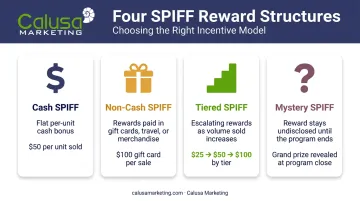
Cash SPIFFs pay a flat dollar bonus per unit sold or goal hit. For example, a distributor might offer an extra $50 for every unit of a slow-moving product sold during a two-week promotional window. Simple, transparent, and easy to calculate.
Non-cash SPIFFs include gift cards, merchandise, event tickets, and travel experiences. Non-cash rewards often carry a higher perceived value than an equivalent cash amount, and reps tend to remember them longer. A $500 trip sticks in someone's memory far past a $500 direct deposit that quietly disappears into a checking account.
This is where a platform like Calusa Marketing's ANY-Card comes in handy. It offers 100+ digital gift card options across categories like retail, dining, gas, and entertainment, from Amazon and Walmart to Chipotle, Uber, and Dunkin'. A VISA option adds full flexibility, functioning as a true cash-equivalent reward without limiting recipients to a single retailer.
Tiered SPIFFs escalate the reward based on performance level, motivating both your top closers and your mid-tier reps to push a little further:
- Sell 5 units: $100
- Sell 10 units: $250
- Sell 20+ units: $600 plus a bonus entry into a travel drawing
Mystery SPIFFs keep the reward undisclosed until the program wraps up, which builds anticipation and keeps engagement high throughout the campaign. A tool distributor might tell reps a top-seller prize is coming without revealing whether it's a $300 gift card or a weekend trip, pushing everyone to fight for the top spot just to find out.
Here's what a full SPIFF might look like in practice: a distributor launching a new product line offers a travel voucher to whichever rep sells the most units within 30 days. Calusa Marketing has fulfilled travel rewards ranging from Napa Valley vineyard tours to Masters golf tournament packages and Alaskan cruises through Glacier Bay, all fully transferable and fully managed from booking to guest coordination.
That's the kind of reward that turns a routine 30-day push into something reps actually talk about afterward.
Benefits of a Well-Designed SPIFF Program
A good SPIFF delivers a jolt of morale that a quarterly bonus simply can't. Quarterly bonuses feel distant. A SPIFF pays off in weeks, which matters most during slow selling periods when reps need something to chase right now.
Beyond morale, a well-designed SPIFF offers advantages a broader comp plan can't easily deliver:
- Targeted focus: Redirects attention to a single product launch or lead-gen push without touching the entire commission structure
- Healthy competition: Builds urgency around one specific goal instead of disrupting everything else reps are already working toward
- Coverage for hidden work: Rewards behaviors like demo bookings or customer service excellence that don't show up in revenue numbers but still matter to the business
The results show up in real programs. Calusa Marketing built a custom incentive program for Hajoca, one of the largest plumbing and HVAC distributors in the country, aligning rewards to specific KPIs across 800+ locations.
Johnstone Supply and Baker Distributing run similar points-based programs designed to drive online orders, giving reps and customers real-time visibility into their progress. According to IRF research on incentives and workplace performance, well-structured incentive programs boost performance by roughly 22%, a figure that tracks with what these distributor programs are built to achieve.
How to Design and Launch a Successful SPIFF Program
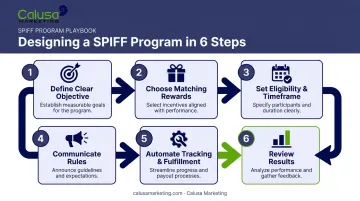
A SPIFF that isn't planned carefully tends to fizzle fast or, worse, backfire. Here's a framework that avoids both outcomes.
- Define a single, clear objective. Tie it to an actual business priority, like clearing aged inventory or launching a new SKU. A program trying to do three things at once dilutes focus and confuses reps.
- Choose rewards that match team preferences and budget. Survey reps or pull feedback from past programs. A "bargain benefit" reward that nobody wants won't move anyone to work harder.
- Set eligibility criteria and a short timeframe. Two to eight weeks is typical, tied to a key event like quarter-end or a product launch date.
- Communicate the rules clearly. Run a kickoff meeting, spell out milestones and payout details, and check in regularly so nobody's guessing where they stand.
- Automate tracking and fulfillment. A CRM or incentive tracking platform removes the manual guesswork. Partnering with a full-service incentive marketing firm like Calusa Marketing moves reward sourcing, delivery, and support entirely off your sales ops team's plate.
- Review results once the program ends. Compare outcomes against the original objective, gather rep feedback, and document what worked before you plan the next cycle.
Common SPIFF Pitfalls to Avoid
Even well-intentioned programs run into trouble. Watch for these three:
- Favoritism or unfair odds. If only your top three reps have any realistic shot at the reward, the rest of the team checks out. Set attainable, transparent metrics tracked in a shared system everyone can see.
- Sandbagging. Reps sometimes delay closing deals in anticipation of an upcoming SPIFF announcement. Vary the timing of announcements and watch for unusual spikes or dips in sales patterns.
- Overcomplication. Too many rules kill participation fast. As Harvard Business Review's research on gaming sales incentives notes, simple, well-documented terms make incentive plans far harder to game. Keep the objective, metric, and payout simple.
Frequently Asked Questions
Is a SPIFF a commission?
No. A SPIFF is a one-time bonus tied to a specific short-term goal, not a recurring percentage-based commission. The two typically work together, with commission driving sustained performance and the SPIFF creating short bursts of urgency.
What is an example of a SPIFF?
A rep earns a flat $50 bonus or gift card for every unit sold during a two-week promotional window. Calusa Marketing builds similar flat-rate programs for distributor clients, tying rewards directly to short-term sales targets.
What does SPIFF mean on a paycheck?
A SPIFF line item represents a supplemental short-term incentive payout, separate from base pay and regular commission. It's typically reported as taxable income alongside your other earnings.
Are SPIFF payments taxable?
Yes. Whether paid in cash or as a non-cash reward like a gift card or trip, SPIFFs are generally treated as taxable compensation. Consult a tax professional for guidance specific to your situation.
How long should a SPIFF program run?
A few weeks to a couple of months, at most. Longer than that, and the sense of urgency that makes a SPIFF effective starts to fade.
How much should a SPIFF payout be?
Payout size should reflect the value of the action you're rewarding and your available budget. Most teams benchmark against historical sales data and weigh that against how much effort the goal actually requires.