94% of top-performing companies now include gift cards in their rewards mix, according to the Incentive Research Foundation's 2025 Top Performer study. That's not a fluke. It reflects a shift toward rewards that people actually want.
Gift cards drive sales performance, boost customer loyalty, and improve employee engagement, all without the shipping delays, warehousing costs, or inventory headaches that come with physical merchandise.
This guide breaks down the best gift cards for incentive programs, how to choose the right ones for your audience, and the best practices that separate high-performing programs from forgettable ones.
Key Takeaways
- Gift cards are the most popular non-cash incentive, prized for flexibility and value
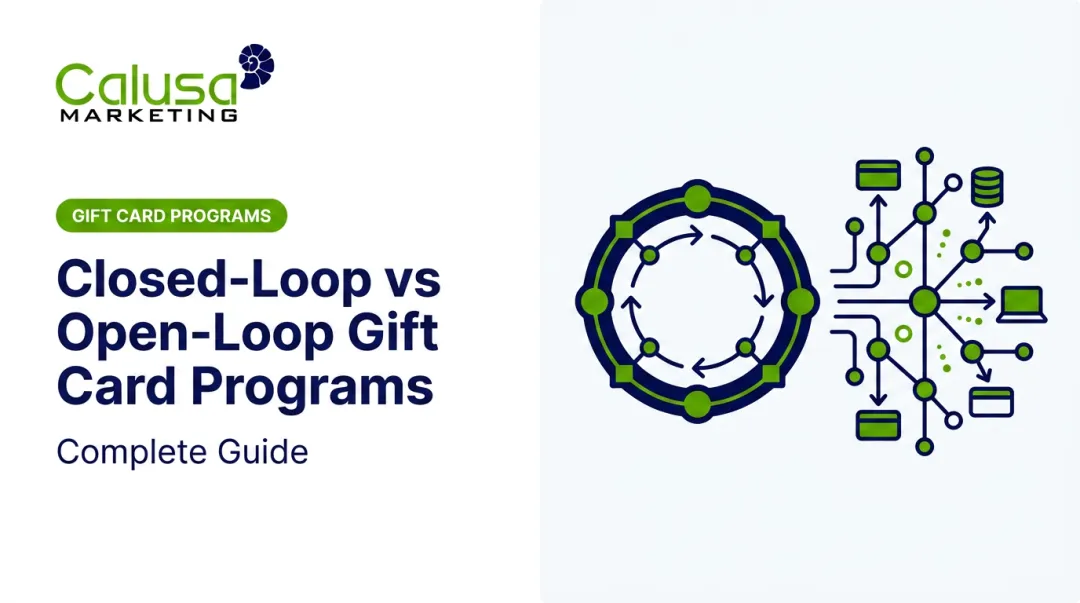
- Open-loop cards (Visa/Mastercard) offer universal acceptance; closed-loop cards feel more like a treat
- Multi-brand choice platforms eliminate guesswork by letting recipients pick their own reward
- Denomination, delivery method, and tax treatment should all shape your card selection
- A managed incentive platform removes the sourcing, tracking, and fulfillment burden
Overview of Gift Cards in Incentive Programs
A gift card incentive is any non-cash reward, delivered as a prepaid or stored-value card, used to motivate a specific behavior. Common triggers include:
- Sales targets and quota achievements
- Safety milestones and compliance records
- Customer referrals and positive reviews
- Employee recognition moments
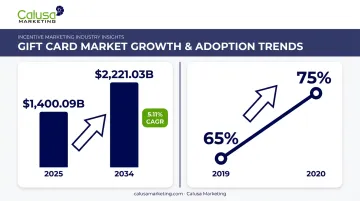
The category has grown into a serious market. Fortune Business Insights valued the global gift card market at $1,400.09 billion in 2025, with growth projected to reach $2,221.03 billion by 2034 at a 5.11% compound annual growth rate.
That growth tracks with what incentive professionals have known for years: gift cards work because recipients get to decide what "reward" means to them.
That preference holds true across industries. Among technology companies specifically, gift card use by top performers climbed from 65% in 2019 to 75% in 2020, consistently outpacing lower-performing peers. So which gift cards actually deliver results? Below is a breakdown of the options businesses rely on most.
Top Gift Cards for Incentive Programs
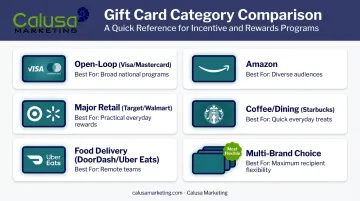
The best gift card choices balance four factors: redemption flexibility, recipient appeal across demographics, ease of bulk distribution, and digital deliverability. Here's how the top options stack up.
Visa/Mastercard Prepaid Gift Cards (Open-Loop)
Open-loop cards function like cash. They're accepted anywhere the card network is honored, both online and in-store. That universal acceptance makes them a safe bet for large or geographically scattered audiences.
Visa notes its gift cards work anywhere Visa Debit is accepted, and Mastercard says the same for its US-issued cards. There's no guessing whether a recipient's local options match the brand on the card.
| Attribute | Details |
|---|---|
| Best For | Broad or mixed employee/customer groups, national programs |
| Redemption Flexibility | Any merchant accepting the card network, online or in-store |
| Considerations | Can feel impersonal; funds may go toward necessities instead of a treat |
Amazon Gift Cards
Amazon's sheer scale makes it a default choice for many programs. Forbes Advisor reports Amazon holds 37.6% of US e-commerce sales, the largest share of any single retailer, which translates into near-unlimited product selection for recipients.
The appeal spans generations. Redemption is instant through the app or website, and there's rarely a "what do I even buy" moment.
| Attribute | Details |
|---|---|
| Best For | Remote or distributed teams, all-age audiences |
| Redemption Flexibility | Millions of products online; app-based redemption |
| Considerations | Some recipients still prefer in-store shopping experiences |
Major Retail Gift Cards (Target, Walmart)
Target and Walmart cards work well for audiences that value practicality over novelty. Target operates roughly 2,000+ US stores, while Walmart reports over 5,200 combined Walmart and Sam's Club locations nationwide.
Recipients can stretch these cards across groceries, electronics, and household goods, often spending more than the card's face value in the process. Industry data shows gift card recipients can spend up to 73% more than the card's original balance, particularly with smaller denominations.
| Attribute | Details |
|---|---|
| Best For | In-office employees, budget-conscious or geographically concentrated audiences |
| Redemption Flexibility | Thousands of US locations plus online ordering |
| Considerations | Less relevant for fully remote or international recipients |
Starbucks / Coffee & Dining Gift Cards
Coffee cards hit differently than most rewards. They're small, immediate, and tied to a daily habit rather than a big-ticket purchase. Starbucks alone operates nearly 41,000 stores globally, giving these cards broad geographic reach.
Dining cards in general perform well too. A National Restaurant Association survey found 77% of respondents wanted a gift card to a restaurant they already knew, and 76% valued cards usable for delivery or takeout, a figure that climbs to 82% among Millennials.
| Attribute | Details |
|---|---|
| Best For | Office-based or urban employees, quick "thank you" rewards |
| Redemption Flexibility | Thousands of global locations plus mobile app ordering |
| Considerations | Limited appeal for recipients without nearby locations |
Food Delivery Gift Cards (DoorDash, Uber Eats)
Food delivery has become a daily convenience, not an occasional splurge. YouGov data shows 28.2% of Americans use delivery apps weekly, with another 44% using them less frequently but regularly.
These cards land well because they feel immediately usable. There's no "saving it for later" mentality. A recipient can order dinner the same night they receive the reward.
| Attribute | Details |
|---|---|
| Best For | Remote teams, quick recognition moments |
| Redemption Flexibility | App-based redemption tied to local restaurant availability |
| Considerations | Redemption quality depends on local restaurant density |
Multi-Brand "Choice" / Any-Card Gift Cards
Instead of committing to one brand, choice cards let recipients pick from a curated catalog. This removes the guesswork of matching a single retailer to hundreds or thousands of different preferences.
Platforms like Calusa Marketing's ANY-Card solution offer this flexibility without requiring recipients to download an app or businesses to juggle multiple vendor relationships.
Recipients receive an emailed voucher with a redemption code, select from 100+ gift card options spanning retailers, restaurants, grocery stores, gas stations, and entertainment, and receive their chosen e-gift card within 3-5 business days. No portal login or app download required.
| Attribute | Details |
|---|---|
| Best For | Large or highly diverse employee/customer bases |
| Redemption Flexibility | Recipient selects from multiple brands within one platform |
| Considerations | Requires a reward platform or partner to manage the catalog |
How to Choose the Right Gift Cards for Your Incentive Program
Picking a gift card isn't just about brand recognition. A few practical factors determine whether your program actually delivers ROI.
Recipient demographics and preferences
- Younger, urban audiences often respond well to dining or delivery cards
- Distributed or remote teams need broad-acceptance options like Amazon or open-loop cards
- Local, in-office teams may prefer retail or coffee cards tied to nearby locations
Denomination and budget
- Corporate gift card incentives and recognition average $152 per recipient across North America
- Benchmark against your program's frequency: smaller, frequent rewards versus fewer, larger ones
- Match denomination to the effort required, not just a round number that feels convenient
Open-loop vs. closed-loop trade-offs
- Open-loop wins when audience diversity or geography makes single-brand cards risky
- Closed-loop wins when you want a specific "treat" feel tied to a beloved brand
- Hybrid programs often pair open-loop cards for broad-based rewards with closed-loop cards reserved for milestone recognition
Digital vs. physical delivery
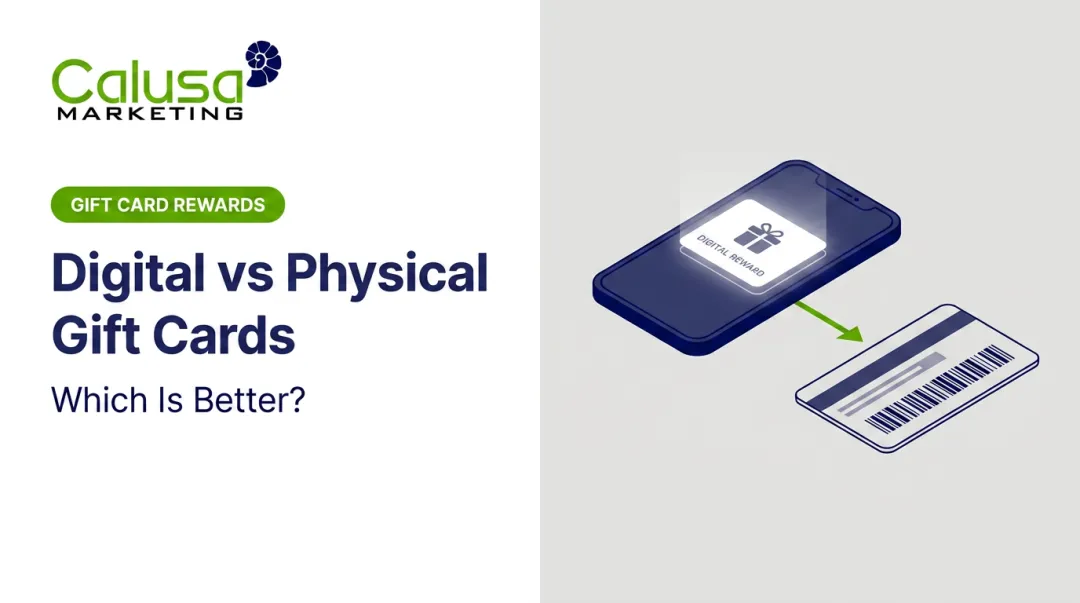
- Digital cards eliminate shipping delays, printing costs, and inventory management
- Physical cards still matter for recipients without reliable email or internet access
- Most modern platforms support both, with digital as the default and physical as a fallback
Tax implications
- Gift cards given to employees are generally taxable as wages, with no de minimis exclusion, according to IRS Publication 15-B
- Nonemployee incentives (referrals, research participation) may fall under separate reporting thresholds
- Always consult a tax advisor before finalizing your program structure. Tax rules shift, and the details matter
Program management complexity
- Manually sourcing, tracking, and fulfilling multiple card types across vendors is one of the most common mistakes companies make
- A managed incentive platform consolidates catalog management, distribution, and reporting into one system, removing the need for spreadsheets and multiple vendor logins
- Platforms like Calusa Marketing's ANY-Card program give you access to 100+ digital gift card brands through a single dashboard, cutting fulfillment work for your team
Best Practices to Maximize Gift Card Incentive ROI
Choosing the right card is only half the equation. How you deploy it matters just as much.
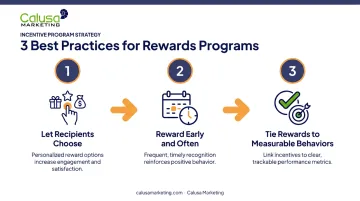
Let recipients choose whenever possible
Research from a 2023 IESP/IMA (Incentive Marketing Association) survey of incentive professionals rated the statement "high-perceived-value rewards produce more incremental effort" at 4.39 out of 5. Recipients who choose their own reward tend to value it more than one assigned to them.
Reward early and often
Frequent, smaller rewards can outperform accumulated milestone payouts in driving effort, based on research summarized by the Incentive Research Foundation (IRF). Rather than saving every reward for a big year-end milestone, build momentum with smaller "fast-start" incentives early in a program cycle.
Tie rewards to specific, measurable behaviors
Vague participation goals produce vague results. Calusa Marketing's work with Memorial Blood Centers illustrates this well: donors receive gift card rewards tied directly to a single, verifiable action: completing a donation. There's no ambiguity about whether the behavior happened, which makes the program simple to administer and easy for participants to understand.
Other clients apply the same principle differently. Baker Distributing built a points program around online order placement, while Johnstone Supply layered in product education completion alongside online orders. In both cases, the reward is anchored to a specific, trackable action rather than general engagement.
Conclusion
The best gift card incentive strategy aligns with both your recipients' preferences and your business goals, not just popularity rankings.
Before committing to a single card type or vendor, weigh scalability, redemption ease, and total program cost. A card that looks great on paper won't help much if half your audience can't redeem it conveniently.
If managing multiple gift card types across vendors feels like more work than it should be, that's a sign it's time for a different approach. Calusa Marketing's cloud-based incentive platform, paired with white-glove fulfillment support, handles the catalog management and distribution so your team doesn't have to. It's one less operational burden standing between your program and its results.
Frequently Asked Questions
What is a gift card incentive program?
A gift card incentive program is a structured reward system where gift cards are given in exchange for actions that benefit a business. Common triggers include hitting sales goals, referring customers, or completing safety training.
How can I get free gift cards through gift card incentive programs?
Individuals typically earn gift cards by participating in employer, brand, or survey incentive programs, not by receiving them with no action required. Completing a qualifying behavior, like a purchase, referral, or survey, is usually the trigger.
What is an appropriate gift card amount for an incentive program?
Employee incentives typically range from $25 to $100, scaled to the difficulty of the goal being rewarded. Customer or research incentives run smaller, often $5 to $25, so benchmark your amount against similar programs in your industry.
Are gift cards given as incentives taxable?
Gift cards given to employees are generally taxable as wages with no de minimis exclusion. Non-employee incentives may have different reporting thresholds, so consult a tax professional for your specific situation.
Should I offer one gift card brand or multiple options?
A single brand works well for targeted, homogenous audiences with clear preferences. Multi-brand choice cards perform better for large or diverse groups where individual preferences vary widely.
What's the difference between open-loop and closed-loop gift cards?
Open-loop cards, like Visa or Mastercard prepaid cards, work anywhere the network is accepted. Closed-loop cards are redeemable only at a specific retailer or group of retailers.