Six months later, her team's numbers were sliding, two reps had quit, and Sarah was working 70-hour weeks trying to fix problems she didn't know existed. Sound familiar?
This happens because closing skills and leadership skills are completely different muscles. Most sales managers get promoted for hitting quota, not for their ability to coach, motivate, or build culture. Nobody hands them a manual.
This guide is that manual. We'll cover hiring the right people, coaching them well, keeping them motivated, streamlining your process, and the culture habits that separate high-performing teams from teams that just show up.
Key Takeaways
- High-performing teams come from deliberate hiring and coaching systems, not quota pressure alone
- Coaching frequency should match rep tier: weekly for new hires, monthly for veterans
- Recognition programs directly affect retention: employees who feel unrecognized are twice as likely to quit
- Technology should support your leadership decisions, not replace the human coaching relationship
Build the Right Sales Team Foundation: Hiring, Assessing, and Onboarding
Great sales teams start before a single call gets made. They start with who you let in the door.
Hire for mindset first, skill second. Talent can be trained, but resilience, curiosity, and internal drive are harder to teach. During interviews, listen for:
- How candidates talk about past losses or rejections (do they own it or blame the market?)
- Whether they ask thoughtful questions about your product, customers, or process
- Signs of self-motivation, such as side projects or unprompted skill-building
- Their reaction when you push back on an answer mid-interview
Run a Team Performance Audit First
Hiring the right person solves only half the problem. Before changing anything, audit what's already happening. Pull CRM data on activity and conversion by rep, then shadow a few calls. Talk to reps one-on-one about where they feel stuck. This tells you whether your real problem is skill, process, or motivation, and each requires a different fix.
Once you know the gaps, define roles clearly. Ambiguity kills ownership. Every rep should know exactly what's expected of them: quota, territory, activity minimums, and how they're evaluated.
Structured Onboarding Pays for Itself
New hires need more than a laptop and a CRM login. Build a structured program covering product knowledge, your sales process, and objection-handling playbooks specific to your company.
The financial case is hard to ignore. According to a national survey highlighted by SalesFuel, replacing a salesperson costs an average of $97,690 once you factor in lost productivity and hiring time.
Structured onboarding shrinks that cost fast. Companies with consistently applied programs cut ramp time to 5.7 months, compared to 9.1 months for reps without structured onboarding — a difference that adds up quickly across a growing team.
Finally, don't wait until you have an open seat to start recruiting. Keep a pipeline of promising candidates warm even when your roster is full, because reactive hiring almost always leads to settling.
Coach and Develop Your Team for Sustained Performance
Managing, training, and coaching are not the same thing, though leaders often use the words interchangeably.
- Managing covers operational goals: quotas, pipeline reviews, forecasting
- Training builds skills through structured lessons, usually in a classroom or onboarding setting
- Coaching is one-on-one development tied to a specific rep's real deals and behaviors
Coaching is the piece most managers neglect, usually because it's the hardest to schedule and the easiest to skip when things get busy. Skipping it slows rep development and shows up later as missed quota.
Build a Cadence That Fits Rep Tier
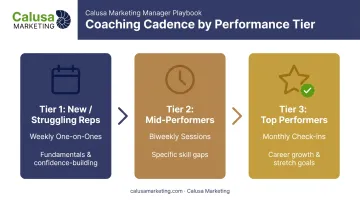
Not every rep needs the same attention. A tiered cadence works better than a blanket policy:
- New or struggling reps: Weekly one-on-ones focused on fundamentals and confidence-building
- Mid-performers: Biweekly sessions targeting specific skill gaps
- Top performers: Monthly check-ins focused on career growth and stretch goals
Research from CSO Insights found that a formal, dynamic coaching process tied to a defined sales methodology correlated with meaningful gains. Teams with structured coaching saw a 27.9% improvement in win rate and a 10.2% improvement in quota attainment compared to teams without it. The pattern is a correlation, not a guarantee, but it's a strong signal that coaching consistency matters more than coaching intensity.
The Coaching Conversation Itself
A good one-on-one follows a simple template:
- Start with CRM data — pipeline health, activity numbers, recent call outcomes
- Ask the rep to self-evaluate before you offer your take
- Agree together on one or two development priorities
- Set a clear next step and revisit it at the next session
Field coaching matters too. Shadow reps on live calls when you can, and give feedback while the moment is still fresh. Encourage reps to regularly ask each other, 'What am I missing right now?' This keeps a growth mindset alive, especially in choppy markets where old playbooks stop working.
Motivate and Retain Top Performers Through Recognition and Incentive Programs
Commission gets people to show up. It doesn't necessarily make them stay, and it rarely makes them feel valued.
Gallup research found that employees who don't feel adequately recognized are twice as likely to say they'll quit within the next year. That's a retention risk hiding in plain sight for a lot of sales organizations.
Recognition doesn't need a big budget. Some low-cost habits that work:
- Spend the first five minutes of every team meeting celebrating a recent win, big or small
- Call out both individual performance and team assists publicly
- Tie incentives directly to SMART goals so rewards reinforce specific behaviors, not just end-of-quarter totals
Building a Structured Incentive Program (Beyond Ad-Hoc Recognition)
Shoutouts in meetings only go so far. At some point, teams need a real incentive structure with gift cards, merchandise, or travel rewards attached to specific KPIs. The problem is most sales leaders don't have the time, budget, or vendor relationships to build that in-house.
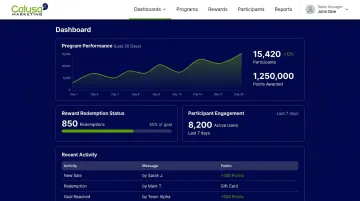
This is where a specialist partner can take the weight off. Calusa Marketing, an incentive marketing firm based in St. Petersburg, Florida, manages more than 1,000 loyalty and incentive programs through a cloud-based platform that requires no app download and no CRM integration to launch.
One example: APG Media of Chesapeake & Florida needed a way to motivate its internal sales team while also encouraging clients to grow ad spend. Working with Calusa's Alex Brown, the company built a layered incentive program tied to measurable revenue goals.
Regional President Jim Normandin later credited the partnership with generating millions of dollars in incremental revenue — calling it "a win for us, a win for our clients, and a win for Calusa."
Calusa's team, including a dedicated Director of Fulfillment and in-house customer service, handles reward selection, delivery, and redemption support directly. That hands-on approach is a big part of why the company maintains a 99% client retention rate across its programs.
Beyond formal programs, don't underestimate peer-to-peer recognition. Ask reps "who helped you land that deal" during team meetings. It reinforces collaboration over lone-wolf competition, and it usually surfaces contributions that would otherwise go unnoticed.
Set Clear Goals, Streamline the Sales Process, and Equip Your Team with Technology
Set Clear Goals, Structure the Sales Process, and Equip Your Team with Technology
Talented, motivated reps still need clear direction and the right tools. This is where structure turns individual effort into predictable team output.
Define SMART, Realistic Sales Goals
SMART goals should be Specific, Measurable, Achievable, Relevant, and Time-bound. The framework only works if the goals actually stretch the team without breaking morale. A quota that's 40% higher than last quarter with no added support crosses the line from ambitious to demoralizing.
Standardize a Winning Sales Process
Your best reps have habits that work, whether or not they can articulate them. Capture those tactics through shadowing and interviews, then build them into a shared playbook:
- Discovery call scripts and qualifying questions
- Common objections and proven responses
- Deal-stage criteria so everyone defines "qualified" the same way
A standardized process doesn't stifle creativity. It gives newer reps a floor to build from instead of reinventing the wheel alone.
Equip Reps with CRM and Sales Technology
CRM tools and AI features like lead scoring and activity automation help reps spend more time selling and less time on data entry. Nucleus Research found CRM implementations returned an average of $3.10 for every dollar spent, with productivity gains accounting for over half of that return. Give reps access to the same dashboards you use as a manager. Shared visibility builds accountability without you having to chase updates manually.
Foster a Transparent, Trust-Based Culture (and Avoid Common Leadership Pitfalls)
Culture is what happens when you're not in the room. It's built through consistent small actions, not a single kickoff speech.
Model radical candor. Ask for feedback often, and never punish someone for giving it honestly, even when it stings. Two-way communication only works if reps trust that speaking up won't backfire on them.
Leading from the front matters too, so set the tempo yourself. If you expect reps in early and prepared, show up early and prepared: standards travel downward from the top, not upward.
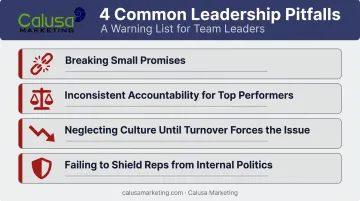
Even consistent leaders can undo this trust with small missteps. Watch for these common pitfalls:
- Breaking small promises (a promised deal desk review, a delayed commission fix)
- Letting accountability slide for top performers while enforcing it for everyone else
- Neglecting culture until turnover forces the issue
- Failing to shield reps from internal politics that have nothing to do with selling
These pitfalls often show up in the numbers before anyone says them out loud, so track performance through leading indicators like pipeline activity and call volume, not by hovering over every rep's calendar. Data should guide your coaching conversations, not replace them with a scoreboard.
Frequently Asked Questions
What is the 70/30 rule in sales?
It's a rule of thumb: reps should listen about 70% of the time and talk only 30% during sales conversations. In practice, large-scale conversation analysis shows the ratio is closer to 55-60% seller talk, but the underlying principle, listen more than you pitch, still holds.
What does it mean to lead a high-performing sales team?
It means consistently hitting revenue targets while keeping morale strong and turnover low. High-performing teams also share a repeatable, coachable sales process rather than relying on a few standout individuals.
How often should a sales manager do one-on-one coaching sessions?
A tiered approach works best: weekly for new or struggling reps, biweekly for mid-performers, and monthly for top performers. Adjust based on individual need rather than a rigid company-wide rule.
What is the difference between managing and coaching a sales team?
Management covers broader operational goals like forecasting, quotas, and process compliance. Coaching zeroes in on an individual rep's specific skills, deals, and development plan.
How can a sales manager motivate a team without relying only on commission?
Build recognition rituals into regular meetings, tie non-cash incentives to specific KPIs, and offer clear paths for career growth. Structured incentive programs, including travel and merchandise rewards, often outperform cash alone for retention.
What KPIs should sales managers track to measure team performance?
Track leading indicators like pipeline coverage and activity volume alongside lagging indicators like win rate and quota attainment. Balancing both gives you early warning signs instead of just after-the-fact results.