Introduction
Picture this: a business owner pulls up the quarterly dashboard and sees repeat purchase rates climbing. The team celebrates, assuming they've built a loyal customer base. Three weeks later, a competitor runs a 20% off promotion, and half those "loyal" customers disappear without a second thought.
This happens constantly. Many businesses struggle to tell the difference between customers who keep buying and customers who actually care about the brand.
That confusion leads to overspending on discounts while underinvesting in the incentive and engagement strategies that build relationships strong enough to survive a competitor's better deal.
This article breaks down what separates repeat purchasing from genuine brand loyalty, plus the metrics that actually reveal the difference. It also covers how businesses can turn transactional buyers into customers who stick around even when the discount disappears.
Key Takeaways
- Repeat purchasing is a behavior; brand loyalty is a mindset that outlasts better offers
- Price, convenience, and habit drive repeat buying—none guarantee retention
- True loyalty means advocacy, lower price sensitivity, and resistance to competitors
- Share of wallet, purchase intervals, and CLV reveal which one you're building
- Structured incentive programs convert repeat buyers into loyal ones better than discounts
Brand Loyalty vs. Repeat Purchasing: Quick Comparison
The two concepts look similar on a spreadsheet but behave very differently once a competitor gets aggressive.
| Factor | Repeat Purchasing | Brand Loyalty |
|---|---|---|
| Motivation | Price, convenience, or habit | Trust, values, emotional connection |
| Reaction to competitor offers | Likely to switch for a better deal | Resistant to price comparisons |
| Advocacy behavior | Rarely recommends unprompted | Actively recommends and defends |
| Long-term value | Moderate, often inflated by brand size | High, sustained through price hikes |
| Dependence on incentives | Needs ongoing discounts to continue | Persists with minimal incentive |
That "long-term value" row deserves a closer look. Larger brands naturally rack up more repeat transactions simply because more people can buy from them—a pattern researchers call the Double Jeopardy Law.
Bigger brands get more "repeat" activity by default, not because their customers are more devoted. Raw repeat-purchase counts, in other words, can flatter a brand's size rather than its emotional pull.
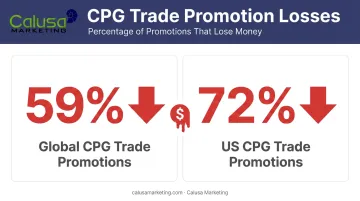
The incentive dependence gap is where budgets get wasted. Trade promotions are one of the most common tools businesses lean on to keep repeat purchases flowing, but they rarely pay for themselves.
Globally, 59% of CPG trade promotions lose money, and in the US that figure jumps to 72%, according to McKinsey's analysis of Nielsen promotion data. Businesses pouring money into discounts to sustain repeat buying are often funding transactions that were happening anyway.
Understanding the Two Concepts
Before you can measure the gap between these two ideas, you need clear definitions of what each one actually is.
What Is Repeat Purchasing Behavior?
Repeat purchasing simply means a customer has bought from you more than once. It says nothing about why. Four drivers typically explain it:
- Convenience: your store, app, or location is the easiest option available
- Competitive pricing: you happen to be the cheapest right now
- Habit: the customer has bought from you before and hasn't thought to change
- Lack of awareness: they simply don't know a viable alternative exists
None of these require an emotional bond, which makes repeat purchasing fragile. Customers who "loved" a brand will still leave fast when something goes wrong.
Nearly 1,000 surveyed US consumers reported that 24% would stop buying from a brand after just one bad experience, and 70% would leave after two, according to Emplifi's 2025 consumer research. Repeat behavior alone isn't a safety net.
What Is Brand Loyalty?
Brand loyalty is a conscious, emotional commitment that persists even when a competitor is cheaper or more convenient.
Researchers Dick and Basu drew a useful distinction back in 1994 that still holds up. Attitudinal loyalty is what a customer says and feels about a brand, while behavioral loyalty is what they consistently do without being incentivized. True loyalty requires both.
Loyal customers typically show three traits:
- Lower sensitivity to price differences or competitor promotions
- Willingness to try new products from the same brand without hesitation
- Spontaneous advocacy: recommending the brand without being asked or paid to
How to Tell Them Apart: The Metrics That Matter
Repeat purchase rate feels like a good metric. It isn't, at least not on its own. Neither is a high review score or Net Promoter Score. Both can mask a fragile relationship built entirely on price or convenience.
Three metrics tell a more honest story:
- Share of wallet — the percentage of a customer's total category spending that comes to you versus competitors. Mastercard's guidance notes there's no universal benchmark, so compare it within your own category and customer segment.
- Inter-purchase interval without discounts — track whether customers return at full price during non-promotional periods, not just when a deal is running.
- Customer Lifetime Value paired with brand-switching rate — CLV tells you how much a customer is worth, but only alongside switching data can you see whether they'd actually leave for a competitor.
Here's a simple litmus test: temporarily pull the discount or incentive and watch what happens. If the customer keeps coming back at full price, that's loyalty. If they vanish, you were never building the relationship you thought you were.
Turning Repeat Buyers into Loyal Customers
Repeat customers are your best conversion candidates. Trust and familiarity already exist; the job now is deepening the relationship without leaning on price cuts.
Personalize Beyond the Transaction
Purchase history and behavioral data let you tailor offers, communications, and recognition at every touchpoint. A customer who buys the same product category every quarter should get different messaging than one who buys once and disappears. Generic blasts train customers to wait for the next coupon, not to feel recognized.
Build Emotional Equity With Structured Rewards
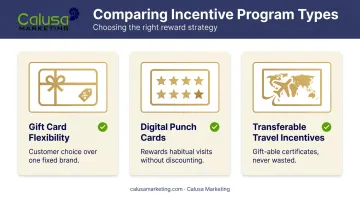
Recurring discounts train customers to shop around. A well-structured incentive or rewards program does the opposite. This is where flexible, meaningful rewards outperform another 10% off:
- Gift card flexibility: programs like Calusa Marketing's ANY-Card give customers a choice of options rather than forcing one brand, so the reward feels personal rather than generic
- Digital punch cards: a modern version of the classic "buy 10, get 1 free" that rewards habitual visits without discounting every transaction
- Transferable travel incentives: certificates that let a recipient gift a trip to a family member instead of losing the reward if they can't personally use it
Two of Calusa Marketing's own client programs illustrate the shift. Johnstone Supply and Baker Distributing (Watsco) both run points-based rewards programs aimed at their own customers rather than employees, structured to encourage online ordering and reward buying behavior with redeemable merchandise instead of markdowns.
One client summed up the impact in a testimonial: their account team is "always looking for ways to increase my customer loyalty and average spending." That's the exact outcome a discount-only strategy struggles to deliver.
The broader data backs this approach. Pilot programs integrating loyalty with pricing produced a 2 to 4 percentage-point improvement in gross-margin dollars compared to standard mass discounts, according to McKinsey's research on loyalty and pricing. Targeted, member-specific value outperforms broad price cuts because it rewards engagement instead of subsidizing purchases that would have happened anyway.
If your repeat purchases still depend on constant promotions, consider whether an incentive program partner can help build the kind of loyalty that survives once the deal ends.
Conclusion
Repeat purchasing and brand loyalty aren't interchangeable. One is a transaction pattern; the other is a durable relationship. Businesses that confuse the two end up celebrating metrics that don't actually predict long-term growth.
The distinction has real consequences. Companies that measure and build for true loyalty, through share of wallet, full-price retention, and structured incentive programs, protect themselves from competitor poaching and rising acquisition costs. Companies chasing repeat purchase numbers alone risk building a customer base that leaves the moment the deal disappears. Calusa Marketing's structured incentive programs are built to create that lasting loyalty instead.
Frequently Asked Questions
Can repeat purchases indicate brand loyalty?
They can be a positive sign, but they're not proof on their own since price or convenience can drive them too. Pair repeat purchase data with share-of-wallet and full-price purchase tracking for a clearer picture.
What metrics are more reliable for measuring brand loyalty than repeat purchase rate?
Customer Lifetime Value, share of wallet, brand-switching rate, and combined behavioral-plus-attitudinal loyalty tracking all give a fuller view than transaction counts alone.
How can customer feedback help reduce churn and build loyalty?
Feedback surfaces friction points before they cause customers to leave, letting brands fix issues proactively and reinforce trust before it erodes.
Why is emotional connection important for true brand loyalty?
Emotional connection is what keeps customers choosing a brand even when it isn't the cheapest or easiest option, making it the foundation of resistance to competitor offers.
What's the difference between a loyalty program and a discount program?
Discount programs reward price sensitivity and can train customers to wait for deals. Well-designed incentive programs build ongoing engagement and emotional equity beyond the transaction itself.
How can a business start converting repeat customers into loyal ones?
Start by unifying purchase-history data into a full customer view. From there, personalize communications and add a structured incentive program that rewards engagement rather than just one-time discounts.