Confusing the two costs companies real money. Leaders pour budget into perks and raises expecting loyalty and performance, then wonder why turnover stays high or customer scores stall.
The gap between the two isn't just semantic. Engaged teams consistently outperform satisfied-but-detached teams on profitability, sales, and customer loyalty, according to Gallup's long-running workplace research. Satisfaction surveys alone rarely predict those outcomes.
This article breaks down what separates the two concepts, where each one matters most, and how structured recognition and incentive programs move employees from simply content to genuinely invested.
Key Takeaways
- Satisfaction reflects contentment with pay and conditions; engagement reflects effort and emotional investment.
- Satisfied employees meet expectations, but engaged employees exceed them and elevate customer experience.
- Engagement predicts retention, performance, and growth more reliably than satisfaction alone
- Recognition and incentive programs turn passive satisfaction into lasting engagement over time.
Employee Engagement vs. Employee Satisfaction: Quick Comparison
Here's how employee satisfaction and employee engagement compare side by side:
| Category | Employee Satisfaction | Employee Engagement |
|---|---|---|
| Definition | Contentment with pay, benefits, and working conditions | Emotional commitment and willingness to invest discretionary effort |
| Focus Area | Job conditions and basic needs | Purpose, growth, and connection to company goals |
| Measurement Method | Satisfaction surveys, exit interviews, benefits utilization | Pulse surveys, eNPS, recognition participation, behavioral indicators |
| Business Impact | Fewer complaints, stable day-to-day operations | Higher productivity, stronger customer loyalty, lower long-term attrition |
Neither metric replaces the other: satisfaction tells you whether people are comfortable enough to stay, while engagement tells you whether they'll actually push your business forward while they're here.
What is Employee Satisfaction?
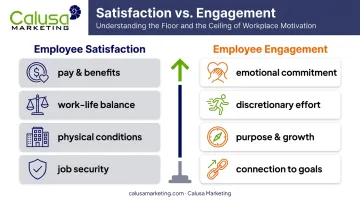
Employee satisfaction is the baseline measure of whether people feel okay about their job. It covers pay, benefits, physical environment, and work-life balance. Think of it as the floor of a healthy workplace, not the ceiling.
When satisfaction is solid, you typically see:
- Fewer formal complaints and grievances
- Reduced short-term turnover among new hires
- Predictable, stable day-to-day operations
- Lower absenteeism tied to basic dissatisfaction
Satisfaction has a real but limited connection to performance. A meta-analysis of 312 samples and more than 54,000 employees found a corrected correlation of just .30 between overall job satisfaction and job performance. That's meaningful, but far from a guarantee. A satisfied employee can still coast.
That's the core limitation: satisfaction tells you people aren't upset. It doesn't tell you whether they'll go out of their way to help a struggling coworker, pitch an idea in a meeting, or advocate for your company outside of work hours.
Indicators & Use Cases of Employee Satisfaction
Satisfaction shows up most clearly in:
- Exit interview themes around pay, hours, and management style
- Annual or biannual satisfaction surveys
- Benefits utilization rates, like health plan and PTO usage
- Turnover during the first 90 days on the job
Satisfaction tends to be the primary HR focus in compliance-heavy, transactional, or high-turnover roles, think warehouse staff, seasonal retail, or entry-level call center positions. Here, the goal is keeping seats filled and avoiding legal exposure.
Here's the catch: satisfaction scores often fail to track with performance or customer outcomes. Research analyzing nearly 8,000 business units found that satisfaction, when measured in isolation from engagement, is a weaker signal for turnover and profit than combined engagement measures. A team can report high satisfaction and still underperform on the numbers that matter to leadership.
What is Employee Engagement?
Employee engagement is the emotional commitment someone feels toward their work and their company's goals. It's the willingness to put in effort nobody's tracking on a timesheet, like staying late to help a customer, mentoring a new hire, or suggesting a process fix during a slow Tuesday.
Where satisfaction asks "are you comfortable?", engagement asks "are you invested?" Researcher William Kahn's original model breaks engagement into three dimensions:
- Physical: the energy someone brings to their role
- Cognitive: the focus and attention they give their work
- Emotional: how connected their feelings and values are to the job
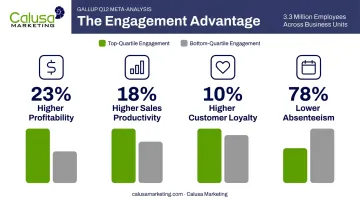
Engagement compounds. Gallup's Q12 meta-analysis covers more than 3.3 million employees across 736 studies.
Top-quartile engagement business units beat bottom-quartile units by 23% in profitability, 18% in sales productivity, and 10% in customer loyalty, plus 78% lower absenteeism. Those are median differences across industries, but the direction holds: engagement moves the numbers that show up on a balance sheet.
Indicators & Use Cases of Employee Engagement
Engagement shows up in different signals than satisfaction:
- Recognition program participation rates
- Career development and training uptake
- Peer-to-peer collaboration and mentorship
- eNPS (employee Net Promoter Score) trends
Engagement becomes a genuine competitive differentiator in customer-facing environments, call centers, distribution sales teams, and retail floors, where Calusa Marketing's clients operate every day.
An engaged call center agent doesn't just close the ticket; they solve the actual problem and leave the customer feeling heard. An engaged distribution sales rep doesn't just process the order; they flag a better product fit before the customer even asks.
Which Matters More for Your Business?
The honest answer: it depends on what problem you're solving.
Weigh these factors first:
- Industry type - compliance-heavy or transactional roles often need satisfaction fixes first; customer-facing or sales-driven roles need engagement
- Workforce structure - high-turnover, entry-level teams benefit from closing satisfaction gaps before layering on engagement work
- Business goal - chasing stability points to satisfaction; chasing growth points to engagement
A simple decision rule:
- If exit interviews cite pay, scheduling, or benefits complaints, fix satisfaction first
- If turnover is manageable but sales, service scores, or innovation have stalled, invest in engagement
A Case Study From Customer Service
T-Mobile's call center operation faced a familiar problem: scripted, handle-time-focused work with little autonomy or recognition. In 2016, the company restructured into "Team of Experts," roughly 40-person teams given ownership of specific customer groups, with incentives shifted from individual speed metrics to team-based outcomes.
The results, reported by a Harvard Business Review case study on T-Mobile's turnaround, included a 60% jump in Net Promoter Score, 39% lower churn, and nearly 50% lower employee attrition since 2014. J.D. Power's independent 2019 customer care study later ranked T-Mobile first among carriers.
The lesson: incentives paired with real ownership and recognition outperform incentives handed out alone.
That pattern holds across the industries Calusa Marketing works with daily. Clients in the call center space, including Alorica and Inktel, run rewards programs built specifically around agent recruitment, retention, and KPI achievement rather than a single flat perk.
Programs like these succeed because engagement isn't a one-time initiative. It's built through consistent recognition, visible incentives, and honest communication delivered on a schedule employees can count on.
That's the gap a done-for-you platform like Calusa Marketing's is built to close:
- Digital punch cards for instant, everyday recognition
- ANY-Card gift card fulfillment
- Merchandise rewards
- Incentive travel
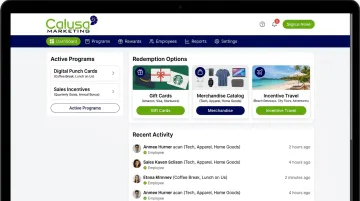
All of it is managed without asking your internal team to build or maintain new software. If your current strategy stops at an annual satisfaction survey, that's a sign it's time for an audit.
Conclusion
Satisfaction is the floor. Engagement is the ceiling. Every organization needs both, but they require different tools, surveys, and investments. Skip satisfaction and you'll bleed talent over pay and conditions. Stop at satisfaction and you'll cap your performance right where it sits today.
The businesses that pull ahead treat engagement as an ongoing practice, not a survey they run once a year. Retention, customer experience, and profitability all trace back to how invested your people feel, not just how comfortable they are.
If it's been a while since you've reviewed your recognition and incentive strategy, that's worth a second look. Calusa Marketing has spent over a decade building programs for distributors, call centers, and retail teams looking to make exactly that shift.
Frequently Asked Questions
What are the C's of employee engagement?
The most cited framework, Seijts and Crim's Ten C's, includes Connect, Career, Clarity, Convey, Congratulate, Contribute, Control, Collaborate, Credibility, and Confidence. Each addresses a piece of what makes someone feel invested at work.
What are the key factors of employee satisfaction?
Employee satisfaction hinges on fair pay, safe working conditions, manageable workload, and job security. These factors create the foundation employees need before genuine engagement can take hold.
Is employee engagement more important than employee satisfaction?
Engagement is the stronger predictor of performance, retention, and customer loyalty. But satisfaction remains the necessary foundation; you can't build engagement on top of a workforce frustrated with pay or basic conditions.
How do you measure employee engagement vs. employee satisfaction?
Satisfaction is typically measured through annual surveys and exit interviews. Engagement requires more frequent tools, including pulse surveys, eNPS scores, recognition participation, and behavioral indicators.
Can an employee be satisfied but not engaged?
Yes. This shows up as "quiet quitting," where employees do the minimum required and stay emotionally checked out, even if they're not actively unhappy with pay or conditions.
What is the most effective way to boost employee engagement?
Recognition, structured incentive programs, career growth opportunities, and transparent communication consistently rank as the top levers. Programs combining all four tend to outperform any single tactic alone.