Introduction
Losing a top performer costs far more than most leaders realize. Gallup estimates that replacing an employee costs half to two times their annual salary, once you factor in lost productivity, hiring costs, and training time.
Retention now ranks among the top priorities for CEOs and HR leaders alike. Yet many organizations describe their strategies as reactive, built on exit interviews and gut instinct rather than data. Few have a repeatable system for improving retention before employees walk out the door.
This article breaks down five real retention case studies from companies that diagnosed a specific problem and fixed it. We'll extract what worked, then show how to translate those lessons into your own strategy.
Key Takeaways
- Culture, career growth, and manager relationships outweigh pay in most retention outcomes
- Frequent employee listening flags turnover risk before resignations happen
- Frontline workers respond to career pathing and recognition, not just wage bumps
- Structured recognition programs turn "soft" retention drivers into daily practice
Why Employee Retention Case Studies Matter
Generic retention advice ("improve culture," "pay competitively") rarely survives contact with a real organization. Case studies matter because they show what specific interventions actually worked, in a specific industry, with a specific workforce.
That specificity matters more once you look at where turnover hurts most. Replacement costs aren't flat across roles. Gallup's role-based breakdown puts it at roughly:
- 40% of salary for frontline employees
- 80% of salary for technical professionals
- 200% of salary for leaders and managers
That's a five-fold difference. A company bleeding managers is losing far more than one bleeding entry-level warehouse staff, dollar for dollar.
This is why case studies function as a benchmarking tool. If you run a logistics operation losing hourly staff, ODW Logistics is a more useful reference point than a tech company's engineering retention story. Match your challenge to the closest case, then borrow the mechanism, not just the headline.
What Are the Key Drivers of Employee Retention?
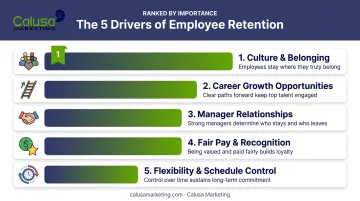
Company survey data consistently points to the same handful of drivers when employees are asked directly why they stay. Here's what shows up again and again.
Culture and Belonging Come First
When companies ask employees "why do you stay," workplace culture and a sense of belonging routinely rank at the top. It's not abstract. Employees who feel their opinions count, who feel connected to teammates, stay longer than those who feel like a number on a roster.
Career Growth Is a Close Second
A visible path forward keeps even well-paid employees from looking elsewhere. Among workers who quit their jobs in 2021, 63% cited a lack of advancement opportunities as a reason. Satisfaction isn't enough if people can't see where they're headed in two years.
Managers Make or Break Retention
Employees leave managers, not companies. Gallup found that 42% of voluntary leavers said their manager or organization could have done something to prevent their departure. Nearly half said no manager had proactively discussed their satisfaction or future in the three months before they quit.
Fair Pay and Recognition Build Trust
Pay level matters less than perceived fairness. Employees who feel adequately recognized are far less likely to leave than those who feel overlooked, and perceived pay fairness correlates with lower turnover intent than the actual number on the paycheck. Unfairness, real or perceived, erodes trust faster than a modest salary ever could.
Flexibility Carries More Weight Than Before
Among 2021 quitters, 45% cited a lack of flexibility in choosing their hours as a reason, especially among younger and hybrid-eligible workers. Schedule control is no longer a nice-to-have.
None of these drivers work in isolation. The case studies below show what happens when companies stack two or three together instead of chasing one fix at a time.
Employee Retention Case Studies: How Top Companies Retain Talent
These five organizations, documented by Quantum Workplace, each diagnosed a specific retention problem and implemented a targeted response. Here's what they did and what happened.
ODW Logistics: Reducing Turnover Through Manager Development
ODW, a supply chain and logistics company, saw voluntary turnover spike to a brutal 51% in Q1 2022. Their response centered on managers, not perks.
They built structured coaching tools, engagement insights, and feedback processes so managers could have real career conversations with their teams.
Leadership development tracks (branded Enlighten, Energize, and Elevate) rolled out alongside a Core Operations Career Ladder and more than $2 million in hourly pay enhancements.
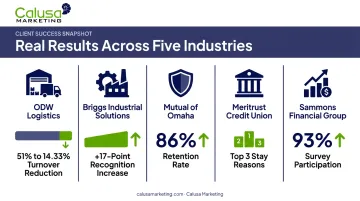
The result: voluntary turnover dropped to 14.33% by Q1 2023, well below the roughly 45% industry benchmark Quantum Workplace cites for warehousing and transportation. That's a swing from crisis-level attrition to a figure beating the sector average in about a year.
Briggs Industrial Solutions: Fixing Pay and Recognition Gaps That Frontline Workers Named Directly
Briggs ran focus groups with technicians after survey data showed intent to stay down 5%, fair-pay perception down 4%, and recognition down 11% year over year.
The fix wasn't a blanket raise. It was targeted:
- Added profit sharing alongside their existing ESOP
- Built a defined technician career path
- Expanded internal classroom training
On their follow-up survey, recognition perception rose 17 points, trust and fairness rose 14 points, and fair-pay perception rose 14 points. Listening directly to the frontline surfaced fixes leadership wouldn't have guessed on their own.
Mutual of Omaha: Using Pulse Surveys to Target the First Two Years
This Fortune 500 insurer noticed elevated attrition specifically among employees in their first two years, particularly in technology roles.
Instead of a single annual survey, they layered in a 30-day onboarding survey plus targeted pulses, including a "War for Talent" check-in during the height of pandemic-era hiring pressure.
The payoff: 94% favorability among 30-day new hires, an 86% overall retention rate, and 93% of associates on track with a learning and growth plan, above their internal 90% benchmark. Catching sentiment early, before the two-year cliff, made the difference.
Meritrust Credit Union: Uncovering the Real Reasons Employees Stay
Meritrust used a branching survey technique to separate genuine loyalty from indifference. Employees who agreed "it would take a lot to get me to leave" got a follow-up question: what makes you stay? Those who didn't agree were asked what would push them out.
The ranked results were clear:
- Workplace culture: 90%
- Career advancement opportunities: 89%
- Relationship with manager: 84%
Notice what's absent from that top three: pay. Culture, growth, and management relationships beat compensation as the stated reason people stayed.
Sammons Financial Group: Increasing Listening Cadence to Drive Faster Action
Sammons used to survey employees every 2-3 years, a cadence too slow to catch problems before they became resignations.
They moved to an 18-month cycle, then to a full annual cadence under a program branded "The Voice of SFG," backed by Culture Councils and supplemental exit and lifecycle surveys.
The shift produced 93%+ survey participation for four consecutive years and 9 in 10 employees recommending SFG as a great place to work. Just as important, annual listening gave leadership a repeatable structure to commit to yearly action items tied directly to what employees said.
Turning Case Study Lessons Into Action: The Role of Recognition and Incentive Programs
A pattern runs through all five cases: culture, recognition, and career growth consistently outperform compensation increases alone. Every company above found this through their own data, not a generic playbook.
The harder question is operational. Most HR leaders already know recognition matters. Few have a consistent, scalable way to deliver it across shifts, locations, or business units. A verbal "great job" from one manager doesn't create the same trust as a program that runs the same way for every employee, every time.
This is where structured incentive infrastructure comes in. Instead of leaving recognition to manager discretion, a platform-based system turns survey-identified drivers, recognition moments, milestone achievements, and career progress markers into a consistent employee experience.
Solutions that require no app download or IT integration matter here too. Friction at rollout is often why recognition programs stall before they ever reach frontline staff.
Flexible reward formats help this land differently across employee segments:
- Gift cards for quick, individual recognition moments
- Digital punch cards for tracking onboarding milestones or KPI achievements
- Incentive travel for top-tier performance or long-tenure milestones
Calusa Marketing builds this kind of customization for clients designing employee retention programs, matching the reward format to the moment instead of applying one blunt incentive across an entire workforce.
Since 2015, the company has managed more than 1,000 incentive programs. It points to its own 99% client retention rate as evidence that well-designed incentive infrastructure is a measurable, repeatable part of a retention strategy.
How to Start Building Your Own Retention Strategy
You don't need to copy any single case study wholesale. The pattern across all five points to a sequence:
- Establish a baseline first. Run engagement surveys, pulse checks, and exit interviews before designing any fix. Every company above started with listening, not assumptions.
- Equip managers before anything else. Manager quality surfaced as a top driver in nearly every case. Coaching resources and career-conversation frameworks give managers something concrete to act on.
- Layer recognition on top of the data. Once survey insights point to specific gaps, whether it's fair-pay perception, recognition, or career visibility, a structured rewards framework reinforces the changes leadership commits to making. A cloud-based platform, like Calusa Marketing's, lets you deploy that framework without added IT overhead.
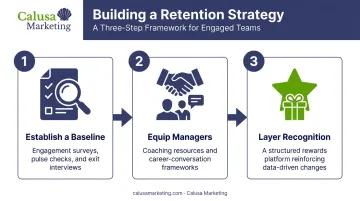
Skipping straight to step three without steps one and two is the most common mistake. Recognition programs built on guesswork rarely land the way Briggs's or ODW's did.
Frequently Asked Questions
What are the key drivers of employee retention?
Culture and belonging, career growth, manager relationships, fair pay and recognition, and flexibility consistently rank as the top drivers. See the full breakdown above for how each plays out in real organizations.
What is an employee retention case study and why is it useful?
It's a real-world account of how an organization diagnosed a specific retention problem and solved it. It's useful for benchmarking your own workforce, industry, or challenge against a company that faced something similar.
How do you measure the success of a retention strategy?
Common metrics include voluntary turnover rate, new-hire tenure and retention, and engagement or favorability scores tracked before and after an intervention. Mutual of Omaha and ODW both tracked these before-and-after pairs directly.
What role does employee recognition play in retention?
Consistent, meaningful recognition builds trust and a sense of fairness, both of which reduce attrition intent. Briggs saw recognition perception jump 17 points after making it a structural priority, not just a manager habit.
How often should companies conduct employee engagement surveys?
Sammons Financial Group's shift from every 2-3 years to an annual cadence, backed by pulse surveys around key moments, is a solid minimum benchmark. More frequent listening catches risk earlier.
What is considered a good employee retention rate?
Benchmarks vary heavily by industry. BLS JOLTS data puts annual quits rates around 2.2% for transportation and warehousing versus 1.3% for finance and insurance, so compare your numbers against your specific sector, not a universal average.