Many companies respond with scattered fixes: a quick survey here, a training session there. Without a structured program behind these efforts, budgets get spent with little measurable improvement to show for it.
This guide breaks down what a customer experience improvement program actually is, why it matters, its core components, and the step-by-step best practices for building one that drives retention and revenue.
Key Takeaways
- A CX improvement program continuously measures and improves every customer touchpoint, not a one-time fix.
- Strong programs pair data collection (NPS, CSAT, journey mapping) with clear action plans and named owners.
- Frontline employee engagement and incentives directly shape how customers perceive a brand.
- Programs fail most often when treated as a project instead of a continuous cycle.
What Is a Customer Experience Improvement Program?
A customer experience improvement program is a systematic, cross-functional initiative. It combines measurement (surveys, feedback, journey mapping) with action planning and accountability to continuously improve how customers perceive and interact with a brand.
It doesn't run like a typical project with a start and end date. Instead, it operates as an ongoing cycle: listen, analyze, act, measure, repeat.
The core objective is alignment. Sales, service, marketing, and operations all need to work from the same customer insight so interactions feel consistent, wherever they happen. That consistency is what reduces churn and drives referrals over time.
CX Program vs. Customer Service vs. Customer Success
These three terms get used interchangeably, but they aren't the same thing:
- Customer service is reactive support: solving a problem after a customer raises it.
- Customer success is proactive account guidance, usually aimed at helping customers get value from a product or subscription.
- A CX improvement program is the enterprise-wide strategic system spanning both, plus product, marketing, and loyalty touchpoints.
The gap between companies that treat CX this way and those that don't shows up in the numbers. McKinsey found that US companies identified as CX leaders achieved more than twice the revenue growth of CX laggards between 2016 and 2021. That's not a small gap to leave on the table.
Why Your Business Needs a CX Improvement Program
Retention is cheaper than acquisition, and the difference isn't marginal. According to Harvard Business Review, acquiring a new customer can cost 5 to 25 times more than retaining an existing one, depending on the industry. A CX program built around retention pays for itself many times over.
Loyalty incentives amplify this effect. Digital punch cards, gift card rewards, and points-based programs give customers a reason to come back rather than shop around.
Clients using Calusa Marketing's Digital Loyalty Card platform, for example, have seen up to a 2X increase in return rates and a 30% boost in revenue. This shows that CX improvement and loyalty marketing work hand in hand, each reinforcing the other.
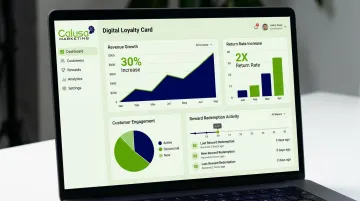
That same reinforcement cuts both ways: doing nothing carries real risk. PwC's global consumer survey found that 32% of customers said they would stop doing business with a brand they loved after just one bad experience. One misstep, and years of loyalty can evaporate.
Key Components of a Successful CX Improvement Program
A working CX program rests on a handful of interconnected pieces. Skip one, and the whole system gets weaker.
Listening and Mapping the Customer Journey
Two components generate the raw material every program needs:
- Voice of Customer (VoC) data: NPS tracks loyalty, CSAT measures satisfaction with specific interactions, and CES gauges ease of doing business. Add online reviews and social listening for continuous feedback.
- Customer journey mapping: Map touchpoints from awareness through advocacy to reveal where friction occurs, often in places leadership never expected.
People and Technology
Data alone doesn't move the needle. Two more components turn insight into consistent action:
- Employee engagement and incentives: Frontline behavior shapes how customers experience a brand. Recognition programs, such as gift cards, points-based rewards, or travel incentives, motivate teams to deliver better service.
- Technology and platforms: CRM and helpdesk tools capture the interaction data your program needs. Cloud-based reward platforms with no IT integration or app download make it easier to launch the incentive side of a CX program.
Most internal teams don't have the bandwidth to design and fulfill reward programs on top of daily operations. This is why some CX teams partner with an incentive marketing firm like Calusa Marketing, whose cloud-based platforms handle setup, fulfillment, and ongoing management without adding to your tech team's workload.
Governance and Measurement
Finally, someone has to own the outcome:
- Cross-departmental governance: A CX steering committee or dedicated program owner connects insights to action across teams. Without this, feedback tends to sit unused.
- KPIs and reporting cadence: Track NPS, CSAT, customer lifetime value, and churn rate on a monthly or quarterly cycle with leadership involved in the review.
How to Build and Launch Your CX Improvement Program
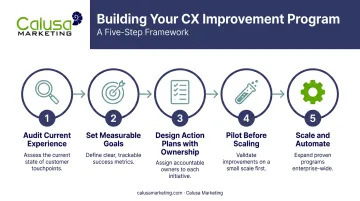
Building a program from scratch feels daunting, but it breaks down into five manageable steps.
- Audit the current experience. Map existing touchpoints and gather baseline data through surveys, customer interviews, or support ticket analysis. You can't improve what you haven't measured.
- Set measurable goals tied to business outcomes. For example: reduce churn by 5% or raise NPS by 10 points within two quarters. Vague goals like "improve CX" don't give teams anything to aim for.
- Design action plans with clear ownership. Assign specific touchpoints or departments to accountable owners, and align incentives so teams are actually motivated to hit CX targets — not just aware of them.
- Pilot before scaling. Test the program in one segment, channel, or region first. Use early feedback to refine the approach before committing budget to a full rollout.
- Scale and automate. Once the pilot proves out, implement reward and recognition platforms that sustain engagement long-term. Specialist providers like Calusa Marketing handle setup, fulfillment, and support, letting your team focus on strategy, not administration.
Best Practices and Common Pitfalls to Avoid
Best Practices for Long-Term Success
Programs that last share a few habits:
- Secure executive sponsorship. Tie CX metrics directly to team and leadership incentive structures, not just dashboards nobody checks.
- Close the feedback loop. Follow up with customers to show how their input led to a real change. Silence after a survey is worse than not asking at all.
- Benchmark regularly. Compare your CX metrics against industry standards and past performance to keep goals realistic and grounded in data.
Common Mistakes That Undermine CX Programs
The same failures show up repeatedly:
- Treating CX improvement as a one-time initiative instead of a continuous, iterative cycle.
- Overlooking the frontline employee experience, which has a direct, measurable impact on customer-facing interactions.
- Collecting feedback without visible follow-through breeds survey fatigue and erodes the trust you're trying to build.
Frequently Asked Questions
What is a customer experience improvement program?
It's an ongoing, structured system combining feedback collection, action planning, and accountability to continuously improve customer interactions across every touchpoint. This continuous, cross-functional effort has no fixed end date.
What are the key components of a CX improvement program?
Voice-of-customer data, journey mapping, employee engagement and incentives, supporting technology, cross-departmental governance, and a consistent KPI reporting cadence. Each piece reinforces the others.
How do you measure customer experience improvement?
Core metrics include NPS, CSAT, and CES for interaction-level feedback, plus churn rate and customer lifetime value for business impact. Track these together, not in isolation.
What is the difference between customer experience and customer service?
Customer service is one reactive touchpoint — solving problems after they arise. Customer experience covers the entire end-to-end relationship, including proactive and preventive efforts across every department.
How much does it cost to run a customer experience improvement program?
Costs vary based on company size, the tools you use, and whether an incentive or reward component is included. Most companies manage budget by rolling out the program in phases rather than all at once.
How long does it take to see results from a CX improvement program?
Early signals, like shifts in survey scores, often appear within a few months. Measurable retention and revenue impact typically takes two or more quarters to show up clearly.