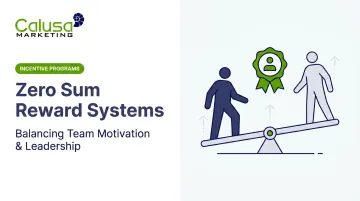
That's a zero-sum reward system in action, and many leaders build them without realizing it. They assume competition automatically fuels performance. But when the reward pie is fixed, one person's win is mathematically another's loss, and that math has a way of eroding trust long before anyone notices the damage.
This article breaks down what zero-sum reward systems actually are, where they show up in business, and how they quietly reshape team behavior. Then we'll cover practical strategies, including the kind of reward technology that lets leaders shift toward positive-sum outcomes without losing the drive that made the contest worth running in the first place.
Key Takeaways
- Fixed-pie thinking erodes trust: zero-sum rewards make one employee's gain another's exact loss, undermining collaboration.
- Common zero-sum traps include forced ranking, single-winner contests, and fixed bonus pools.
- Positive-sum redesigns expand reward tiers, align individual and team goals, and add transparent tracking.
- The right platform converts competitive tension into shared motivation without sacrificing recognition for top performers.
What Is a Zero-Sum Reward System?
The term comes from game theory: in a zero-sum game, total gains and losses always net out to zero. If you win $100, someone else loses exactly $100. Nobody creates new value; they just redistribute what's already there.
Translate that to the workplace, and a zero-sum reward system is any program that divides a fixed budget, a limited number of recognition slots, or a single promotion opportunity among competitors. One person's win requires someone else's loss. There's no way around it, because the total reward available never grows.
This setup usually shows up when leadership treats a reward pool as a fixed pie that simply needs slicing.
Negotiation researchers call this "distributive bargaining," a win-lose process over a fixed amount of value. The alternative, "integrative bargaining," looks for ways to expand the pie before anyone starts dividing it up.
Zero-Sum vs. Positive-Sum vs. Negative-Sum Rewards
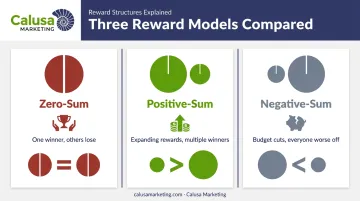
Not every incentive structure has to work this way. Three distinct models exist:
- Zero-sum: A fixed reward pool divided among winners and losers, total value stays flat.
- Positive-sum: The pie expands, meaning more than one person can win. Think unlimited reward tiers or added budget for every rep who hits a target.
- Negative-sum: The hardest scenario. Company-wide budget cuts mean even the "winners" end up worse off than where they started.
Here's the trap leaders miss: employees often perceive a program as zero-sum even when it isn't structurally fixed. If a manager never explains that reward tiers are uncapped, staff will assume there's only room for one winner, and they'll behave accordingly. Perception drives behavior just as much as the actual program design.
Real-World Examples of Zero-Sum Reward Systems in Business
Zero-sum structures aren't rare. They're baked into some of the most common incentive formats companies still run today.
Single-winner sales contests are the most visible example. Only the top-performing rep earns the trip, bonus, or prize, while everyone else who put in real effort walks away with nothing to show for it. That includes the rep who finished a close second after a genuinely strong quarter.
Forced distribution, or stack-ranking, shows up in performance reviews at larger organizations. A set percentage of employees must be rated below average, regardless of what they actually delivered.
Microsoft ran this model for years before ending it in November 2013, after SHRM reported that critics said ranking employees against coworkers fostered internal competition and undermined collaboration. GE's well-known "vitality curve" followed a similar logic before the company moved toward more frequent, informal manager conversations.
Fixed departmental budgets or bonus pools create the same dynamic at a team level:
- Boosts one department's bonus allocation while shrinking what's left for another
- Forces managers to compete with peers for budget instead of collaborating on shared goals
- Penalizes high performers on smaller teams simply because their department's pool is smaller
Each of these examples shares the same DNA: a fixed number of winners, or a fixed dollar amount, that has to be divided rather than expanded.
How Zero-Sum Rewards Impact Team Motivation and Trust
Zero-sum thinking doesn't just affect the person who loses the contest. It reshapes how people treat each other day-to-day.
When employees believe helping a colleague reduces their own shot at winning, they start withholding things:
- Information about processes or accounts
- Leads that could benefit a teammate
- Shortcuts that speed up shared work
- Basic coaching for newer team members
Nobody announces this behavior out loud. It just quietly becomes the norm.
The Trust Cost Is Measurable
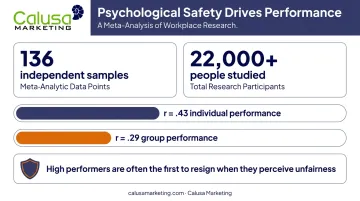
This matters because psychological safety, the sense that it's safe to speak up, share information, and ask for help, has a documented link to performance. A 2017 meta-analysis covering 136 independent samples and more than 22,000 people found psychological safety positively correlated with individual task performance at r = .43, and with group task performance at r = .29.
When zero-sum contests erode that safety, teams lose more than morale. They lose the information-sharing and cooperative behavior that drives results.
There's also a majority-morale problem. In any single-winner contest, only one person walks away happy. Everyone else, including reps who genuinely performed well, ends up feeling like they lost. Run that same structure quarter after quarter, and you're training most of your team to associate effort with disappointment.
The retention risk compounds this: research from Harvard Business Review found that high performers are often the first to resign when they perceive unfairness, particularly when newly hired peers receive better treatment for equivalent work. Reward systems that feel arbitrary or winner-take-all send exactly that signal to the people you can least afford to lose.
Finally, hyper-competitive, siloed teams tend to collaborate less across functions. Compare that to teams with shared, achievable incentive goals, where coordination naturally improves because everyone's success is at least partly linked.
Leadership Challenges in Zero-Sum Environments
Leaders running zero-sum programs face a genuine balancing act. Recognizing individual achievement matters. So does keeping the broader team culture collaborative rather than cutthroat. Lean too far into individual competition, and you risk the trust erosion outlined above. Lean too far into "we're all in this together," and your top performers stop feeling seen.
The mindset shift that helps most: framing success as collective and synergistic rather than purely individual. This doesn't mean eliminating individual recognition. It means positioning wins as part of a bigger team story instead of a zero-sum trophy that only one person gets to hold.
Communication is the other half of the challenge. McKinsey's research on performance management identifies three practices most linked to perceived fairness:
- Linking employee goals directly to business priorities
- Providing consistent, effective manager coaching
- Differentiating compensation based on actual performance, not arbitrary curves
Leaders who skip the explanation step, announcing winners without clarifying how rewards were earned, invite exactly the kind of favoritism perception that kills trust. Publishing eligibility rules, measurement periods, and tie-break procedures before the contest starts does more for morale than any prize increase.
Strategies to Shift From Zero-Sum to Positive-Sum Reward Systems
Shifting away from a fixed pie doesn't mean abandoning competition. It means redesigning how the pie gets divided, or better yet, letting it grow.
Reframe success metrics. Instead of ranking purely on individual output, weigh in collaborative behaviors: mentoring, knowledge sharing, cross-team support. This signals that helping a colleague doesn't cost you anything.
Move to multi-winner recognition. Rather than one top-performer prize, set a threshold: every rep who hits it earns a reward.
This is the core idea behind tiered, open-ended eligibility, which the Incentive Research Foundation recommends specifically to keep more participants engaged rather than checked out after the first month of a quarter.
Expand the pie with tiered reward levels. Instead of a capped pool divided among finishers, scale the budget with performance. Companies already running this model see it play out in practice:
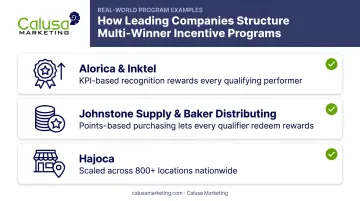
- Alorica and Inktel tie rewards to KPI achievement, so agents who hit targets earn recognition, not just the single top performer
- Johnstone Supply and Baker Distributing run points-based programs where rewards scale with purchasing behavior and account growth
- Hajoca runs a custom program across 800+ locations, proving multi-winner structures scale even across large, distributed teams
Calusa Marketing builds cloud-based SaaS reward platforms designed around exactly this kind of threshold model, where participants accumulate points and every qualifying person, not just the top scorer, becomes eligible to redeem a reward.
No integration or app download required on the client's end, which matters when you're trying to reduce friction, not add another login employees have to remember.
Use transparent, real-time tracking. Visibility reduces zero-sum perceptions even when the structure itself hasn't changed. When people can see their point balance, pending rewards, and progress toward a threshold on a dashboard, they stop assuming there's only room for one winner.
Build in peer-to-peer recognition. Pairing individual incentives with informal peer shoutouts reinforces that helping others doesn't come at a personal cost.
Pair individual rewards with group bonus pools. Tie a portion of the incentive to collective KPIs, so personal wins and team wins reinforce each other rather than compete.
If you're not sure whether your current program has drifted toward zero-sum territory, an outside audit from an experienced incentive program partner can usually spot the warning signs faster than an internal review.
Frequently Asked Questions
What is a zero-sum system?
A zero-sum system is one where one party's gain is exactly offset by another party's loss. The total net change across all participants always equals zero; no new value gets created.
How do you win a zero-sum game?
Winning typically means playing an optimal strategy given fixed resources. In business, though, the smarter move is often changing the game itself into a positive-sum structure where more people can succeed.
What are real-world examples of zero-sum games?
Chess, checkers, and poker (with fixed chips) are classic examples. In the workplace, forced-ranking performance reviews and single-winner sales contests apply the same logic.
Can a reward system be both zero-sum and motivating?
Yes, in limited doses. A single top-performer award can drive short-term effort, but overusing zero-sum structures risks long-term morale and trust problems across the rest of the team.
How can leaders tell if their incentive program has become zero-sum?
Watch for reduced collaboration, information hoarding, and complaints about fairness. If those signs show up, an audit with an experienced incentive marketing partner like Calusa Marketing can help pinpoint the cause.
What's the difference between zero-sum and positive-sum incentive programs?
Positive-sum programs expand rewards or align interests so multiple people can win. Zero-sum programs divide a fixed pool, meaning one person's win always comes at another's expense.