Most businesses can't deliver that. They run a website loyalty widget, a separate in-store punch card, and a phone team with zero visibility into either. The result is missed data, inconsistent rewards, and members who feel like strangers every time they switch channels.
This guide breaks down what an omnichannel loyalty program actually is, the four pillars that keep members engaged, the channels you need to cover, real examples, and a step-by-step approach for building one — without a massive technology lift.
Key Takeaways
- One member profile unifies rewards across every touchpoint, not separate tools per channel
- Omnichannel shoppers spend up to 1.5x more per month than single-channel buyers
- The 4 C's (Consistency, Communication, Convenience, Care) drive long-term engagement
- No-integration SaaS platforms launch a digital loyalty program in days, no app needed
What Is an Omnichannel Loyalty Program?
An omnichannel loyalty program recognizes and rewards members the same way no matter how they engage with your business. Whether a customer buys online, walks into a branch, calls your service line, or orders through a dealer rep, their activity feeds into one connected profile instead of a channel-specific silo.
That connected profile is often called a single customer view: one account that syncs both transactional data (purchases, point balances) and non-transactional data (preferences, support history, enrollment source) from every touchpoint.
When a member logs into an app, calls in, or hands over their phone number at checkout, the system already knows who they are.
Here's what that looks like in practice:
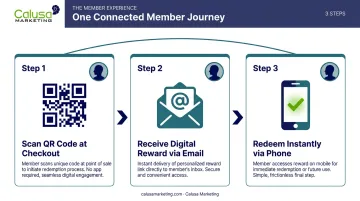
- A customer scans a QR code at checkout to enroll in a rewards program
- She receives an email a day later with a digital reward tied to that same account
- Next time she's in line, she pulls up her phone and redeems it instantly, with no re-entering information and no separate login required
This kind of continuity matters because shopping behavior has already blurred the line between digital and physical. According to a 2022 IBM Institute for Business Value and National Retail Federation study of more than 19,000 consumers, 27% of consumers now name hybrid shopping as their primary buying method.
That figure climbs to 36% among Gen Z, the group most likely to blend online and in-store shopping. A loyalty program that only tracks one channel misses a third or more of how people actually shop.
Multichannel vs. Omnichannel Loyalty Programs: Why They're Not the Same
These terms get used interchangeably, but they describe very different setups.
- Multichannel simply means offering rewards through more than one channel, such as a website, an app, or a punch card at the register
- Omnichannel means those channels are fully integrated, sharing the same member data, point balances, and redemption rules
A "false omnichannel" setup is easy to spot once you know what to look for.
Say a business builds a loyalty app that mirrors its website perfectly (same look, same rewards catalog), but a purchase made in-store never shows up in the app, and a phone order isn't linked to the member's account at all. That's multichannel wearing an omnichannel costume.
A true omnichannel fix ties every one of those transactions back to a single member record, regardless of where the purchase happened.
Why Omnichannel Loyalty Matters: Key Benefits
Beyond convenience, omnichannel loyalty changes the underlying economics of a rewards program. Here's how.
Incentivized data collection. When you reward members for identifying themselves at every touchpoint (an in-store scan, an app login, a phone registration), you build a far richer profile than any single channel could produce on its own. That data fuels smarter targeting later.
Seamless, richer member journeys. Features like card-linking and location-based offers smooth the handoff between channels. A member who gets a geofenced push notification near a store location, then redeems that same offer at checkout, never notices a "channel switch" at all.
Increased lifetime value and spend. Omnichannel shoppers spend 1.5x more per month than single-channel shoppers, based on NewStore's 2024 Consumer Trends Report as cited in Deloitte's analysis of leading retail trends. That difference points to a far more valuable, higher-spending customer relationship.
Stronger retention and advocacy. Loyalty programs already influence buying behavior on their own. According to Bond's 2024 Loyalty Report, 85% of consumers say a loyalty program makes them more likely to keep buying from a brand, and 79% say they'd recommend that brand to others.
An omnichannel structure amplifies that effect by making the program easier to actually use.
Competitive differentiation for B2B and incentive-driven industries. This advantage extends well beyond retail. For distributors, media companies, and vacation ownership businesses, an omnichannel incentive program gives dealers, advertisers, or members a real reason to stay.
Calusa Marketing has seen this play out with HVAC and plumbing distributors like Johnstone Supply and Hajoca, where points-based dealer rewards tied to purchasing behavior become part of the account relationship itself.
The 4 C's of Customer Loyalty
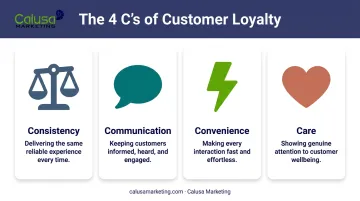
Channels are only half the equation. Most loyalty experts point to four foundational pillars that determine whether members actually stick around: Consistency, Communication, Convenience, and Care. Definitions vary slightly by source, but these four hold up well as a working framework.
Consistency
Members expect the same brand experience, tone, and reward value no matter which channel they use. If a point is worth one amount online and a different amount in-store, trust erodes fast, and members notice inconsistency far quicker than they notice a good experience.
Communication
Personalized, two-way communication (email, SMS, in-app messaging, or a conversation at the counter) needs to match each member's preferred channel. A member who signed up via text shouldn't be forced into email-only updates just because that's easier for your team.
Convenience
Frictionless earning and redemption keep members engaged. That means minimal sign-up steps, no forced app download, and flexible reward choices. The moment a program feels like homework, participation drops.
Care
Responsive, empathetic support available across channels turns a transaction into a relationship. Real support, not a bot loop, is what builds the trust that keeps members loyal past the first redemption.
Core Channels of an Omnichannel Loyalty Program
A true omnichannel program typically spans three established channels, plus an emerging fourth built around values.
eCommerce & Digital
This channel needs a loyalty landing page, a member dashboard, and light gamified profiling tied into the single customer view. A well-built dashboard shows a member their point balance, year-to-date spend, and pending points at a glance. This turns an abstract rewards program into something tangible members can actually track.
In-Store & Offline
Capturing offline purchases doesn't require expensive kiosk hardware anymore. A staff-facing scanner app lets employees issue a punch or reward at the point of sale. Customers enroll by scanning a QR code, clicking a link, or opting in via text, with no physical card and no app download required on their end.
Mobile & Phone/Call Center
Mobile wallet passes (Apple Wallet or Google Wallet) deliver most of what a dedicated branded app promises, minus the months of development and App Store approval. This matters especially for businesses driven by phone orders and call centers, such as distributors, media sales teams, or customer service operations. For these teams, a verified member lookup by phone matters just as much as an app icon on someone's home screen.
Lifestyle & Core Values
An emerging trend rewards members for values-aligned actions beyond pure transactions, including recycling, donations, and community involvement. Calusa Marketing has built this into programs for clients like Memorial Blood Centers, where the incentive itself supports a public health outcome rather than just a purchase.
Real-World Examples of Omnichannel Loyalty Programs
Retail example: Starbucks Rewards is one of the most recognized cases. Members earn Stars through mobile orders or by scanning the app in-store, then redeem those Stars at any participating location. One account, tracked and redeemable across every way a customer chooses to order.
B2B/incentive example: Consider a distributor loyalty scenario where a dealer:
- Places an order by phone one week
- Logs into an online ordering portal the next
- Picks up product at the counter the week after
In a true omnichannel setup, every one of those purchases rolls into the same point balance, visible on one dashboard — not three disconnected records the dealer has to track manually. This is the model Calusa Marketing has built for HVAC and plumbing distributors like Johnstone Supply and Baker Distributing, where points-based dealer programs are designed around exactly this kind of purchase visibility.
The common thread: In every example above, the member never has to think about which system they're in. There's one balance, and it follows them.
How to Build Your Omnichannel Loyalty Program
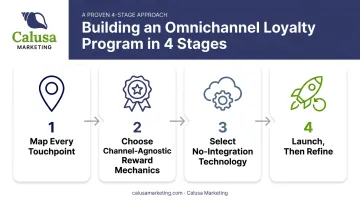
Building an omnichannel program doesn't require a multi-year IT project. Follow these four steps:
Map every touchpoint. List every place customers or members currently interact with your business (website, branch, phone, app) and note what data each one can realistically capture.
Choose channel-agnostic reward mechanics. Pick mechanics that work anywhere: points, tiers, digital punch cards, or gift cards. Avoid anything that only functions in one environment.
Select technology that skips heavy integration. This is where most programs stall. Calusa Marketing's cloud-based SaaS platform needs no POS integration or app download, with digital punch cards live in under a week. Add ANY-Card's 100+ gift card options and white-glove fulfillment with 7-day support to handle the operational lift most teams lack bandwidth for.
Launch, then refine. Use member feedback and engagement data gathered across every channel to adjust reward values, communication cadence, and redemption options over time.
Frequently Asked Questions
What is an omnichannel loyalty program?
It's a unified reward strategy that recognizes members consistently across in-store, online, mobile, and phone touchpoints through one connected profile. Instead of separate systems per channel, every interaction feeds the same account.
What are the 4 C's of customer loyalty?
Consistency, Communication, Convenience, and Care. Together, these four pillars determine whether members stay engaged with a brand long after their first purchase or sign-up.
What is an example of a loyalty program?
Starbucks Rewards is a well-known example, letting members earn and redeem Stars across mobile and in-store purchases. Calusa Marketing runs similar B2B programs for HVAC and plumbing dealers, syncing phone, online, and counter purchases into one point balance.
How is an omnichannel loyalty program different from a multichannel program?
Multichannel means offering rewards on multiple platforms without connecting them. Omnichannel unifies the member data and reward rules across all of them, so a purchase on one channel is visible everywhere else.
Do I need a mobile app to run an omnichannel loyalty program?
No. Mobile wallet passes, digital punch cards, and cloud-based SaaS platforms can deliver a fully omnichannel experience without requiring a dedicated app download from your members.
How long does it take to launch an omnichannel loyalty program?
Timelines vary by complexity, but no-integration SaaS platforms can launch in about a week. Custom-built or POS-integrated systems typically take much longer due to development and testing requirements.