Gallup's latest global data found that 64% of employees are not engaged and another 16% are actively disengaged, with disengagement costing the global economy roughly $10 trillion in lost productivity, or 9% of global GDP, according to Gallup's State of the Global Workplace data.
Autonomy, purpose, and growth opportunities still matter. But on their own, they're often too abstract for employees to feel day-to-day. People need visible proof they're making progress, not just a mission statement on a break room wall.
That's the gap gamification fills. This guide breaks down what it actually is, why it works psychologically, proven best practices, real workplace examples, and the mistakes that sink programs before they start.
Key Takeaways
- Disengagement costs employers billions annually; perks alone rarely fix it
- Gamification works by making feedback immediate, visible, and social
- Best programs pair badges with genuine recognition, not hollow rewards
- Overusing leaderboards can backfire, increasing stress instead of motivation
- Reliable reward fulfillment matters as much as the game mechanics themselves
What Is Gamification for Employee Engagement?
Gamification means applying game design elements, such as points, badges, levels, and leaderboards, to everyday work tasks to influence behavior. Rather than turning the office into an arcade, it borrows the feedback loops that make games compelling and uses them to reinforce the actions a business actually needs.
The concept traces back to a foundational definition: gamification is "the use of game design elements in non-game contexts." SHRM describes workplace applications as layering points, badges, leaderboard rankings, and rewards directly into existing work tasks.
Intrinsic vs. Extrinsic Motivation
Gamification taps two distinct motivational systems:
- Intrinsic motivators: mastery, autonomy, connection to teammates, a sense of purpose
- Extrinsic motivators: points, badges, prizes, public recognition, tangible rewards
Neither works well in isolation: extrinsic rewards without intrinsic meaning feel hollow, while intrinsic motivation without a visible progress marker can feel invisible. The strongest programs use extrinsic mechanics as a delivery system for intrinsic wins.
Translating Work Into Game Mechanics
Here's how that dynamic translates into everyday work behaviors:
| Work Behavior | Game Mechanic |
|---|---|
| Completing a training module | Earning a digital badge |
| Hitting a sales or quota goal | Climbing a leaderboard |
| Helping a teammate solve a problem | Earning recognition points |
| Reaching a work anniversary | Unlocking a milestone reward |
Why Gamification Works: The Psychology Behind It
Humans are wired to seek progress. We want to know we're getting somewhere, and we want that feedback fast. Gamification satisfies this by making achievement visible and immediate instead of buried in an annual review.
Not Everyone Wants to Compete
Richard Bartle's well-known player taxonomy identifies four orientations:
- Achievers – driven by progress and points
- Explorers – motivated by discovery and novelty
- Socializers – energized by team interaction and recognition
- Killers – fueled by competition and rank
Bartle himself notes most people show traits from all four, and the mix depends heavily on the environment.
Newer research reinforces the social angle. A 2024 study of gamified corporate training platforms found that the direct link between gamification and knowledge sharing was weak on its own. What actually drove results was social interaction, meaning collaborative and team-based mechanics tend to outperform pure competition for most workforces.
The Training Data Backs It Up
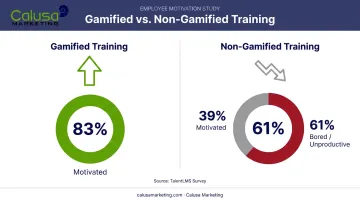
A TalentLMS survey of nearly 900 employees found that 83% of workers receiving gamified training said they felt motivated, compared to just 39% who reported motivation from non-gamified training. Meanwhile, 61% of those without gamification said they felt bored and unproductive.
That's a meaningful gap. But there's a catch worth flagging before we get to best practices: gamification works best when it reinforces genuine recognition and purpose, not when it replaces them. A leaderboard without meaning behind it is just noise.
Best Practices for Implementing Gamification for Employee Engagement
Start With Clear, Measurable Goals
Every mechanic should tie to a specific business outcome, not vague "fun." If the goal is training completion, badges should map to modules finished. If it's sales performance, points should track against quota attainment.
One Calusa Marketing client, an HVAC distributor, built a points-based program tied directly to two measurable behaviors: online order volume and product education completion. Nothing was decorative. Every point earned mapped to a specific business goal.
Balance Extrinsic Rewards With Intrinsic Motivation
Points and badges shouldn't feel transactional. Pair them with:
- Public acknowledgment from a manager or peer
- A clear connection to skill growth or career advancement
- Context on why the achievement matters to the team
Design for Different Motivation Types
Not every employee wants to compete on a leaderboard. Build in multiple paths:
- Competitive: rankings and quotas for achievers
- Collaborative: team challenges for socializers
- Self-improvement: personal progress tracks for those who dislike public comparison
Keep Rules Transparent and Simple
If employees can't explain how points are earned in one sentence, the rules are too complicated. Ambiguity erodes trust faster than almost any other program flaw.
Measure Participation and Iterate Often
Track participation rate, completion rate, and redemption rate monthly. Collect informal feedback, not just dashboard numbers. Programs that never change stagnate; the ones that last get adjusted every quarter based on real usage data.
Pair Recognition With Meaningful, Redeemable Rewards
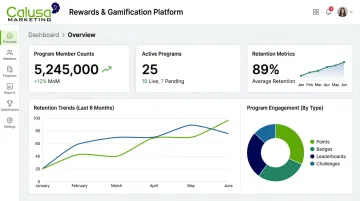
Badges and points lose value fast if there's nothing real behind them. This is where reward logistics matter more than most program managers expect. Calusa Marketing's platform gives clients access to 100+ digital gift card brands and 10 million-plus merchandise items shipped to over 100 countries. It also offers custom travel incentives for groups up to 10,000 people, so HR and marketing teams can focus on program strategy instead of fulfillment headaches.
Real-World Examples of Gamification in the Workplace
Distributor Leaderboards and Team-Based Challenges
In industries like HVAC, electrical, and tire distribution, dealer rewards programs commonly track purchases and account growth against tiered point thresholds. A tire distribution client, for example, runs a dealer program where points accumulate based on purchase volume and account expansion, giving reps a visible scoreboard tied to real revenue.
Cross-functional challenges apply this same scoreboard concept to teams rather than individuals, grouping employees from different departments around a shared metric like a quarterly customer satisfaction score. This format leans into the social-interaction research mentioned earlier: shared goals build cooperation instead of internal competition.
Peer Recognition and Milestone Celebrations
Recognition platforms let employees award points to coworkers for specific behaviors, like solving a customer issue or covering a shift. Those points typically redeem for gift cards or travel credits, turning informal praise into something tangible.
Work anniversaries and certifications get a similar boost from digital shoutouts or badges. Recognizing "tribal knowledge" holders, the long-tenured employees who carry institutional expertise, is a common use case for platforms tracking KPIs alongside peer recognition.
Gamified Onboarding and Training
Call center and customer service environments often use badges to mark onboarding milestones, such as completing the 90-day introductory period or hitting first-call resolution targets. Two BPO clients use programs specifically designed around agent recruitment and retention, tying recognition to concrete KPI achievement rather than tenure alone.
Common Pitfalls to Avoid
Gamification isn't automatically positive. Design it poorly and it can do real damage.
- Overloading on competition: Heavy reliance on leaderboards alone can alienate non-competitive employees and increase stress rather than engagement, especially when performance tracking turns into constant surveillance.
- Hollow rewards: Points or badges with no real value behind them erode trust quickly. Employees notice when "gamified" just means "tracked."
- Involuntary, high-pressure mechanics: At Disneyland's laundry facilities, electronic screens once ranked workers by name and speed, prompting employees to dub the system an "electronic whip."
The lesson is consistent: gamification imposed without employee input tends to backfire. Involve frontline staff in program design before rolling anything out company-wide.
Choosing the Right Gamification and Rewards Partner
Not every HR team has the bandwidth to build a gamification program from scratch, and that's fine. The right partner handles the heavy lifting.
Look for:
- No IT burden: Cloud-based platforms that require no app download and no integration work let programs launch fast without straining internal resources.
- Reliable fulfillment: Gift cards, travel incentives, and digital punch cards need to arrive accurately and on time, every time.
- Industry-specific customization: A call center program looks nothing like a distributor dealer program. Templates rarely fit both.
Calusa Marketing has built programs for distributors, call centers, media companies, and more, backed by 500,000-plus program members across 1,000-plus programs and a 99% client retention rate. That track record comes from tailoring each program to its audience rather than forcing a generic playbook on every client. Companies exploring a program can talk to Calusa Marketing about a program to see what fits their team.
Frequently Asked Questions
What is an example of gamification for employee engagement?
A common example is employees earning a digital badge for completing a training module, or climbing a sales leaderboard for hitting a monthly quota. Both turn an everyday task into a visible, trackable achievement.
What are the 4 pillars of gamification?
There's no single universally agreed-upon framework, but most workplace programs rely on points, badges, levels, and leaderboards working together to signal progress and status.
What are the 5 C's of employee engagement?
Definitions vary by source, but one common version cites Care, Connect, Coach, Contribute, and Congratulate. Gamification supports each by making contribution and recognition visible in real time.
What are some fun employee engagement activities?
Trivia contests, milestone shoutouts, team-based challenges, and point-based peer recognition are popular low-lift options that most teams can launch quickly.
Does gamification actually improve employee engagement?
TalentLMS found that 83% of employees felt motivated by gamified training, showing measurable gains when programs are well-designed. Poorly built programs, however, can raise stress instead of morale.
What tools are commonly used for workplace gamification programs?
Common categories include recognition platforms, learning management systems for training, and incentive fulfillment partners that handle gift cards, merchandise, and travel rewards.