Introduction
Picture this: your best account executive just gave notice. Not because of quota. Not because a competitor poached her with a bigger base.
She left because the incentive plan stopped making sense. The accelerators changed mid-quarter, the payout formula required a spreadsheet to decode, and she couldn't trust what she'd actually earn.
This scenario is playing out across industries in 2026. Hybrid teams and tighter budgets have forced companies to prove ROI on every reward dollar, pushing incentive compensation far beyond sales commissions.
98% of U.S. organizations now use some form of bonus program, up from 93% just a few years ago, according to WorldatWork's research on bonus program adoption.
This guide breaks down 12 proven incentive compensation types, how they differ, and a practical framework for choosing the right one for your team or channel network.
Key Takeaways
- Incentive compensation now spans 12 plan types beyond sales commissions, each suited to specific roles and goals
- The right plan depends on role, company stage, and culture, not what's trending or easy to copy
- Blending cash with recognition, travel, and experiential rewards deepens engagement beyond cash alone
- Well-designed plans boost performance by 25% to 44%, according to the Incentive Research Foundation (IRF)
- Picking a plan type is only half the job — clear communication and simple administration decide the outcome
What Is Incentive Compensation and Why It Matters in 2026
Incentive compensation is performance-based pay or rewards layered on top of base salary or hourly wages, tied to specific, measurable outcomes. Unlike fixed pay or benefits, it's variable and contingent, designed to reinforce particular behaviors, not guarantee income.
That distinction matters more than ever. Labor markets remain tight, teams are distributed across time zones, and finance leaders want proof that every incentive dollar produces a return.
The evidence backs a well-built plan. The Incentive Research Foundation's synthesis of 45 studies found properly structured incentive programs improve performance by 25% to 44%.
Programs running at least a year averaged the higher end, 44%, versus 30% for shorter campaigns. The catch: results depend on choosing goals employees can actually control and monitoring the plan after launch, not just at rollout.
Incentive compensation has also outgrown its sales-only reputation. Companies now apply it to:
- Customer success teams (retention and expansion metrics)
- Engineering and product teams (milestone delivery)
- Distributor and channel networks (volume and loyalty)
- Operations teams (efficiency and quality gains)
That expansion is exactly why choosing the right structure matters so much heading into 2026.
12 Types of Incentive Compensation Plans
Incentive plans generally fall into three buckets: monetary, non-monetary, and hybrid. They can also target individuals, teams, or the whole organization.
Pick from this list based on what's actually measurable and controllable for the role in question. Not because a competitor uses it.
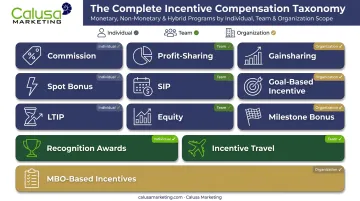
Commission-Based Incentives
Employees earn a percentage of the revenue they generate. It's the oldest and most recognizable incentive structure in direct sales.
- Best for: Sales reps, business development teams, channel partners
- Watch out for: Reps chasing deal volume over deal quality without margin or retention guardrails built in
Profit-Sharing Plans
The company distributes a slice of profits company-wide, usually quarterly or annually, using a predefined formula.
- Best for: Mature, flatter organizations with stable profit margins
- Watch out for: Diluted "line of sight": individual contributors struggle to connect daily work to the eventual payout
Gainsharing
Teams share in productivity, quality, or efficiency gains measured against a historical baseline.
- Best for: Manufacturing, logistics, and operations teams with measurable throughput
- Watch out for: Setting a fair baseline; get it wrong and the whole plan feels rigged
Spot Bonuses
One-time, unplanned rewards for a specific achievement, delivered close to the moment it happened.
- Best for: Any team, as ad-hoc recognition for going above and beyond
- Watch out for: Overuse. Hand these out too often and they stop feeling special
Sales Incentive Plans (SIPs)
More sophisticated than flat commission, SIPs layer in quotas, accelerators, and payout curves tied to stretch goals.
- Best for: Account executives and sales leadership managing complex deal cycles
- Watch out for: Design complexity. These plans need regular calibration or reps stop trusting the math
Goal-Based Bonuses
Payouts tie to OKRs or KPIs for functions without a direct revenue line, such as marketing, product, or operations.
WorldatWork's 2023 data shows how broadly annual incentive eligibility already extends beyond sales: 99% of public companies and 93% of private companies include managers and supervisors in some form of annual incentive plan.
- Best for: Cross-functional teams where success isn't measured in closed revenue
- Watch out for: Vague KPIs that leave payout amounts open to argument
Long-Term Incentive Plans (LTIPs)
Multi-year structures, most commonly a three-year horizon, tied to metrics like EBITDA and often paired with vesting schedules.
- Best for: Executives and strategic senior hires focused on long-range value creation
- Watch out for: Weak motivational pull for junior staff who won't stick around long enough to vest
Stock Options & Equity-Based Plans
Equity grants (RSUs, options, or company-wide ESOPs) give employees an ownership stake in outcomes, not just a paycheck.
- Best for: Startups conserving cash and senior technical hires who value upside over certainty
- Watch out for: Delayed, uncertain payout value that means little to someone who needs income now
Milestone-Based Bonuses
Bonuses trigger when a defined project phase wraps up: a product launch, a system rollout, a certification earned.
- Best for: Product, engineering, and implementation teams working in project cycles
- Watch out for: Limited relevance for ongoing, non-project roles where "milestones" don't naturally exist
Team-Based / Group Incentives
The plan pools rewards and distributes them based on the group's collective outcome, not any one person's individual output.
- Best for: Agile squads and channel or distributor networks chasing a shared target
- Watch out for: Free-riding, where lower performers coast on the group's effort while still collecting the payout
Non-Monetary Incentives
Recognition, flexible schedules, experiential rewards, and travel motivate without a direct cash payout attached.
Don't dismiss these as "nice to have." A 2016 survey of more than 350 large U.S. firms found 84% used tangible noncash rewards, up from just 26% in 1996. That adoption keeps climbing because these rewards stick in memory longer than a deposit that blends into a paycheck.
- Best for: Culture-driven organizations where sustained engagement matters more than a short-term output spike
Many companies don't manage this in-house. Calusa Marketing, for example, designs and fulfills travel incentives, digital gift card programs, and digital punch card rewards, handling bookings, redemptions, and member support so internal teams aren't buried in fulfillment logistics.
Management by Objectives (MBO) Plans
Compensation ties to goals the employee and manager build together, rather than rigid, standardized KPIs.
- Best for: Customer success teams and mid-level managers whose impact doesn't reduce cleanly to one number
- Watch out for: Subjectivity. If goals aren't documented clearly upfront, payout disputes follow
How to Choose the Right Incentive Compensation Type for Your Business
Picking a plan means matching structure to role, budget, and culture, not chasing a single "best" option.
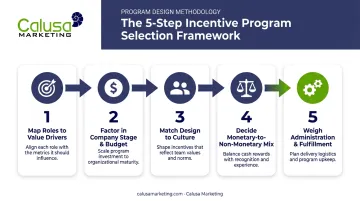
Step 1: Map roles to value drivers.
| Role | Primary Value Driver | Best-Fit Plan Type |
|---|---|---|
| Sales reps | Closed revenue | Commission / SIP |
| Customer success | Retention & expansion | MBO |
| Executives | Long-term value creation | LTIP / Equity |
| Distributor networks | Shared volume goals | Group incentives |
| Operations teams | Efficiency gains | Gainsharing |
Step 2: Factor in company stage and budget. Early-stage companies often lean on equity or milestone bonuses to conserve cash. Established organizations can layer cash, equity, and non-monetary rewards without straining runway.
Step 3: Match design to culture. Survey your teams to find out what motivates them most: ownership, recognition, or team wins. Guessing wrong here undermines the whole plan.
Step 4: Decide your monetary-to-non-monetary mix. This choice carries real weight: in SITE and IRF's 2024 Incentive Travel Index, 58% of senior managers said incentive travel plays an increasingly distinct role in motivation and culture-building, beyond what cash alone delivers.
Step 5: Weigh administration and fulfillment. Reward-heavy or travel-based programs come with real logistics — bookings, redemptions, member questions, upgrades. Many businesses work with an incentive marketing partner to handle that layer. Calusa Marketing, for instance, manages travel bookings, gift card fulfillment, redemptions, and reporting directly, which frees internal teams to focus on strategy instead of chasing confirmations.
Common Mistakes to Avoid When Selecting an Incentive Plan
Even a well-intentioned plan can fail if it trips over one of these:
- Overcomplicating the formula. If employees can't calculate their own expected payout in their head, the plan has already lost them.
- Leaning on cash alone. Ignoring recognition and experiential rewards leaves long-term engagement on the table.
- Copying a competitor's plan. What works for another company's culture and goals may not fit yours at all.
- Skipping the review cadence. WorldatWork found that 90% of companies make some change to their sales plan every year — plans left untouched go stale fast.
Conclusion
No single incentive plan fits every team. That's why 12 distinct types exist: roles, goals, and cultures differ too much for a one-size-fits-all formula.
Audit your current plan against this list, then choose intentionally, not by default or habit. Whatever your goal, whether sharper sales performance, stronger distributor loyalty, or better employee retention, an experienced incentive program provider like Calusa Marketing can simplify both the design and the day-to-day execution.
Frequently Asked Questions
What are the different types of incentive plans?
Plans generally fall into individual (commission, spot bonus, MBO), group/team-based, and hybrid categories. Rewards range from cash and equity to non-monetary options like recognition and travel.
What is the most common type of incentive plan?
Commission-based and goal-based bonuses remain the most widely used, especially in sales roles. Non-monetary and team-based incentives are gaining ground fast as companies diversify their reward mix.
What is the difference between an incentive and a bonus?
A bonus is typically a one-time or periodic reward. An incentive plan is a structured, ongoing system tying rewards directly to predefined, measurable performance criteria.
Are non-monetary incentives as effective as cash rewards?
Non-monetary incentives like recognition, travel, and flexible perks often drive stronger long-term engagement than cash alone, particularly when tailored to what employees actually value.
How often should incentive compensation plans be reviewed?
Review formally at least once a year, with quarterly check-ins on performance data. This keeps the plan aligned as business priorities and market conditions shift.
What incentive type works best for distributor or channel partner networks?
Group and team-based incentives, paired with structured non-monetary rewards like travel or points programs, tend to work best for motivating distributor and channel networks toward shared goals.