Most businesses still measure loyalty through points balances and discount codes. Many overlook the messier, harder-to-quantify relational glue: the community, the staff friendships, the peer recommendations that actually keep customers coming back.
This gap matters. Points can be matched by any competitor with a bigger budget. A relationship can't be discounted away.
This article breaks down what social ties actually are, why they work on a psychological level, and how to build them deliberately, whether through community programs, referral incentives, or the kind of personal service that turns a transaction into a relationship.
Key Takeaways
- Customer-to-brand, customer-to-customer, and employee-to-customer bonds create loyalty that price alone can't break
- Belonging drives socially connected customers to spend more and churn less than transactional shoppers
- Personalized service and community building are the strongest levers for turning customers into advocates
- Segment CLV, NPS, and referral rate by social engagement to reveal loyalty's real drivers
What Are Social Ties and Why They Matter for Customer Loyalty
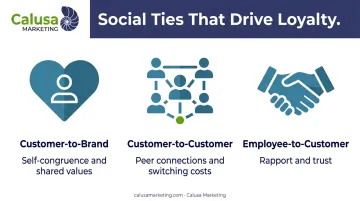
Social ties, in a marketing context, are the emotional and relational bonds connecting a customer to a brand, to fellow customers, and to the staff behind the counter. They stand apart from transactional loyalty, which rests on price and convenience and can vanish the moment a competitor drops their price by a dollar.
Research on self-identification backs this up. In a 2022 hospitality study, brand identification carried a strong statistical relationship with loyalty, explaining 60% of the variance researchers observed in customer behavior. Customers who see their own values reflected in a brand tend to stick around longer than customers who simply like the product.
Customer-to-Brand Ties
When a customer feels a brand reflects who they are, purchases stop being purely functional. A hiking brand that mirrors someone's outdoor identity, or a bank that positions itself around a customer's financial values, earns repeat business because buying reinforces self-image. This self-congruence effect explains why some shoppers pay a premium without blinking, choosing a product because it "fits who I am" rather than because it's cheapest.
Customer-to-Customer Ties (Community Bonds)
Peer connections built inside a brand's community, think forums, loyalty tiers, or member groups, create what researchers call a relationship switching cost. Leaving isn't just about losing a discount; it means losing a social network.
Studies of banking and hairstyling customers found that interpersonal relationships and perceived switching costs acted as barriers to leaving, even when satisfaction dipped. That said, community effects aren't automatic. At least one study found identification with a brand community didn't move the loyalty needle on its own; it worked only when paired with genuine satisfaction.
Employee-to-Customer Ties
Frontline relationships matter more than most loyalty strategies admit. Gremler and Gwinner's research on customer-employee rapport found two dimensions at play: enjoyable interaction and personal connection. In a study of bank customers, rapport explained over 20% of the variance in word-of-mouth behavior.
Consistency counts too. PwC's 2025 survey of more than 5,500 US consumers found that 86% considered human interaction moderately or very important to their brand experience, and 29% had already dropped a brand over a poor customer experience. A customer who sees the same account manager or barista repeatedly builds trust that's hard for a competitor to replicate, no matter their price point.
The Psychology Behind Social Ties and Loyalty
Social identity theory explains a lot of this. When customers view a brand as part of their in-group, the brand becomes an extension of self rather than an external purchase decision. That shift produces two measurable outcomes: longer engagement and lower sensitivity to price.
In a 2022 hospitality study, the link between identification and loyalty was notably stronger among highly engaged customers than among casual ones. The effect compounds the deeper someone gets pulled into a brand's orbit. Three forces amplify that pull:
- Belonging holds up only when tied to real relationships, not unredeemed points
- Social proof lowers perceived risk for new purchases
- Trust built through repeated interactions eases price increases
Belonging plays a similar role, though it's easy to overstate. A BCG survey of more than 10,000 consumers across nine countries found the average American belongs to 15+ loyalty programs, up 10% year over year. Program engagement and loyalty fell over the same period.
More programs, less genuine attachment. That gap is exactly where social ties matter: belonging tied to real relationships holds up where a stack of unused point balances doesn't.
Social proof reduces risk on top of that. Nielsen's global survey of more than 40,000 consumers found that 88% trusted recommendations from people they knew over any other channel, including ads.
A review, a referral, a friend's testimonial: visible peer loyalty does double duty. It reassures new customers the decision is safe, and it reinforces existing customers' sense they made the right call by sticking around.
Repeated positive interactions build trust, and trust is sticky. It's the reason a customer will absorb a price increase from a brand they've dealt with for years but bail immediately on a stranger charging the same rate.
That trust doesn't stay contained to one relationship; it spreads. Word-of-mouth converts better than paid acquisition, and the data backs it with real numbers.
A study tracking over 5,000 referred customers against a matched group of nonreferred customers at a German bank found referred customers were about 18% less likely to churn and carried lifetime value at least 16% higher than customers acquired through other channels. That gap held steady over time, long after the initial acquisition-cost advantage faded.
How Social Ties Influence Key Loyalty Metrics
Social ties aren't just a feel-good concept, they move the numbers businesses already track. Retention rate and customer lifetime value (CLV) both climb when customers have peer or community connections, since socially anchored customers are statistically less likely to churn even under competitive pressure.
The catch: most dashboards don't separate socially engaged customers from everyone else, so the real impact gets buried in an average.
To surface that hidden impact, look at referral rate and Net Promoter Score (NPS), the clearest quantifiable signals of social-tie-driven loyalty. Both directly measure whether a customer will vouch for a brand within their own network.
- NPS asks a simple 0-10 recommendation question; the percentage of detractors (0-6) subtracted from promoters (9-10) equals the final score
- Referral rate measures actual behavior: the percentage of new customers who arrived because an existing customer sent them
- Together, they separate customers who merely tolerate a brand from ones actively advocating for it
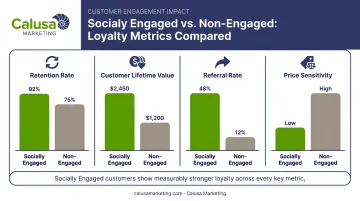
Businesses that want to isolate the real effect should segment these metrics by "socially engaged" versus "non-engaged" customers:
| Metric | Socially Engaged Customers | Non-Engaged Customers |
|---|---|---|
| Retention rate | Higher | Baseline |
| CLV | Higher | Baseline |
| Referral rate | Elevated | Low |
| Price sensitivity | Lower | Higher |
This kind of split, used in academic research through multigroup structural analysis, shows that blended loyalty averages often hide where the real value sits. A community member and a one-time discount hunter can carry the same "loyalty tier" label while behaving in completely different ways.
Strategies to Build and Strengthen Social Ties for Lasting Loyalty
Understanding social ties is one thing. Building them on purpose is another. Here's how the psychology above turns into features a business can actually launch.
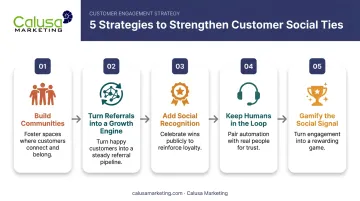
Build communities, not just discount lists. Branded forums, VIP tiers, and member events give customers a reason to interact with each other, not just redeem points. The community itself becomes the switching cost, provided the value inside feels genuine rather than a sales funnel in disguise.
Turn referrals into a growth engine. Referral and advocacy programs convert a customer's existing network into new customers who arrive pre-vetted by someone they trust. Rewarding both the referrer and the referred person, instead of just one side, keeps the incentive feeling mutual rather than transactional.
Calusa Marketing's Digital Loyalty Card platform builds referral program setup directly into its digital punch card tools, so a business can launch a referrer-and-referred reward structure without writing code or hiring a developer.
Add social recognition. Leaderboards, member spotlights, and public shout-outs deepen emotional investment by letting customers see, and be seen for, their loyalty. This works especially well layered onto gamified elements like point balances or milestone badges, since visible status becomes something a customer wants to maintain.
Keep humans in the loop. Personalized, human-based service beats automation-only support for retention, especially in service-heavy industries. Calusa Marketing staffs its own support line seven days a week rather than routing members to a chatbot.
This model has helped the firm maintain a 99% client retention rate across more than 1,000 programs and 500,000-plus members. When customers can reach the same responsive team repeatedly, the employee-to-customer tie discussed earlier starts compounding.
Gamify the social signal. Badges, tiers, and shareable milestones let customers broadcast their loyalty publicly, which reinforces social proof for prospective customers watching from the outside. A customer sharing a "5-year member" badge does more organic marketing than most paid campaigns, at a fraction of the cost.
Common Pitfalls to Avoid When Leveraging Social Ties
Social ties can backfire when businesses treat them as a feature to bolt on rather than a relationship to nurture.
- Forced interaction without value: Adding a community tab because competitors have one, without giving members a genuine reason to engage, produces disengagement rather than loyalty. Members notice when "community" is just a marketing veneer.
- Over-incentivized referrals: Rewarding referrals with purely transactional perks (cash for every signup regardless of fit) can flood a program with low-quality customers who leave as quickly as they came.
- Neglecting data and privacy: Social features run on personal information: who someone's friends are, what they share, and how they engage. Mishandling that data erodes the very trust these programs are built to create.
A single privacy misstep can undo years of relationship-building faster than any competitor's price cut ever could.
Frequently Asked Questions
What are the factors of customer loyalty?
Product quality, customer experience, and price all matter, but trust, social ties, community, referrals, and staff relationships often determine whether a satisfied customer becomes a repeat one. Social bonds are usually the hardest factor for competitors to copy.
What is an example of a social tie affecting customer loyalty?
A gym member who stays subscribed mainly because of friendships made in class, or a customer who follows a favorite account manager to a new branch, both illustrate social ties in action. The relationship outweighs the price comparison.
How do brand communities increase customer retention?
Communities create peer accountability and a sense of belonging, making customers less likely to switch even when a competitor offers a better deal. Leaving means losing a social network, not just a discount.
Can referral programs really strengthen customer loyalty?
Yes. They reward existing loyal customers for advocacy while bringing in new customers who are pre-vetted by someone they already trust. Referred customers also tend to churn less than customers acquired through other channels.
What role does word-of-mouth play in customer loyalty?
Word-of-mouth acts as social proof, reducing a prospect's perceived risk and reinforcing an existing customer's decision to stay loyal every time they recommend the brand to someone else.
How can small businesses build social ties with customers?
Small businesses can start with affordable tactics: personalized service, a simple referral or reward program, and active engagement on social media. A digital loyalty card with built-in referral setup can go live in under a week without any technical investment.