Travel is one of the most review-driven industries that exists. In Tripadvisor's 2021 study of 9,000 consumers across five countries, 75% said online reviews were "extremely" or "very" important when deciding where to book, a figure that climbed to 82% for accommodations alone. One bad interaction, shared publicly, can undo months of marketing spend.
This guide breaks down what travel customer experience (CX) actually means, the strategies that move the needle, and how travel incentive and loyalty rewards, an often-overlooked lever, can turn satisfied travelers into repeat customers.
Key Takeaways
- Travel CX spans the entire journey, and one weak link among providers can undo the whole experience.
- Personalization, clear communication, and empowered frontline staff form the backbone of standout travel CX.
- Loyalty and incentive programs deepen retention, but only when paired with real data insights and dependable fulfillment.
- NPS, CSAT, and CES help travel brands confirm whether their CX investments are paying off.
What Is Travel Customer Experience and Why It Matters
Travel CX is the sum of every interaction a traveler has with a brand: the inspiration phase, the booking process, pre-trip communication, the trip itself, and post-trip support like refunds, lost luggage, or loyalty rewards.
What makes travel CX uniquely difficult is that multiple providers touch the same journey. An airline, a hotel, and a tour operator might all play a role in a single vacation, and a traveler rarely separates their frustration with one from their overall impression of the trip.
A confusing booking flow or a delayed flight with poor communication can overshadow days of otherwise excellent service, dragging down the traveler's rating of the entire trip.
The cost of getting this wrong is steep. Qualtrics and ServiceNow research found that 80% of customers have switched brands after a poor customer service experience, a general CX finding that applies with particular force in travel, where switching costs are low and alternatives are abundant.
Why CX drives travel growth more than almost any other industry:
- Travel purchases are infrequent, so brands rely heavily on repeat bookings and referrals rather than one-off transactions
- Reviews and word of mouth shape purchase decisions before a customer ever sees a price
- Airlines, hotels, tour operators, and vacation ownership companies compete on service since flights, rooms, and resort stays are largely interchangeable across competitors
These dynamics turn CX into the primary growth engine for travel businesses, driving the repeat bookings and referrals that product alone can't guarantee.
Core Strategies to Elevate the Travel Customer Experience
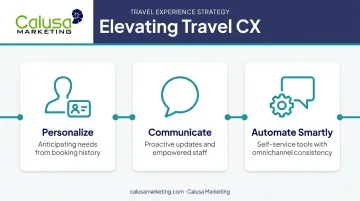
Improving travel CX comes down to three connected disciplines: knowing your customer, communicating well, and using technology to support (not replace) human judgment.
Personalize Every Touchpoint
Personalization in travel goes well beyond inserting a name into an itinerary. It means using booking history and stated preferences to anticipate what a traveler wants before they ask.
Practical examples include:
- Recommending excursions based on a past trip's activity level
- Offering a room upgrade to loyal guests without them requesting it
- Adjusting pre-trip emails based on whether someone is traveling for business or leisure
- Flagging dietary or accessibility needs across every provider in the journey, not just the one that collected the information
Brands that use customer data this way turn routine communications into moments that feel considered rather than automated.
Communicate Clearly and Empower Your Team
Proactive, transparent communication needs to happen at every stage, not just when something goes wrong. Booking confirmations, itinerary changes, and disruption updates all shape whether a traveler feels informed or left in the dark.
Response speed matters more than most companies assume. Zendesk's current benchmark guidance sets these as reasonable targets:
| Channel | Acceptable | Strong |
|---|---|---|
| Live chat | 1 minute or less | 40 seconds or less |
| Social media | 5 hours or less | 2 hours or less |
| 12 hours or less | 4 hours or less |
Source: Zendesk, First Reply Time Guide
Hitting these targets requires empowered frontline staff, agents with the authority to issue a refund, rebook a flight, or offer a credit without escalating to a supervisor. Every escalation adds friction, and friction is what travelers remember.
Use Technology and Automation Without Losing the Human Touch
Self-service tools, automated check-in, booking-change portals, and FAQ bots handle simple requests quickly, freeing up agents for complex issues that actually need a human. A traveler rebooking a delayed connection through a mobile app, for example, gets resolved in minutes instead of waiting on hold.
The key is omnichannel consistency. When a traveler moves from the app to a phone call to an in-person desk, their context should follow them. Nobody wants to repeat their confirmation number three times to three different people. Achieving this means the technology and the human team draw from the same information, not separate systems that force travelers to start over.
How Travel Incentives and Loyalty Rewards Elevate the Travel CX
Loyalty and incentive programs are one of the most tangible ways travel and travel-adjacent companies can reward good experiences and convert them into lasting relationships. But owning a loyalty program and actually using it well are two different things.
Many brands still struggle to translate the data they collect into rewards that feel personal. Offering a real travel reward (a resort stay, a cruise, a vacation package) builds stronger emotional loyalty than generic points or discounts.
It gives customers something aspirational to look forward to, not just a small transactional benefit.
This is where an experienced incentive partner matters. Calusa Marketing, a technology-based incentive marketing firm founded in 2015 and based in St. Petersburg, Florida, manages 1,000+ programs for 500,000+ members with a 99% client retention rate.
Its travel rewards, including hotel and cruise certificates and high-end individual or group trips, are fully transferable. Bookings, confirmations, and support are handled end-to-end by Calusa's team, with phone and email support available seven days a week.
Clients like Capital Vacations, Travel Resorts of America, InnSeason Resorts, AAA, and Travel+Leisure Co. use gift card and travel incentives to drive presentation attendance, new member acquisition, and retention, without building that fulfillment infrastructure themselves.
Why removing this operational burden matters for CX:
- Internal teams administering travel rewards without experience often hit booking delays, confirmation errors, or support gaps
- Those gaps undermine the very experience the reward program was meant to enhance
- A dedicated fulfillment team, like Calusa's, absorbs the logistics complexity of high-end travel so the client's staff can focus on their core business

A reward is only as good as the experience of redeeming it. A delayed confirmation email or an unreachable support line turns an aspirational trip into a source of frustration.
Real-World Examples of Travel Companies Getting CX Right
Cathay Pacific: Smarter Routing, Stronger Loyalty
Cathay Pacific implemented predictive routing that sends each customer contact to the next available adviser with the right skill set, rather than the next agent in a queue. Genesys reports this change delivered a 7x improvement in NPS relative to Cathay's baseline, along with more consistent service across the airline's global operation.
HotelTonight: Support Built for Speed
HotelTonight, an OTA built around last-minute hotel bookings, needed support that matched the urgency of its inventory. Moving to fully remote contact centers with real-time service-level visibility let the company deliver 24/7 support. New agents came online in under an hour, keeping pace with a business where "tonight" is a real deadline, not a figure of speech.
The common thread across both examples: anticipating needs and turning routine moments, a delay, a rebooking, a last-minute change, into reassurance instead of frustration. Neither company waited for a complaint to fix the experience; they built the system to prevent it in the first place.
Measuring Travel CX: Key Metrics That Matter
You can't improve what you don't measure. Three metrics form the backbone of most travel CX programs:
- Net Promoter Score (NPS): Measures likelihood to recommend on a 0-10 scale, scored as percent promoters minus percent detractors.
- Customer Satisfaction Score (CSAT): Captures satisfaction with a specific interaction, such as a booking call or check-in, measured as the percentage choosing the top two options on a five-point scale.
- Customer Effort Score (CES): Measures how much effort a customer expends completing a task or resolving an issue, typically on a five- or seven-point ease scale.
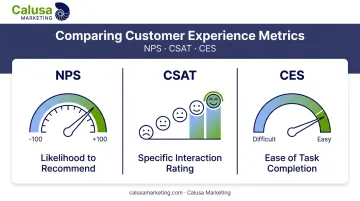
NPS respondents scoring 9-10 are promoters, 7-8 are passives, and 0-6 are detractors, producing a score between -100 and +100. It's the primary loyalty metric for gauging referral likelihood and repeat business.
Beyond these three, travel-specific signals worth tracking include:
- Online review ratings across major platforms
- Repeat booking rate
- Referral percentage among existing customers
Industry benchmarks vary widely by sector. Hotels tend to score higher on NPS than airlines or car rental companies, a useful reminder to compare your results against your own category, not travel as a whole.
Frequently Asked Questions
What are good customer experience examples?
Personalized upgrades, proactive disruption communication, fast agent response times, and travel rewards programs that turn satisfied customers into repeat bookers are all strong examples. The best ones anticipate needs before the customer has to ask.
What is CX in hospitality?
Hospitality CX covers every guest interaction, from the initial reservation through checkout and post-stay follow-up. It centers on comfort, personalization, and how well a brand recovers when something goes wrong.
How can travel companies measure customer experience success?
NPS, CSAT, and CES are the core measurement tools, supported by repeat booking rate and referral percentage. Together they show both immediate satisfaction and long-term loyalty trends.
What is the biggest driver of customer loyalty in travel?
A customer's previous experience with a brand is usually the strongest predictor of future loyalty, often outweighing price. A smooth past trip builds trust that a competitor's lower fare can't easily overcome.
How do travel incentive programs improve customer retention?
Travel rewards give customers an aspirational reason to stay engaged and return, especially when providers like Calusa Marketing handle fulfillment and support seamlessly. A resort stay or cruise feels more memorable than a small discount.
What does poor travel customer experience look like?
Unhelpful interactions, inconsistent communication across channels, and slow issue resolution are the clearest signs. Travelers notice when they have to repeat themselves or wait too long for a simple answer.