

Introduction
Your new hire in Manila starts their day as your HR manager in Chicago is finishing dinner. Your developer in Lisbon needs a tax form your US-based onboarding checklist has never heard of. This is the normal reality for most growing companies now.
Recent workforce data shows that among U.S. employees in remote-capable jobs, 52% work hybrid and 26% work fully remote, leaving just 22% on-site full time. Gallup's global hybrid work indicator confirms this shift isn't slowing down.
Generic onboarding checklists weren't built for this. They assume everyone shares a time zone, a legal system, and a first language. Once your team spans borders, those assumptions break down fast.
This guide walks through the frameworks and tactics that actually hold up for global and distributed teams: the 4 C's, the 30-60-90 day roadmap, and practical fixes for compliance, culture, and connection gaps.
Key Takeaways
- Compliance, culture, and communication cadence must be localized for every hire's location
- The 4 C's—Compliance, Clarification, Culture, Connection—paired with a 30-60-90 day roadmap end onboarding chaos
- Milestone recognition matters most for remote hires who never get an in-person handshake
- Region-segmented metrics reveal onboarding gaps a single global dashboard will always hide
Why Global Team Onboarding Needs a Different Playbook
A single live orientation call sounds simple until you try scheduling it across eight time zones. Someone always joins at 6 a.m. or stays up past midnight. That's why global onboarding has to be async-first by design, not as an afterthought.
Recorded sessions, shared documents, and project boards need to carry the same weight as live meetings. Otherwise, whichever region gets stuck with the worst meeting times will disengage first.
Compliance Isn't One-Size-Fits-All
Paperwork requirements shift dramatically by country:
- United States — Employers must complete Form I-9 for every hire, plus federal withholding paperwork
- Canada — New hires complete Form TD1, the Personal Tax Credits Return
- United Kingdom — Employees without a P45 use HMRC's starter checklist to set their PAYE tax code
Data privacy adds another layer: under GDPR, organizations handling EU employee data must collect only what's necessary, secure it properly, and support employee data rights.
If a breach occurs, supervisory authorities generally must be notified within 72 hours. Miss that window, and you're looking at regulatory exposure on top of a security problem.
The takeaway: a single onboarding checklist can't serve every jurisdiction; it needs country-specific branches built in from day one.
The 4 C's of Effective Onboarding for Global Teams
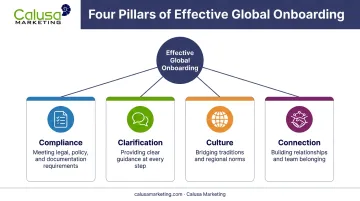
Talya Bauer's SHRM Foundation research identified four elements that separate strong onboarding from the passive, sink-or-swim kind. For global teams, each one requires extra intention.
Compliance
This goes beyond paperwork. It means adapting tax documentation, employment contracts, and data privacy practices to each employee's country of residence. What satisfies a US audit won't satisfy an EU one, and vice versa.
Clarification
When language and cultural context vary, vague expectations become a real risk. Role definitions, goals, and success metrics need to be written down, not just discussed on a call. Verbal explanations can get lost to accent or translation gaps.
Culture
Culture shouldn't be a headquarters export. Instead of forcing every new hire into the exact rituals of the home office, introduce company values in ways that respect local communication styles and customs. Feedback might be direct in one region and more indirect in another.
Connection
Relationships don't form automatically across time zones. Structured buddy systems, recorded leadership intros, and async spaces like dedicated Slack channels give new hires a way to build a network even without shared office hours.
Best Practices for Onboarding Global and Distributed Teams
Frameworks only work if the daily execution supports them. Here's what that looks like in practice:
- Start preboarding 1-2 weeks early. Send digital welcome kits, localized documents, and pre-provisioned tech access so no one loses day one to IT setup
- Localize training content by language and region while keeping core company messaging consistent everywhere
- Assign time-zone-matched mentors or buddies so every new hire has a same-hours contact for questions
- Record key onboarding sessions and rotate live meeting times so no single region always sacrifices early mornings or late nights
- Mix async tools with live video calls — shared docs, project boards, Slack threads, and Loom recordings respect varying work hours better than mandatory synchronous meetings
- Build a virtual social integration plan with cross-region team activities and recognition tools, so distributed hires feel like part of one team
That last point matters more than it might seem.
Isolation is one of the fastest ways to lose a remote hire before they've even hit their 90-day mark.
The 30-60-90 Day Onboarding Framework for Global New Hires
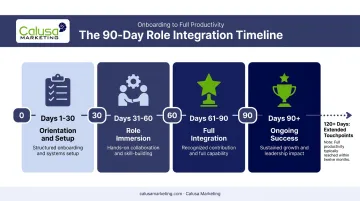
Without daily in-person oversight, global hires need clear checkpoints to know they're on track. A 30-60-90 day roadmap solves this, breaking onboarding into three sequential 30-day increments, a model Harvard Business School uses to frame the process.
Days 1-30: Orientation and Setup
Focus here stays practical:
- Complete compliance paperwork specific to the hire's country
- Confirm tool and system access
- Facilitate initial team introductions
- Deliver one small early win to build confidence
Days 31-60: Role Immersion
The hire moves from learning to contributing:
- Deepen cross-team collaboration on real projects
- Hold a time-zone-adjusted manager check-in (not scheduled at the manager's convenience alone)
- Clarify performance expectations in writing
Days 61-90: Full Integration
This phase brings a comprehensive engagement check-in, a career development conversation, and milestone recognition. Recognition is the piece most likely to get overlooked when teams are spread across time zones.
For distributed hires, tangible recognition replaces the in-person lunch or handshake a co-located employee would get. Digital gift cards and points-based reward platforms fill that gap well.
Calusa Marketing's ANY-Card program, for example, offers over 100 digital gift card options, including international selections and VISA cash-alternative cards, delivered entirely digitally with no shipping delays. The platform reaches over 100 countries in 20 languages and includes bilingual, 7-day support, useful when a new hire's redemption question comes in outside your HR team's business hours.
Don't stop at day 90. Bauer's SHRM Foundation research recommends milestones extending to 120 days and beyond, citing companies like Microsoft that maintain six- and twelve-month touchpoints. Gallup research shows it takes 12 or more months for most people to reach full productivity, so check-ins should outlast the standard 90-day window.
Common Challenges and Measuring Success in Global Onboarding
Common Challenges
Three problems surface repeatedly in global onboarding programs:
- Multi-country compliance complexity: Partner with legal counsel, an EOR, or a PEO where you lack local HR infrastructure. An EOR becomes the legal employer for compliance; a PEO handles administration via co-employment.
- Isolation among remote or international hires: Combat this with proactive daily or weekly check-ins during the first few weeks, not just the scheduled 30/60/90 milestones.
- Cultural and language gaps: Train managers on cultural competency and provide translation support for key documents so nothing critical gets lost in interpretation.
Measuring Success
You can't fix what you don't measure by region. Track these:
| Metric | Why It Matters |
|---|---|
| Retention and time-to-productivity, segmented by region | Reveals which locations underperform the global average |
| Pulse surveys at 30/60/90 days, translated locally | Captures accurate feedback instead of guesswork |
| Engagement scores by region or remote-vs-hybrid status | Flags disparities before they show up in turnover |
Manager involvement isn't optional either. Gallup's onboarding research found employees were 3.4 times as likely to rate their onboarding successful when managers stayed actively engaged throughout. For distributed teams, that engagement has to be deliberate — it won't happen through hallway conversations that don't exist.
Frequently Asked Questions
What is the 30-60-90 onboarding rule?
It's a milestone-based roadmap breaking the first 90 days into orientation, role immersion, and full integration phases. This structure gives global hires clear checkpoints despite lacking the daily in-person oversight a co-located employee would have.
What are the 5 pillars of onboarding?
Some practitioners extend Bauer's original framework by adding "check-ins/feedback" as a fifth pillar alongside compliance, clarification, culture, and connection. There's no single universal standard, so treat this as a practical extension rather than a fixed rule.
What are the 4 C's of effective onboarding?
Compliance, Clarification, Culture, and Connection, developed by researcher Talya Bauer for the SHRM Foundation. Together they form the foundational framework this guide builds on.
How long should onboarding last for global or remote employees?
While the first 90 days are critical, extending structured touchpoints through the first year improves outcomes for globally distributed hires, since most people need 12 or more months to reach full productivity.
What tools help simplify onboarding for distributed teams?
Digital onboarding platforms, HRIS and payroll systems built for multi-country compliance, and async communication tools like shared docs and recorded video all reduce friction across time zones.
How can companies build connection with remote and international new hires?
Virtual buddy systems matched to time zone, regular video check-ins, and milestone recognition tools (including digital gift cards delivered internationally) replace the in-person gestures distance makes impossible.