Many executives sense engagement matters. Few can draw a clean line from a survey score to a dollar figure on the P&L. That gap creates real risk: budgets get cut from engagement initiatives precisely when the business case is strongest.
This article breaks down the data behind that business case, the factors that actually move engagement scores, and practical strategies — including structured recognition and incentive programs — that companies can deploy without a massive internal lift.
Key Takeaways
- Top-quartile engagement yields 23% higher profitability and 18% higher sales productivity
- Replacing disengaged employees costs 0.5x to 2x annual salary in turnover and lost output
- Managers account for at least 70% of the variance in team engagement scores
- Annual surveys alone miss problems; pulse checks catch issues before they hit performance
- Structured recognition programs remain one of the fastest, most measurable ways to lift engagement
What Is Employee Engagement?
Employee engagement is the emotional commitment and discretionary effort a person brings to their work. It's the difference between an employee who does the job and one who actively looks for ways to improve it, speak up in meetings, and stay late when a deadline matters.
That's a different concept than simple job satisfaction, and the distinction matters more than most leadership teams realize.
Employee Engagement vs. Employee Satisfaction
Satisfaction measures personal happiness:
- Am I paid fairly?
- Do I like my coworkers?
- Is my chair comfortable?
Engagement measures something else entirely: whether an employee feels connected to outcomes and organizational goals.
A satisfied-but-disengaged employee is a familiar type. They like their job, feel no pressure, and coast comfortably without contributing much beyond the minimum. Nothing is wrong on the surface. Nothing is exceptional either.
Both metrics matter, but engagement is the stronger predictor of business performance. It's the one that shows up in revenue numbers, not just exit-survey comments.
The Impact of Employee Engagement on Business Performance
Engagement is a measurable performance driver, not an abstract culture concept.Engagement is a measurable performance driver with substantial research behind it. Gallup's 11th-edition Q12 meta-analysis, covering 736 studies and over 3.3 million employees across 90 countries, is the largest dataset available on this relationship, and its findings are hard to dismiss.
Productivity and Profitability
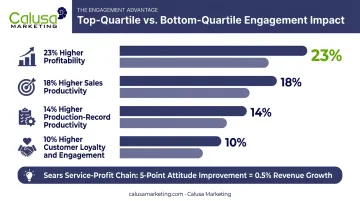
Comparing top- to bottom-engagement-quartile business units, Gallup's meta-analysis found:
- 23% higher profitability
- 18% higher sales productivity
- 14% higher productivity based on production records and evaluations
The mechanism behind those numbers isn't mysterious. Engaged employees give discretionary effort: the extra 10% nobody asks for but everyone benefits from. They make fewer errors because they're paying attention, not going through motions. They execute faster because they aren't second-guessing whether the work matters.
Customer Satisfaction and Retention
The same meta-analysis found 10% higher customer loyalty and engagement in top-quartile units. This lines up with the service-profit chain framework, first documented through companies like Sears: internal service quality shapes employee attitudes, employee attitudes shape customer impressions, and customer impressions drive revenue.
Sears' own model found that a 5-point improvement in employee attitudes correlated with a 1.3-point improvement in customer impressions, translating to a 0.5% revenue growth increase. Small movements in engagement ripple outward into measurable customer outcomes.
Employee Retention and Turnover Costs
Replacing an employee typically costs 0.5x to 2x their annual salary, once recruiting, onboarding, and lost productivity are factored in. Engaged employees are far less likely to walk out the door and take that cost with them.
This hits certain industries especially hard. Call centers, distribution, and media (three verticals Calusa Marketing serves directly) tend to run tighter margins on labor, absorbing turnover costs more painfully than most.
A contact center losing agents every few months loses more than backfilled seats: institutional knowledge, retraining costs, and service quality erode all at once.
Key Factors That Drive Employee Engagement
Ask any HR leader what drives engagement and you'll get a laundry list. The research narrows it down to five factors that consistently move the needle:
- Manager quality: direct supervisors, more than any other single factor, shape team-level engagement
- Recognition and rewards: timely, specific appreciation for real contributions
- Growth and development: training, mentorship, and visible career pathing
- Communication of mission and purpose: employees understanding how their role connects to something bigger
- Wellbeing and work-life balance: flexible scheduling and genuine mental health support
Why Managers Carry Outsized Weight
Gallup research attributes at least 70% of the variance in engagement scores across business units to management quality. That's not a typo. Two teams in the same company, doing similar work, can have wildly different engagement levels based purely on who's running the room.
Gallup's follow-up work on manager development found that participating managers improved their own engagement by up to 22%, while their teams saw up to 18% higher engagement and 21%-28% less turnover. Manager training delivers outsized returns compared to most other engagement investments.
Recognition, Growth, Purpose, and Wellbeing
Recognition quality separates engaged workforces from disengaged ones. Employees who feel appreciated for specific contributions (not generic praise) show measurably higher commitment.
Growth opportunities, clear mission communication, and genuine wellbeing support round out the list. Employees who strongly agree their organization cares about their overall wellbeing are 4.4x as likely to be engaged and 73% less likely to report frequent burnout, according to Gallup's workplace wellbeing research.
How to Measure Employee Engagement
Measurement has to come before strategy. You can't fix what you haven't quantified, and guessing at engagement levels wastes budget on solutions to problems that may not exist.
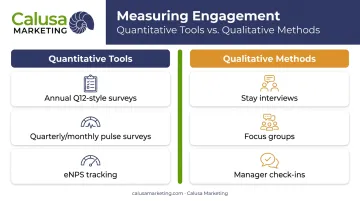
Quantitative tools:
- Annual comprehensive surveys using structured frameworks (Q12-style assessments are the industry standard)
- Pulse surveys run quarterly or monthly to catch emerging issues between annual cycles
- eNPS (Employee Net Promoter Score) tracking to monitor advocacy trends between full survey cycles
Qualitative methods:
- Stay interviews with current employees to understand what keeps them, not just why people leave
- Focus groups for context numbers alone can't capture
- Regular manager check-ins that surface problems before they show up in survey data
Here's the catch: measuring without acting can do real damage. Gallup found that only 8% of employees strongly agree their organization acts on survey results. Asking the same question year after year with no visible change tells employees their feedback doesn't matter, which erodes trust faster than not asking at all.
Strategies to Improve Employee Engagement
Improving engagement requires a closed loop: measure, act, re-measure. Generic gestures (a pizza party, a mass email about "valuing our team") without follow-through tend to backfire, since they signal effort without substance.
Invest in Manager Coaching
Managers shape day-to-day engagement more than any single perk or policy, which is why coaching investment often pays off faster than almost any other lever. Teach managers to run regular one-on-ones, deliver specific feedback tied to real examples, and act on the engagement data their own teams generate. A manager who reviews survey results and changes one thing, even something as small as meeting cadence, signals more than a company-wide memo ever could.
Build Structured Recognition Programs
One-off gestures don't stick. Recognition tied to specific behaviors and milestones does. Gallup's retention research found that well-recognized employees were 45% less likely to have changed employers two years later, and recognition hitting most quality markers was linked to 9x higher engagement odds compared to recognition that missed the mark entirely.
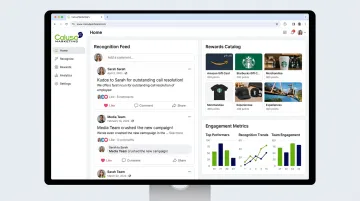
This is where a platform like Calusa Marketing's cloud-based SaaS reward and recognition system becomes practical rather than theoretical. Instead of building a recognition infrastructure from scratch, companies deploy a configurable platform designed to operationalize appreciation, sales incentives, and retention rewards without heavy internal lift.
A few specifics worth knowing:
- Programs typically launch in under one week, with no IT integration and no app download required for employees
- Clients like Alorica and Inktel, both call center operations, have used Calusa's platform specifically for agent recruitment, retention, and KPI-based rewards
- Postmedia, a media company, layered employee incentives into a broader program alongside subscriber acquisition rewards
- Support runs seven days a week, so HR teams aren't fielding redemption questions on top of everything else
Calusa's track record (1,000+ programs, 500,000+ members, and a 99% client retention rate) reflects a platform built for organizations that need recognition infrastructure fast, not a multi-quarter IT project.
Add Growth Pathing and Purpose
Recognition solves the short-term motivation problem. Growth opportunities and purpose communication solve the long-term one. Clear career pathing, mentorship access, and regular reminders of how a role connects to company goals should be built into everyday operations, not saved for an annual town hall.
Frequently Asked Questions
What are the key factors of employee engagement?
Manager quality, recognition, growth opportunities, communication of mission and purpose, and wellbeing support are the five factors research consistently ties to engagement. Manager quality alone accounts for the majority of the variance between teams.
How does employee engagement impact profitability?
Engaged employees give more discretionary effort, make fewer errors, and deliver better customer experiences. Gallup's research found top-quartile engaged units show 23% higher profitability than bottom-quartile units.
What is the difference between employee engagement and employee satisfaction?
Satisfaction reflects personal happiness with the job. Engagement reflects commitment to outcomes and organizational goals. A satisfied employee can still be disengaged and contribute minimal discretionary effort.
How often should companies measure employee engagement?
Run a comprehensive annual survey alongside quarterly or monthly pulse checks. Relying on a single annual check-in misses problems that could have been addressed months earlier.
What role do rewards and recognition play in employee engagement?
Timely, specific recognition is one of the most consistent and cost-effective engagement drivers in retention studies. Well-recognized employees are far less likely to leave within two years.
Can small and mid-sized businesses benefit from formal employee engagement programs?
Yes. Right-sized, turnkey platforms like Calusa Marketing's cloud-based SaaS reward system let smaller businesses deploy the same recognition and retention infrastructure larger enterprises use, without the internal overhead required to build one from scratch.