That confusion has a cost. Picking the wrong approach, or ignoring one entirely, can drain your marketing budget without moving the metrics that matter: retention, average spend, and referrals. The global loyalty management market alone is projected to grow from $12.89 billion in 2025 to $20.36 billion by 2030, a 9.6% compound annual growth rate, so the stakes for getting this right are only rising.
This article breaks down what separates loyalty from engagement, where each works best, and why the strongest customer retention strategies rarely pick just one.
Key Takeaways
- Loyalty programs reward repeat purchases via points, tiers, and punch cards.
- Engagement programs build emotional connection through personalization and dialogue.
- Combining both approaches outperforms running them separately.
- The right mix depends on purchase frequency, business model, and goals.
- A single platform supporting both approaches simplifies execution and management.
Loyalty vs. Engagement: Quick Comparison
Before going deeper, here's how the two strategies stack up side by side:
| Factor | Loyalty Programs | Engagement Programs |
|---|---|---|
| Primary Goal | Drive purchase frequency and volume | Build emotional connection and advocacy |
| Core Mechanics | Points, tiers, punch cards, discounts | Personalization, gamification, two-way communication |
| Metrics Tracked | Redemption rate, repeat purchase rate, average order value | Interaction rate, sentiment, referral/advocacy rate |
| Time Horizon | Short-to-mid term transactional wins | Long-term relationship building |
| Best Fit For | High-frequency businesses (retail, distribution, travel) | Infrequent-purchase or relationship-driven businesses (media, donation centers, home services) |
Neither column is inherently better. The right fit depends entirely on how often customers interact with your brand and what you're trying to accomplish.
What Is a Customer Loyalty Program?
A customer loyalty program rewards repeat purchasing behavior directly. Buy more, earn more. It's a transactional exchange, and that's exactly the point.
Loyalty programs matter because they create predictable, repeat revenue. McKinsey research found that top-performing programs can increase annual revenue from customers who redeem points by 15% to 25%, driven by higher purchase frequency, larger basket sizes, or both.
That's a meaningful lift, but it applies specifically to top-performing programs and active redeemers, not every loyalty initiative on the market.
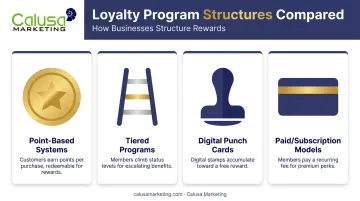
Common loyalty program structures include:
- Point-based systems where customers accumulate points redeemable for products or discounts
- Tiered programs that unlock better perks as customers spend more (think silver, gold, platinum)
- Digital punch cards that reward the Nth purchase with a free item or discount
- Paid/subscription loyalty models where customers pay upfront for enhanced benefits
Use Cases of Loyalty Programs
Loyalty mechanics shine in businesses with frequent, repeatable purchases. If a customer buys from you weekly or monthly, points and tiers give them a reason to keep choosing your brand over a competitor.
Industries where loyalty dominates:
- Airlines, through frequent flyer miles that reward every booking
- HVAC, electrical, and tire distributors, rewarding repeat contractor or dealer purchases
- Jewelry retailers, where tiered rewards encourage return visits for gifting occasions
Calusa Marketing has seen this play out firsthand with distribution clients like Johnstone Supply, an HVAC/R parts distributor. The company needed to push customers toward online ordering while also making sure those customers understood the products they were buying.
A points-based loyalty program solved both problems at once: it rewarded digital purchasing behavior while delivering ongoing product education, tying incremental sales directly to a measurable rewards mechanic.
What Is a Customer Engagement Program?
Customer engagement programs work differently. Instead of rewarding a transaction, they build an emotional connection that exists independent of any single purchase.
This distinction matters because engagement drives outcomes that loyalty mechanics alone can't reach: reduced churn, stronger brand advocacy, and richer first-party data.
McKinsey's personalization research found that 78% of consumers said personalized communications made them more likely to repurchase, and the same share said it made them more likely to recommend a brand to friends and family. That's advocacy driven by connection, not discounts.
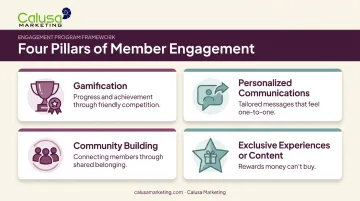
Engagement programs typically include:
- Gamification, such as challenges, badges, or progress tracking
- Personalized communications tailored to individual preferences and behavior
- Community building, including forums, member events, or exclusive groups
- Exclusive experiences or content unavailable to non-members
Use Cases of Engagement Programs
Engagement fits best where purchases are infrequent or where the relationship itself is the product. A newspaper subscriber doesn't "purchase" daily. A blood donor gives a handful of times a year. Loyalty points alone won't sustain those relationships.
Industries where engagement leads:
- Media and broadcasting companies, engaging readers and listeners between purchase moments
- Blood and plasma donation centers, nurturing repeat donor relationships without a transactional hook
- Timeshare and vacation ownership companies, building member communities around infrequent, high-value decisions
The American Press Institute found that 86.3% of surveyed publishers rated welcoming, engaging, and onboarding new subscribers as having fairly high or greater potential value for retention.
Calusa Marketing saw this firsthand with a Denver Post subscriber gift card fulfillment program. What started as a friction-heavy process, generating complaints and callbacks, was rebuilt into a smooth experience through better fulfillment management and responsive support, turning a transactional reward into a genuine source of subscriber goodwill.
Choosing the Right Approach: Loyalty, Engagement, or Both?
Deciding between loyalty and engagement (or both) comes down to four factors:
- Business model - Is your relationship transactional or ongoing?
- Purchase frequency - Do customers buy weekly, or once every few years?
- Budget - Can you support both mechanics, or does one need to come first?
- Desired outcome - Are you chasing near-term sales lift or long-term advocacy?
Situational Recommendations
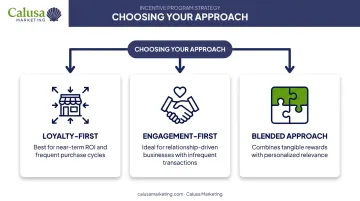
- Choose loyalty-first if you need measurable, near-term ROI from purchase frequency, such as a retail chain or distributor pushing repeat orders.
- Choose engagement-first if you're in an infrequent-transaction business like home improvement or donor centers, where the relationship matters more than any single sale.
- Choose blended if you want both. A 2024 EY loyalty study found that 73% of consumers rated the ability to choose their own rewards as very important. This shows shoppers want tangible value and personalized relevance in the same program, not one or the other.
Real-World Example: Blending Loyalty & Engagement in Practice
Combining both approaches is easier when they run on one system instead of two disconnected tools. Calusa Marketing's cloud-based platform pairs loyalty mechanics, like digital punch cards and ANY-Card gift card rewards, with engagement tactics such as gamification, personalized fulfillment, and travel incentives. No app download. No integration required.
That combination has supported Calusa Marketing's work managing 1,000+ programs and 500,000+ members, sustained by a 99% client retention rate across distribution, media, and travel clients.
Consider the distributor challenge above: Johnstone Supply needed both channel migration (loyalty) and product knowledge (engagement). A points program alone would have driven orders without improving competency. Layering education into the rewards structure addressed both goals in a single system.
Takeaway: if your business faces a similar dual challenge, a purely transactional or purely relational program will leave value on the table. Blending the two, on one platform, tends to close that gap.
If you're weighing your own mix of loyalty and engagement tactics, talking with an incentive marketing partner can help you design a program suited to your specific goals.
Conclusion
Loyalty and engagement solve different parts of the customer relationship rather than competing for the same budget. Loyalty rewards the transaction. Engagement builds the reason customers keep coming back to make that transaction in the first place.
Businesses that integrate both approaches consistently outperform those relying on either alone, seeing stronger retention and higher spend per customer, with more brand advocates willing to refer others. What matters is combining them in a way that fits your customers' purchase frequency, your budget, and the relationship you want to build. Calusa Marketing's SaaS-based loyalty and engagement platforms make that integration straightforward, giving clients the tools to run both without added operational strain.
Frequently Asked Questions
What is loyalty engagement?
Loyalty engagement describes the combined strategy of rewarding repeat purchasing behavior while also building an emotional, ongoing connection with customers. It blends transactional incentives with relationship-building tactics.
What are the 5 stages of customer engagement?
Most frameworks describe five customer journey stages: awareness, consideration, decision, retention, and advocacy. Each stage calls for different tactics, from brand discovery content early on to referral incentives at the end.
What are the 5 C's of customer engagement?
There's no single, universally standardized "5 C's of customer engagement" framework. Some marketers reference consistency, continuity, context, content, and creativity, terms more formally tied to customer communications strategy than engagement specifically.
What's the difference between a loyalty program and a rewards program?
Many marketers use "rewards program" as a subset or synonym of loyalty programs, focusing specifically on the points-and-redemption mechanic. "Loyalty program" typically describes the broader strategy built around that mechanic.
Can a business run both loyalty and engagement programs at the same time?
Yes, and the strongest customer retention strategies typically do. Running both on a single platform, rather than separate disconnected tools, makes the combined approach far easier to manage.
How do you measure the success of a customer loyalty program?
Track redemption rate, repeat purchase rate, member retention rate, and incremental spend per member. These metrics show whether the program is actually changing purchasing behavior, not just accumulating signups.