

Introduction
Short-term incentive (STI) plans used to be an executive-only perk. Not anymore.
Today, sales reps, distributors, support teams, and even hourly frontline staff participate in structured variable pay programs. STI plans now show up in 99% of public companies and 92% of private companies, according to WorldatWork's Incentive Pay Practices 2025 survey of 706 organizations.
The problem? Many companies just copy a generic bonus template. No clear metrics, no fair payout curve, no meaningful reward at the end. The result is a plan that pays out but doesn't motivate.
This article breaks down what STI plans actually are and the design decisions that matter most. It also covers the common structures companies use and how pairing a formal plan with flexible rewards can extend motivation further into your organization.
Key Takeaways
- STI plans reward performance within a year, unlike discretionary bonuses, commissions, or long-term incentives (LTI)
- Four decisions drive effective design: eligibility, bonus size, performance metrics, and payout curve structure
- Three STI structures dominate: balanced scorecards, profit sharing, and discretionary bonuses, each with real trade-offs
- Non-cash rewards layered onto a formal STI framework extend motivation beyond the traditional bonus tier
What Is a Short-Term Incentive Plan?
An STI plan is a formal, structured variable pay program tied to performance goals set at the start of a cycle, usually one year or less. Unlike a discretionary bonus, it's built on predetermined results, not after-the-fact judgment calls.
Most STI plans pay in cash. Some incorporate equity or other compensation, but cash remains the standard vehicle.
Payment frequency matters, too. According to WorldatWork's research, once-per-year payouts are the norm: 83% of public, 85% of private, and 88% of nonprofit organizations pay annually. Quarterly and monthly cycles exist, but they're the exception, not the rule.
What's changed is who's eligible: STI plans once lived exclusively in the C-suite. Now they stretch into sales, support, and hourly roles, part of a broader shift toward pay-for-performance culture across the workforce.
How STI Compares to Bonuses, Commissions, and LTI
Is an STI plan just a bonus? Not exactly, since "bonus" is the umbrella term. An STI plan is a structured bonus program with defined eligibility, targets, and formulas. A discretionary bonus, by contrast, skips the formula entirely: management decides the pool and the payouts after the year ends.
Commission plans differ too, tied directly to individual sales activity on an ongoing basis rather than annual company or team goals.
LTI plans operate on a completely different timeline: multi-year vesting, typically equity-based, and generally reserved for senior leadership.
Here's how the four stack up:
| Pay Type | How It's Earned | Who's Eligible | When/How Paid |
|---|---|---|---|
| STI | Predetermined formula tied to annual goals | Broad, from hourly to executive | Cash, typically annual |
| Commission | Individual sales production | Sales roles | Ongoing, per transaction or quota |
| Discretionary Bonus | Management judgment after the period | Varies, often broad | Cash, no fixed schedule |
| LTI | Multi-year performance or value creation | Senior leadership | Equity, vests over years |
Key Design Considerations for STI Plan Design
Getting an STI plan right comes down to a handful of decisions. Get these wrong, and even a well-intentioned plan falls flat.
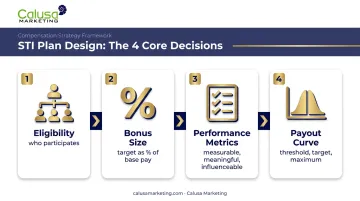
Eligibility. Who participates? Broader eligibility, extending the plan to mid-level and frontline roles, drives motivation deeper into the organization but adds complexity. Every additional tier means more communication, more tracking, and more room for confusion.
Bonus size. Target percentages scale by level. WorldatWork's data shows median targets ranging from 5% of base pay for hourly workers to 100% for CEOs, with executives and managers landing somewhere in between depending on whether the company is public or private. Benchmark against market data for your specific job categories rather than assuming a flat percentage across levels.
Choosing the Right Metrics
Good metrics share three traits, per SHRM: they're measurable, meaningful, and influenceable by the person being measured. A frontline rep shouldn't be scored on company-wide EBITDA they can't move.
Common metric types include:
- Financial: Revenue, EBITDA, profit margin
- Operational: Quality scores, on-time delivery, customer satisfaction
- Individual: Personal goals tied to role-specific outcomes
WorldatWork's sales compensation guidance recommends capping sales plans at three or fewer measures. More than that, and line of sight gets muddy fast.
Target setting. Targets should be rigorous yet achievable, anchored to the annual operating plan and adjusted for business cycles or growth stage. A target that's too easy breeds complacency; one that's unreachable kills motivation before the year even starts.
Payout Mechanics: Threshold, Target, and Maximum
Most STI plans use a three-point curve to build in differentiation between average and exceptional performance:
| Performance Level | Typical Payout (% of Target) | Frequency of Achievement |
|---|---|---|
| Threshold | 25%–50% | 85%–90% |
| Target | 100% | 55% |
| Maximum | 150%–200% | 6%–20% |
This benchmark comes from WTW's 10-year analysis of S&P 1500 CEO payouts. It's executive-level data, so don't force it onto every broad-based plan, but the logic applies universally: threshold should feel attainable, target should feel like a real stretch, and maximum should be genuinely rare.
Stability vs. variability. How much discretion should leaders apply on top of the formula? Some is fine. Too much, and participants stop trusting the math altogether.
Common STI Plan Structures & Examples
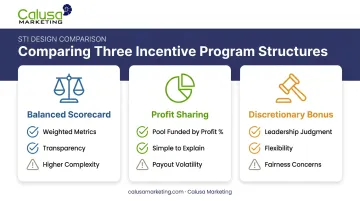
Three structures dominate the STI landscape, each with distinct trade-offs.
Balanced scorecard. Weighted financial, operational, and individual metrics combine into a single payout score. Participants can see exactly how their score was built, which builds transparency. The trade-off: more measures mean more administrative complexity and harder-to-calibrate targets.
Profit sharing. A bonus pool gets funded from a percentage of profit or cash flow, then distributed among participants. It's simple to explain and easy to administer. The risk shows up in lean years, when profit dips and payouts swing hard, sometimes to zero.
Discretionary bonus. Boards or owners use holistic judgment instead of a strict formula. This offers flexibility when formulas miss context, but it comes at a cost. In private-company benchmarking research, respondents flagged communication of rationale (66%), perception of fairness (63%), and consistency across the organization (59%) as the top weaknesses of discretion-heavy plans.
Two additional structures worth calling out:
- Team/group incentive plans: Collaborative goals give teams a rallying point, but poorly designed group targets can create inequity if one team's goals are easier to hit than another's
- Individual bonus plans: Personal objectives combine with company or business-unit results, driving strong accountability, though typically at a higher administrative cost. Private-company plans average around four individual goals per participant, according to the same benchmarking research
Beyond Cash: Strengthening STI Plans with Rewards & Recognition
A formal STI plan covers the bonus-eligible population. But what about everyone else, the frontline sales rep, the support agent, the distributor who influences results but never sees a formula-driven payout?
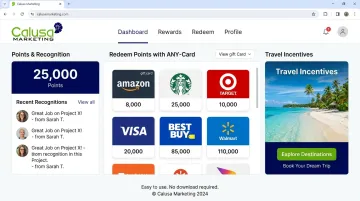
This is where non-cash rewards fill the gap. Gift cards, merchandise, and travel incentives layered alongside a formal STI structure extend motivation to people outside the traditional bonus tiers.
At Calusa Marketing, we build these programs through cloud-based reward platforms that don't require app downloads or IT integration. That matters because the whole point of layering rewards is to reduce administrative friction, not add to it.
A few ways this plays out in practice:
- Points-based recognition for teams or individuals who fall short of formal bonus eligibility
- Flexible gift card options through our ANY-Card program, covering 100+ retail, dining, and entertainment brands
- Transferable travel incentives that top performers can redeem themselves or gift to family, no strings attached
That transferability point deserves a moment. When a travel certificate isn't locked to one person, it doesn't go to waste if the winner can't travel that quarter. They can pass it along, and the reward still lands.
Combined with group travel programs that scale from small teams to 10,000-person events, it gives companies a way to differentiate top performers without managing redemptions in-house.
Common Pitfalls to Avoid in STI Plan Design
Even well-designed plans break down over time. Watch for these three warning signs:
- Overreliance on discretion. A WTW pulse survey of 46 North American insurers found that more than 60% used discretion in STI scoring at least once between 2019 and 2023. The median upward adjustment was 25%, often with little formal governance in place, which erodes trust fast.
- Overly complex metrics. Piling on measures to capture every nuance of performance backfires. It obscures the plan's intent and leaves participants unsure what actually moves their payout.
- Poor calibration. A plan that pays out at or above target year after year signals that targets aren't rigorous enough. Target-level achievement should land around 55% of the time, not every time, so consistent overpayment should trigger a plan review.
Frequently Asked Questions
What is a short-term incentive plan?
An STI plan is a structured variable pay program tied to annual (or shorter) performance goals, typically paid in cash. It's built on defined eligibility, targets, and metrics rather than after-the-fact judgment.
What is an example of a short-term incentive plan?
A balanced scorecard bonus program is a common example, combining financial, operational, and individual metrics into one payout score. A team incentive plan, where a group shares a collective goal, is another.
Is a short-term incentive the same as a bonus?
Not exactly. STI is one form of structured bonus with formal rules and a predetermined formula. "Bonus" more broadly includes discretionary or spot awards that fall outside any formal plan.
What is the difference between STI and LTI?
STI covers performance periods of one year or less and is typically cash-based. LTI spans multiple years, is usually equity-based, and is generally reserved for senior leadership.
How is an STI target percentage typically determined?
Targets are set as a percentage of base pay and scaled by employee level, from around 5% for hourly workers up to 100% for CEOs. Companies benchmark these percentages against market data for comparable roles.
How often should a company review or redesign its STI plan?
Regular review is essential, checking targets and metrics against results at least once a year. A more substantial redesign usually happens when business strategy shifts or when payouts consistently miss the mark on calibration.