This scenario plays out daily across car dealerships, electrical supply houses, tire shops, and home improvement retailers. The confusion that follows is predictable: Is this a rebate? A bonus? Taxable income? Who's even supposed to get this money?
These payments are real, common, and legally distinct from anything else in a paycheck. This guide breaks down what manufacturer incentive payments actually are, how the money moves from manufacturer to recipient, the different program types you'll encounter, how the IRS treats them at tax time, and how businesses build these programs from scratch.
Key Takeaways
- A manufacturer's incentive payment (SPIFF) rewards dealers, distributors, or salespeople for selling specific products
- Unlike consumer rebates, this money goes to the seller, not the buyer
- These payments count as taxable "other income" but skip self-employment tax, FICA, and withholding
- Programs range from stair-step volume bonuses to training incentives and customer satisfaction bonuses
- Structured incentive programs drive measurable sales performance across nearly every distribution industry
What Is a Manufacturer's Incentive Payment?
A manufacturer's incentive payment is money a manufacturer pays, either directly or through a dealer or distributor, to reward salespeople or channel partners for selling, promoting, or hitting targets on specific products. Industry insiders often shorten this to SPIFF, generally understood as a Sales Performance Incentive Fund: a short-term reward tied to a defined sales goal.
These programs exist for one reason: manufacturers need to move targeted inventory, encourage reordering, and win market share against competitors. Nobody's doing anyone a favor here. It's a business tool.
Incentives vs. Rebates: Know the Difference
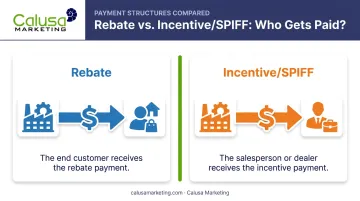
This is where most confusion starts. A rebate returns money to the customer after a purchase. A manufacturer incentive payment rewards the seller for making that sale happen in the first place. For instance, a $50 rebate lowers the buyer's out-of-pocket cost, while a $50 incentive payment goes straight to the salesperson who closed the deal.
| Payment Type | Money Flows |
|---|---|
| Rebate | Manufacturer → End customer |
| Incentive/SPIFF | Manufacturer → Salesperson, dealer, or distributor |
It's Not Just Cars
The classic example is a car dealership: a rep pushes a slow-moving model and pockets an extra $200 from the manufacturer. But the same mechanics run through HVAC, electrical, and tire distribution, where manufacturers pay reps directly to prioritize certain product lines over a competitor's.
Calusa Marketing works with distributors in exactly these spaces, including Hajoca, Johnstone Supply, and Baker Distributing, showing this practice extends well beyond auto sales floors.
The Legal Classification Matters
Under Rev. Rul. 70-337, bonuses a manufacturer pays to a dealer's sales employees, whether directly or through the dealer acting as the manufacturer's agent, count as payment for services rendered to the manufacturer. They are not wages from the employing dealer. That distinction matters enormously once you get to tax treatment.
How Manufacturer Incentive Payments Work & Who Receives Them
The typical flow looks like this: manufacturer sets a program → dealer or distributor administers it → salesperson or dealership receives the payout based on performance.
Who Actually Gets the Money?
There are three possible recipients, and the program type determines which one applies:
- The dealership or distributor — through dealer cash or holdback payments
- The individual salesperson — through direct SPIFF payments
- The end customer — occasionally, through a rebate structure
Payments usually trigger when someone hits a monthly or quarterly volume target, completes required manufacturer training or certification, or clears a customer satisfaction survey threshold. A regional HVAC distributor might set the bar at 15 units per month, while an electrical supplier could require a completed certification course before a rep sees a dime of their bonus.
The Stair-Step Mechanic, With Numbers
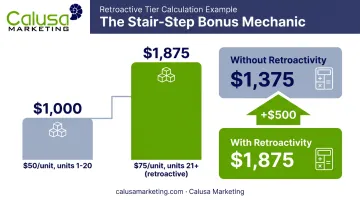
Volume-based programs often use a "stair-step" structure, where crossing a sales threshold retroactively bumps the bonus rate on every unit sold that period. Here's how it plays out:
- Tier 1: $50 per unit for units 1–20
- Tier 2: $75 per unit once reps cross 21+ units (applied retroactively to all units)
A rep who sells 25 units without retroactivity earns: (20 × $50) + (5 × $75) = $1,375.
With the retroactive stair-step applied: 25 × $75 = $1,875.
That's an extra $500 just for crossing the threshold, which is exactly why these programs push reps hard in the final days of a sales period. WardsAuto's reporting on stair-step incentive programs shows how missing a target by even one unit can eliminate the bonus tier entirely.
Different Industries, Different Channels
Auto dealer programs, HVAC/electrical distributor programs, and home improvement dealer programs don't all route money the same way. Some pay the dealership entity; others pay the individual rep directly. The channel structure decides who touches the money first.
Manufacturers fund these programs, but the day-to-day grind — tracking sales, calculating tiers, cutting checks — usually falls to the dealer, the distributor, or a third-party incentive management partner brought in specifically to handle it.
Types of Manufacturer Incentive Programs
Not every incentive program looks the same. Here's a rundown of the most common structures:
| Program Type | How It Works | Who Benefits |
|---|---|---|
| Volume/stair-step bonuses | Escalating per-unit payments once sales targets are hit, often retroactive | Dealer or distributor |
| CSI incentives | Payments tied to customer satisfaction survey scores | Dealership |
| Training/certification | Bonuses for completing manufacturer product training | Salesperson or dealer |
| Seasonal/conquest promotions | Limited-time bonuses, including rewards for competitor trade-ins | Salesperson |
| Holdback/floor plan assistance | Standing percentage payment regardless of volume | Dealership |
A few worth unpacking:
- Training and certification incentives motivate reps to learn the product instead of winging it on the sales floor. Daikin's contractor programs pair certification with SPIFF payments.
- Holdback provides a baseline profit cushion. Edmunds reports this typically runs 2% to 3% of MSRP or invoice, though the figure varies by manufacturer.
- Co-op and market development funds show up heavily in electrical distribution. A NAED study found 72% of manufacturers had formal co-op programs, typically allocated by sales volume.
Tax Treatment of Manufacturer Incentive Payments
Here's where a lot of recipients get tripped up. Manufacturer incentive payments are taxable, but they don't behave like a regular paycheck or a self-employment gig.
Reporting: Schedule 1, Not Schedule C
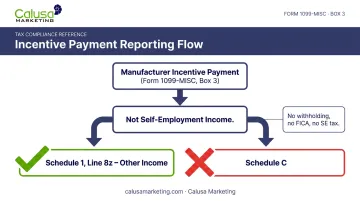
- Payments are generally issued on Form 1099-MISC, box 3, as "other income"
- They're not subject to federal income tax withholding, Social Security, Medicare, or unemployment tax
- IRS Publication 525 directs these payments to Schedule 1 (Form 1040), line 8z, as other income, not Schedule C
This distinction matters because it determines who's responsible for the tax bill. Since the manufacturer doesn't withhold anything, that responsibility lands squarely on the recipient come filing season.
Why it isn't self-employment income: A salesperson receiving a SPIFF check isn't running an independent trade or business by participating in the program. They're an employee of the dealer or distributor, just receiving a third-party payment from the manufacturer. That means:
- No self-employment tax applies
- The income doesn't belong on Schedule C
- Recipients still owe regular income tax on the amount
That employee classification doesn't mean the payments come tax-free, though. One catch worth flagging: under the Tax Cuts and Jobs Act, expenses incurred to earn the incentive (mileage, supplies, and similar costs) stopped being deductible starting in 2018 under §67(g).
That disallowance was set to expire after 2025, but 2025 legislation made it permanent. Don't expect to write off expenses tied to earning these payments going forward.
Designing an Effective Manufacturer Incentive Program
Ad hoc bonuses, a manager handing out a $50 check here and there, rarely move the needle the way a structured program does. Manufacturers and distributors that invest in professionally designed incentive programs see more consistent, measurable results from their channel partners.
A program that actually works needs a few things:
- Clear performance tiers participants understand without a spreadsheet tutorial
- Fast, accurate fulfillment so rewards show up when promised
- Simple point tracking and redemption that doesn't require a new app download
- Transparent reporting for both the sponsoring business and the people earning rewards
Calusa Marketing builds these programs around a straightforward framework:
- Define the behavior you want, whether that's more units sold, faster training completion, or a shift toward a preferred product line.
- Determine what that behavior is actually worth to the business.
- Identify exactly which reps or accounts can deliver it.
The program then runs on a cloud-based platform requiring no integration and no app download, with full-service fulfillment covering gift cards, merchandise, and travel rewards once someone earns them.
That last part matters more than it sounds. A manufacturer or distributor running a SPIFF program shouldn't need an IT project to launch it, and reps shouldn't need to install anything to redeem what they earned.
Frequently Asked Questions
What are manufacturer incentives?
Manufacturer incentives are payments from manufacturers to dealers, distributors, or individual salespeople to encourage the sale of specific products. Unlike rebates, this money never goes to the end customer.
Who gets the incentive money?
It depends on the program. Dealer cash and holdback stay with the dealership or distributor. Direct SPIFF payments go to the individual salesperson, while rebates occasionally reach the end customer.
Are manufacturer incentive payments taxable?
Yes, they're taxable as other income, reported on Schedule 1 of Form 1040. However, they're exempt from federal income tax withholding, Social Security, and Medicare taxes.
Is a SPIFF the same thing as a manufacturer's incentive payment?
Yes. SPIFF is just the common industry shorthand for a manufacturer's sales performance incentive payment, most often used at the individual salesperson level.
Do I owe self-employment tax on manufacturer incentive payments?
No. Recipients aren't considered independently engaged in a trade or business through these programs. As a result, self-employment tax doesn't apply, and the income shouldn't be reported on Schedule C.
How can a manufacturer or distributor set up an incentive program for its sales team?
Partnering with an experienced incentive marketing firm simplifies design, fulfillment, and ongoing management. Calusa Marketing, for example, works directly with manufacturers and distributors to build and launch these programs from the ground up.