Here's the uncomfortable part: pay raises alone rarely fix this. Employees leave jobs where they feel invisible, untrusted, or unappreciated — even when the paycheck looks fine on paper. Loyalty, not compensation, is the variable most companies get wrong.
This article breaks down what employee loyalty actually means, why the gap between engagement and commitment is widening, the root causes driving people out the door, and the strategies (including structured recognition programs) that measurably slow the exodus.
Key Takeaways
- Trust, recognition, and growth opportunities drive loyalty more than pay alone
- Turnover costs far more than a recruiting budget in lost knowledge and morale
- Combining financial and non-financial recognition consistently outperforms one-off perks
- Structured incentive programs turn good intentions into a measurable retention system
What Is Employee Loyalty and Why It Matters
Employee loyalty is different from job satisfaction or day-to-day engagement. Satisfaction measures how someone feels about their job right now. Engagement measures their enthusiasm and effort.
Loyalty measures whether they intend to stay, an emotional and behavioral commitment built over time, often described in organizational psychology as affective attachment to the company.
That distinction matters because loyal employees give something engagement surveys don't fully capture: discretionary effort.
Gallup's Q12 meta-analysis, spanning 736 studies and nearly 184,000 business units, found top-quartile teams outperform bottom-quartile teams by 23% in profitability and 18% in sales productivity.
The same research links stronger employee engagement to a 10% lift in customer loyalty, meaning how your team feels directly shapes how your customers behave.
The Loyalty Gap Is Widening
Median U.S. job tenure dropped to 3.9 years in 2024, down from 4.1 in 2022, the lowest mark since 2002, per the Bureau of Labor Statistics.
Private-sector tenure sits even lower, around 3.5 years. People simply aren't sticking around like they used to.
Why this costs more than most leaders assume:
- Recruiting and onboarding a replacement drains weeks of manager and HR time
- New hires take months to reach prior performance levels
- Institutional knowledge (the tacit know-how that isn't written down anywhere) leaves with the departing employee
- Remaining team members absorb the workload gap, often accelerating their own burnout
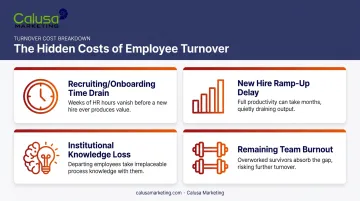
Ignoring these costs doesn't make them disappear. It just defers them to next quarter's budget.
Common Causes of Employee Turnover
Most resignations trace back to a handful of recurring issues, and they're rarely about the paycheck first.
The most frequent root causes:
- Lack of recognition — feeling like contributions go unnoticed
- Limited growth opportunities — no visible path forward
- Burnout and poor work-life balance — chronic overwork without relief
- Weak leadership communication — feeling out of the loop on decisions
- Uncompetitive pay — usually a factor, but rarely the whole story
A 2024 iHire survey of over 2,000 U.S. workers and employers found the top reasons employees cite for quitting are toxic environment (32.4%), poor leadership (30.3%), and manager dissatisfaction (27.7%). Culture issues outrank pay by a wide margin.
According to MIT Sloan's analysis of 34 million employee profiles and 1.4 million Glassdoor reviews, toxic culture proved 10.4 times more predictive of attrition than compensation. Failure to recognize good work showed up as one of the leading culture-related warning signs.
Different groups leave for different reasons, too. Gallup research shows millennials are far more likely than older colleagues to prioritize career development and remote flexibility, while a growing share of Gen Z workers say they'd leave for better mental health support.
That's exactly why reviewing exit interview data and running periodic engagement surveys matters: you can't fix a problem you haven't diagnosed. Catching these signals early, through stay interviews rather than exit interviews, costs far less than replacing the talent after the fact.
Proven Strategies to Build Employee Loyalty
Building loyalty requires a consistent, multi-pronged effort that touches communication, wellbeing, growth, pay, and recognition simultaneously. No single initiative accomplishes this alone.
Foster Open Communication and Trust
Regular one-on-ones, genuine open-door policies, and transparency around company decisions build the foundation. Employees who trust their organization's leaders are 61% more likely to stay and stop looking for other jobs, according to Gallup research on workplace trust.
Soliciting feedback through surveys or focus groups only builds trust if you visibly act on it. Asking without responding does more damage than not asking at all.
Prioritize Work-Life Balance and Wellbeing
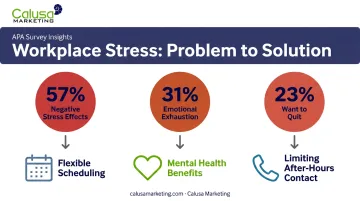
Burnout carries measurable costs. The APA's 2023 Work in America Survey found 57% of workers reported negative effects from work stress, including 31% experiencing emotional exhaustion and 23% actively wanting to quit because of it.
Practical levers that make a real difference:
- Flexible scheduling and hybrid or remote options
- Mental health benefits and access to counseling
- Limiting after-hours emails and calls
That last one matters more than most leaders realize. Respecting personal time signals genuine care, not just policy compliance.
Invest in Professional Development and Career Growth
LinkedIn's Workplace Learning Report found 94% of employees would stay at a company longer if it invested in their learning and development. That's one of the strongest stay-or-go statistics available.
Concrete tactics worth implementing:
- Mentorship pairings between junior and senior staff
- Tuition or certification reimbursement
- Internal mobility programs that prioritize existing talent
- Stretch assignments that build new skills before a promotion is even on the table
Ensure Fair, Competitive Compensation and Benefits
Compensation is foundational to retention decisions. In the iHire survey, 68.1% of employees ranked health insurance among their top reasons to stay, tied closely with work-life balance and just behind overall positive environment (83.4%).
Regular market benchmarking, using tools like Glassdoor or industry wage surveys, helps you catch pay gaps before they become resignation letters.
Recognize and Reward Contributions Consistently
This is the piece most companies underinvest in. Lack of appreciation is repeatedly cited as a leading reason employees quit, and MIT Sloan's research names failure to recognize performance as one of the strongest predictors of attrition.
The smartest organizations are shifting away from recognition being either all-cash or all-verbal praise. Blending financial rewards (bonuses, gift cards) with non-financial recognition (public praise, milestone celebrations) is proving far more effective than either alone. Structured platforms make this blend easy to manage: Calusa Marketing's cloud-based reward systems let companies combine gift cards, merchandise, and travel incentives into a single program without added IT overhead.
Why Structured Incentive and Recognition Programs Accelerate Loyalty
Ad hoc recognition fades. A manager who's great about shout-outs in January often forgets by June, especially once workloads pile up. A structured incentive program solves that by creating a repeatable system, not a mood-dependent habit.
Gallup tracked roughly 3,500 employees from 2022 to 2024 and found those receiving high-quality recognition were 45% less likely to leave within that window. High-quality recognition, in Gallup's framework, was fulfilling, authentic, personalized, and embedded into the culture, not a one-time gesture bolted on top.
This is where the format of recognition matters as much as the frequency. Effective programs typically blend:
- Point-based rewards employees redeem on their own timeline
- Digital gift cards across major retailers, restaurants, and gas stations
- Digital punch cards for smaller, frequent wins
- Travel incentives, from individual trips to larger group experiences
Calusa Marketing builds these kinds of programs for HR teams that don't want to manage the technical side themselves. Our cloud-based reward platform requires no app download and no integration work. That means an HR team can launch a recognition program in days rather than the months it typically takes to stand up custom software.
Rewards range from digital gift cards and branded merchandise to fully transferable group travel incentives. Companies can tailor the program to what actually motivates their specific workforce and budget, not a generic one-size-fits-all catalog.
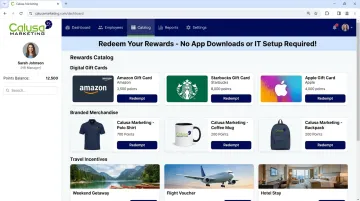
The technology matters less than what it removes: the friction that causes well-intentioned recognition efforts to fade within six months of launch.
How to Measure Employee Loyalty and Track Progress
You can't manage what you don't measure, and loyalty is no exception. Four metrics matter most:
- Employee Net Promoter Score (eNPS): measures how likely employees are to recommend your company as a workplace, scored from -100 to +100 (10-30 is healthy; above 50 is exceptional)
- Turnover and retention rate: your clearest lagging indicator of loyalty trends over time
- Engagement survey scores: tracked quarterly, not just annually, to catch dips early
- Internal referral rates: employees rarely refer friends to a workplace they don't trust
The key is tracking these as trends, not one-time snapshots. A single low eNPS score might be noise. Three consecutive quarters of decline is a signal.
Pair the numbers with stay interviews: structured conversations asking why employees stay, what frustrates them, and what would make them consider leaving. Unlike exit interviews, stay interviews happen before someone's already decided to go, giving you an actual chance to fix the problem.
Frequently Asked Questions
How do you build employee loyalty?
Loyalty comes from consistent recognition, fair pay, real growth opportunities, and genuine two-way communication. It's an ongoing practice, not a single initiative you launch and forget.
What is the difference between employee loyalty and employee engagement?
Engagement reflects day-to-day enthusiasm and effort at work. Loyalty is the longer-term emotional commitment and intent to stay, built through repeated positive experiences over time.
How much does employee turnover really cost a business?
Replacing an employee typically costs half to two times their annual salary, according to Gallup, once you factor in recruiting, onboarding, and lost productivity during ramp-up.
What are some examples of employee loyalty or incentive programs?
Common formats include point-based recognition platforms, service milestone awards, digital gift card rewards, and group travel incentives. The most effective programs mix several formats rather than relying on just one.
How long does it take to build employee loyalty?
Loyalty builds gradually through repeated positive experiences — there's no instant fix. That said, a well-structured recognition program can show measurable engagement improvements within just a few months.
Can incentive and recognition programs actually reduce turnover?
Yes. Gallup found employees who receive high-quality recognition are 45% less likely to leave within two years than those without it. Calusa Marketing can help build a program that fits your team and budget.