That mix-up isn't harmless. It shapes retention, productivity, and morale in measurable ways. A 2026 study of 625 clinical nurses found average work-engagement scores of 4.69 among highly empowered employees, compared to just 3.31 among those with low empowerment — a statistically significant gap (PMC, 2026).
This article breaks down what separates engagement from empowerment, where they overlap, and how to build both intentionally instead of hoping one produces the other.
Key Takeaways
- Engagement is emotional investment; empowerment is structural authority
- Empowerment feeds engagement, but it's only one input among several
- Surveys capture engagement; decision-making authority and role design reveal empowerment
- Teams that are empowered but disengaged underperform, as do engaged teams without real authority
- Recognition programs are a fast, measurable lever for strengthening both at once
Employee Engagement vs Empowerment: Quick Comparison
Here's how the two concepts stack up side by side:
| Dimension | Engagement | Empowerment |
|---|---|---|
| Definition & Focus | Emotional commitment and discretionary effort | Real authority and autonomy to act |
| Primary Driver | Recognition, meaning, growth, connection | Decision rights, resources, role scope |
| Employee's Role | Bring energy, initiative, and ownership of attitude | Make and own decisions without waiting for sign-off |
| Manager's Role | Coach, recognize, communicate purpose | Delegate, set guardrails, remove approval bottlenecks |
| How It's Measured | Surveys, sentiment scores, pulse checks | Decision-making authority, role design, delegation patterns |
Notice the pattern: engagement lives in how people feel about their work, while empowerment lives in what people are structurally allowed to do. Both matter, but they require different fixes.
What Is Employee Engagement?
Employee engagement is the emotional commitment and discretionary effort a worker brings to their job: the extra energy that shows up beyond the basic job description. It's the difference between someone who clocks in and someone who actually cares whether the project succeeds.
This isn't a soft metric. Gallup's latest global data shows only 20% of employees worldwide were engaged in 2025, and low engagement cost the global economy roughly $10 trillion in lost productivity, equal to 9% of global GDP (Gallup, 2026 State of the Global Workplace). Those numbers reflect millions of employees who show up physically but stay checked out mentally.
Engagement isn't built from one factor. It's a blend of:
- Satisfaction with day-to-day work conditions
- Meaning derived from the role's purpose
- Growth through learning and advancement
- Connection to teammates and leadership
- Impact: seeing tangible results from one's effort
The Four Pillars of Employee Engagement
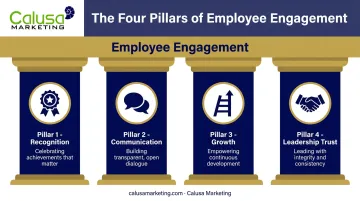
Different frameworks label these differently, but four drivers show up consistently across research:
- Recognition: regular acknowledgment of good work, not just annual reviews
- Communication: employees feel heard and their opinions carry weight
- Growth: clear paths to learn, develop, and advance
- Leadership trust: supervisors who care and align on goals transparently
The throughline across every model: engagement requires ongoing reinforcement. A single town hall or a one-time bonus won't sustain it.
Signs and Examples of Engaged Employees
Engaged employees look different day to day. Watch for:
- Volunteering for problems outside their job description
- Proactively flagging issues before they escalate
- Speaking positively about the company to customers and outsiders
- Staying focused during slow periods instead of coasting
Business units with top-quartile engagement consistently outperform bottom-quartile units across profitability, sales productivity, absenteeism, and quality metrics. This pattern has held up across decades of workplace research spanning millions of employees (Gallup Q12 Meta-Analysis).
What Is Employee Empowerment?
Employee empowerment means giving people real authority, autonomy, and resources to make decisions affecting their day-to-day work, without needing a manager's sign-off for every move. It's structural, not emotional. Either the authority exists, or it doesn't.
The operational payoff is straightforward:
- Fewer bottlenecks: decisions don't stall waiting for approval
- Faster response times: front-line staff act in the moment
- Higher accountability: employees own outcomes because they made the call
That said, empowerment needs boundaries. Give someone zero autonomy and you get micromanagement resentment. Give them unlimited autonomy with no support, and self-management becomes its own burden: employees spend more energy figuring out how to work than actually doing the work.
The healthiest setups pair discretion with clear expectations, resources, and feedback loops, not autonomy in a vacuum.
Examples of Employee Empowerment
Empowerment shows up differently depending on scale:
- Individual level: A customer service rep resolves a billing dispute on the spot instead of escalating to a supervisor
- Team level: A cross-functional group self-organizes sprint work without a project manager assigning every task
- Organizational level: A regional manager owns a full P&L, including hiring and vendor decisions
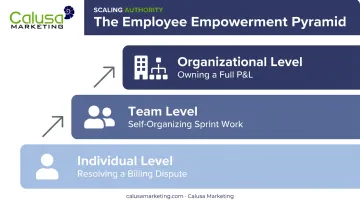
According to McKinsey's research on organizational decision-making, only 46% of companies consistently make high-quality delegated decisions. Yet organizations that place decision rights at the right level are 6.8 times more likely to rank as top performers.
Structured well, empowerment becomes a measurable competitive advantage, not just a cultural nicety.
Engagement and Empowerment: How They Work Together
Here's the direct answer: empowerment is one input into engagement, not a substitute for it. Autonomy without meaning, growth, or recognition doesn't automatically produce an engaged workforce. It just produces employees with more control and possibly less direction.
Use this as a rough diagnostic:
- Bottlenecks and slow decisions? Prioritize empowerment first: clarify decision rights and remove approval layers.
- Turnover or low morale despite existing autonomy? The problem is engagement: recognition, growth, or connection is likely missing.
- Both symptoms present at once? Address decision rights and recognition together, since fixing one without the other only solves half the problem.
Recognition programs are a practical bridge between the two. Celebrating a well-made call reinforces empowered decision-making and builds the emotional connection that keeps people motivated long after the initial autonomy was granted.
Gallup's longitudinal tracking of nearly 3,500 employees found that those who received high-quality recognition were 45% less likely to have left their organization two years later (Gallup, 2024).
This is where a structured recognition or incentive program earns its keep. At Calusa Marketing, we help employers close that loop with a scalable mix of digital rewards, gift card options, and incentive travel.
Managers can recognize a well-handled customer situation or a well-run project the moment it happens, rather than waiting for an annual awards banquet. A cloud-based platform lets a manager log an employee's good judgment call and issue recognition in near real time, instead of letting it go unnoticed until review season.
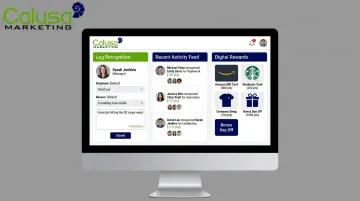
The practical takeaway: engagement and empowerment reinforce each other in a loop. Empowered employees who are also recognized and engaged tend to stay longer and perform better than employees with only one half of that equation.
Conclusion
Engagement and empowerment work as partners, not substitutes. Empowerment gives employees the how: the authority and autonomy to act. Engagement gives them the why: the emotional investment that makes acting worthwhile in the first place.
Building one without the other leaves value on the table. Directionless autonomy and frustrated enthusiasm are both expensive problems, and they show up in the same places: retention, productivity, and customer satisfaction.
Structured recognition and incentive programs remain one of the lowest-lift ways to reinforce both simultaneously. They give leaders a concrete, repeatable way to celebrate good decisions while building the connection that keeps people around to make more of them.
Frequently Asked Questions
How is empowerment related to employee engagement?
Empowerment, meaning autonomy and decision rights, is one contributing factor to engagement. But engagement also depends on recognition, growth, and connection, so empowerment alone isn't sufficient to create an engaged workforce.
What are the four pillars of employee engagement?
The commonly cited pillars are recognition, communication, growth opportunities, and leadership trust. These work together rather than in isolation — removing one weakens the others.
What are some examples of employee empowerment?
Common examples include front-line staff resolving issues without escalation, employees owning a project end-to-end, and cross-functional teams self-organizing their own workflows.
Which comes first, engagement or empowerment?
Empowerment often needs to be structurally in place first, since it defines what employees are allowed to do. Engagement then determines whether employees actually use that empowerment productively.
Can a company have empowerment without engagement, or engagement without empowerment?
Yes, and both scenarios are common. Empowerment without engagement leaves employees making decisions with no real sense of purpose behind them. Engagement without empowerment does the opposite — it builds motivated employees who have no room to act on their ideas.
How do you measure employee engagement and empowerment differently?
Engagement is typically measured through surveys and sentiment scores, such as Gallup's Q12. Empowerment is assessed by looking at decision rights, role scope, and how much managers actually delegate.