Introduction
Every small business owner wants more sales. But generic advice — "post on social media," "run a discount" — rarely accounts for your actual stage, budget, or customer base.
Many owners struggle with a simpler problem: they don't know which lever to pull first. Should you chase new customers, upsell the ones you already have, or retrain your sales team entirely? Mixing up these priorities wastes time and money you don't have to spare.
Results vary widely depending on where you focus. A business chasing new leads while ignoring its existing customer base often works twice as hard for half the return.
This guide walks through a step-by-step framework for increasing sales. You'll learn when each tactic applies, what to prepare before you start, which factors most affect your results, and which mistakes stall growth without warning.
Key Takeaways
- Four levers drive sales growth: new customers, existing revenue, retention, and team performance.
- New customers cost 5 to 25 times more to acquire than retaining existing ones (Harvard Business Review).
- A goal-driven approach with numeric targets, a defined customer profile, and tracked data beats ad hoc tactics.
- Structured rewards for customers and sales teams remain the fastest, most measurable way to lift sales.
How to Increase Sales: A Step-by-Step Framework for Small Businesses
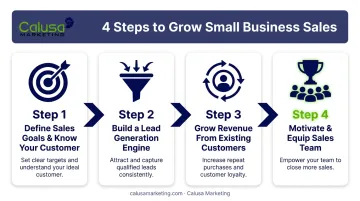
These four steps work in sequence. Skip the foundational ones (goals, customer understanding), and the tactics that follow won't stick.
Step 1: Define Your Sales Goals and Know Your Customer
"Grow the business" isn't a goal. It's a wish. Replace it with something specific: "20 new customers in 90 days" or "15% increase in repeat purchases by Q3." Numeric targets force you to pick tactics that actually move that number, instead of trying everything at once.
Next, build a simple customer profile. You don't need expensive market research — pull it from what you already have:
- Recent sales or CRM data (who's buying, how often, what they spend)
- Direct customer surveys or feedback forms
- Common pain points your team hears repeatedly
Finally, make sure everyone on your team (sales, service, marketing) can state your value proposition in one sentence. When customer-facing teams share a common view of the customer, deals move faster and fewer qualified leads stall between departments. Misalignment is one of the quietest ways small businesses leak revenue without ever noticing.
Step 2: Build a Lead Generation Engine
Once you know who you're selling to, focus on channels that fit a small budget:
- Referral requests built directly into your sales process: ask satisfied customers at the moment of purchase, not months later
- Local networking and community events where your ideal customer already shows up
- An SEO-friendly website that answers the questions your prospects are already searching for
- Cross-promotion with complementary businesses that share your audience but don't compete with you
Referred customers tend to be more valuable long-term than those acquired through mailings or cold outreach: they stick around longer, spend more, and cost less to bring in. That's a strong reason to build referrals into your process rather than treating them as an afterthought.
Step 3: Grow Revenue From Customers You Already Have
This is where most small businesses leave money on the table. Two tactics work well here:
- Win-back offers for dormant customers: a targeted discount or reminder aimed specifically at people who haven't purchased in a while
- Purchase-history-based upsells: recommending products or services based on what someone already bought, not generic promotions
The math behind this step is hard to ignore. Bain & Company found that increasing customer retention by just 5% can lift profits by 25% to 95%. That's not a typo: a small retention improvement compounds into a massive profit swing over time.
Loyalty and reward programs are one of the most reliable ways to drive that retention. A well-designed program shouldn't require you to build an app or overhaul your point-of-sale system.
This is exactly the gap Calusa Marketing fills for small businesses: its cloud-based digital loyalty cards run through Apple Wallet or Google Wallet, with no integration and no app download required for customers or the business owner. Programs like this are built to increase both repeat purchase frequency and average order value, without adding to your workload.
Step 4: Motivate and Equip Your Sales Team
A motivated, well-trained sales team closes more deals than one left to figure things out alone. Ongoing training closes the gap between what reps do and what buyers actually expect. That gap is real: 73% of B2B buyers actively avoid suppliers who send irrelevant outreach.
Incentives matter just as much as training. A meta-analysis of more than 45 studies by the Incentive Research Foundation found that properly designed incentive programs produced an average 22% performance increase, with team-based incentives outperforming individual ones by a wide margin. Programs running longer than a year averaged even bigger gains than short-term contests.
Structuring a program like this from scratch is time-consuming for a lean team. Firms like Calusa Marketing design incentive structures using gift cards, branded merchandise, travel rewards, or contest-based prizes, built around the specific behaviors you want to encourage, so small businesses can reward top performers without building complex systems internally.
When to Prioritize New Customer Acquisition vs. Existing Customer Growth
Not every business should split its budget the same way.
Acquisition-focused tactics make more sense when:
- You're a newer business without an established customer base
- You're entering a new market or launching a new product line
- Your current customer base is too small to sustain growth on its own
Retention and upsell tactics make more sense when:
- You're an established business with a healthy, active customer base
- Your margins are tight and you need lower-cost ways to grow revenue
- You already have purchase history data to personalize outreach
Most small businesses benefit from running both simultaneously. What matters is how much budget and time you weight toward each, based on your current cash flow needs and how mature your customer base already is.
What You Need Before You Start
Jumping straight into tactics without preparation leads to wasted spend and inconsistent messaging. Before launching anything, get three things in place:
- A simple tracking system: even a spreadsheet works, as long as you're logging leads, purchase history, and follow-up dates consistently
- A defined budget for marketing and incentives, so you're not deciding spend on the fly
- Buy-in from anyone customer-facing: sales, service, and marketing all need to know the plan before customers do
One step owners skip too often: review your existing customer feedback and reviews first. Complaints and recurring requests frequently point to quick wins, such as a pricing tweak, a service gap, or a missed upsell opportunity, before you spend a dollar on new campaigns.
Key Factors That Determine Your Sales Growth Results
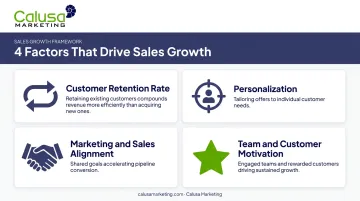
The same tactic can produce very different results depending on how well you manage these four variables.
Customer Retention Rate
Repeat customers close at a far higher rate than new prospects and cost less to serve. Even small improvements in retention compound into significant profit gains over time. The 5%-retention-to-95%-profit relationship from Step 3 applies here too.
Personalization
Tailored offers based on purchase history build trust and relevance faster than generic promotions. Businesses that personalize well, matching offers to what a customer has actually bought before, consistently see stronger repeat engagement than those sending the same message to everyone.
Marketing and Sales Alignment
When marketing and sales share one view of the customer, qualified leads don't stall between handoffs. Faster follow-up and clearer next steps directly shorten your sales cycle, often the difference between closing a deal this week versus losing it to a competitor who called back sooner.
Team and Customer Motivation
Incentive-driven behavior, for both staff and customers, creates consistent, repeatable actions instead of one-off pushes. Well-structured rewards programs, similar to those Calusa Marketing helps clients design and manage, tend to outperform one-time discounts because they encourage ongoing engagement rather than a single transaction.
Common Mistakes That Stall Sales Growth
A few habits undermine otherwise solid sales efforts:
- Setting vague goals like "increase sales" instead of specific, measurable targets tied to a timeframe
- Over-focusing on new customer acquisition while ignoring the lower-cost, higher-probability opportunity sitting in your existing customer base
- Offering discounts inconsistently, without tracking which offers actually drove repeat behavior
- Neglecting sales team motivation, assuming reps will perform well without structured training or reward systems, such as tiered incentives or recognition programs
Frequently Asked Questions
What are the 4 ways to increase sales?
Acquiring new customers, increasing purchase frequency from existing ones, increasing average order value, and improving retention to reduce churn. Most sales strategies combine at least two of these.
How do I increase sales per customer?
Use personalized upsell and cross-sell recommendations based on purchase history, loyalty or reward programs, and product bundling. These tactics raise both average order value and how often someone buys.
What's the fastest way for a small business to increase sales?
Re-engaging existing customers with a targeted win-back offer typically produces faster results than new customer acquisition, since these customers already know and trust you.
How can small businesses increase sales on a tight budget?
Lean on referral requests, community events, win-back campaigns, and simple loyalty perks that skip major tech investment. A digital loyalty card, for example, launches in under a week with no integration needed.
Do sales incentive programs really work?
Yes. Research from the Incentive Research Foundation found properly designed programs drive measurable performance gains, and team-based incentives outperform individual ones. Structured, ongoing programs consistently beat one-off bonuses.
How much does customer retention affect sales growth?
Significantly. Bain & Company found that a 5% increase in retention can boost profits by 25% to 95%, which is why retention deserves equal focus alongside new customer acquisition.