Global employee engagement fell to just 21% in 2024, according to Gallup's State of the Global Workplace 2025 report. That decline shows up directly in retention costs, productivity, and profitability. This article breaks down the ten engagement goals worth prioritizing in 2026, with SMART examples and the KPIs to track them.
TL;DR
- Engagement goals give HR a clear path to higher morale and retention in 2026
- The top 10 goals span alignment, recognition, wellbeing, communication, and culture
- SMART structure turns intentions into measurable, achievable results
- Recognition and incentive programs drive motivation and retention across teams
- Quarterly reviews keep goals from becoming a once-a-year checkbox exercise
Overview of Employee Engagement Goals Heading Into 2026
Employee engagement goals are specific, trackable targets tied to how emotionally and behaviorally committed employees are to their work and their company. They go beyond satisfaction surveys — they measure whether people show up ready to contribute, or just show up.
The numbers going into 2026 aren't encouraging. According to Gallup, only 31% of U.S. employees were engaged and 17% were actively disengaged in 2024. A year earlier, the same research found that 50% of the workforce fell into the "not engaged" category, often described as quiet quitting.
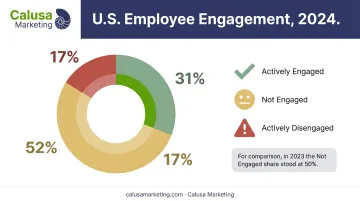
Those numbers point to a bigger issue: goals without structure rarely move the needle. A statement like "improve engagement" gives your team nothing to act on. A goal like "raise recognition frequency to two touchpoints per employee per month" does. Below are the ten engagement goals worth building into your 2026 plan.
Top 10 Employee Engagement Goals for 2026
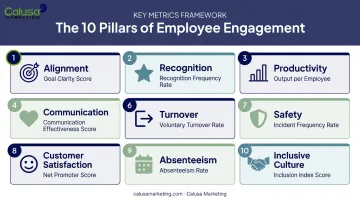
Each goal below was selected using four criteria: measurability, business impact, relevance to 2026 workplace trends (hybrid work, AI adoption, wellbeing), and ease of implementation.
Goal 1: Align Employees With Company Goals and Values
Only 46% of U.S. employees clearly knew what was expected of them at work in 2024. That gap creates wasted effort, missed priorities, and frustrated managers. Alignment goals close it by connecting daily work to company-level priorities.
| Element | Details |
|---|---|
| SMART Goal Example | Link 100% of team quarterly objectives to two company priorities within 30 days |
| How to Measure Progress | Goal-alignment survey scores; OKR completion rate |
Goal 2: Boost Motivation Through Recognition and Rewards
Employees who received high-quality recognition were 45% less likely to have left their organization two years later. Recognition works only when it's consistent and specific, not a once-a-year holiday bonus. Platforms like the one Calusa Marketing builds for clients make it possible to deliver timely recognition at scale, whether through digital gift cards or points-based reward systems, without adding to HR's workload.
| Element | Details |
|---|---|
| SMART Goal Example | Deliver two specific recognitions per employee per month for a full quarter |
| How to Measure Progress | Recognition frequency; eNPS scores |
Goal 3: Increase Productivity and Discretionary Effort
Engaged employees don't just meet the minimum — they bring ideas, cover gaps, and push harder when it matters. Gallup's meta-analysis of 183,806 business units found top-quartile engagement units posted 18% higher sales productivity and 23% higher profitability than bottom-quartile units.
| Element | Details |
|---|---|
| SMART Goal Example | Lift revenue per employee by 5% within six months through workflow improvements |
| How to Measure Progress | Output per employee; cycle time |
Goal 4: Enhance Employee Wellbeing
Wellbeing has moved from perk to baseline expectation. 92% of workers say it's important to work for an organization that values emotional and psychological wellbeing, and 77% reported work-related stress in the past month.
| Element | Details |
|---|---|
| SMART Goal Example | Reach 60% employee participation in a wellness or financial-health program within one quarter |
| How to Measure Progress | Program utilization rate; burnout indicators from pulse surveys |
Goal 5: Improve Manager-Employee Communication
Feedback timing matters more than most managers realize. Employees who received meaningful feedback in the past week were 80% likely to be fully engaged — those on annual review cycles were far less likely to feel motivated at all.
| Element | Details |
|---|---|
| SMART Goal Example | Achieve 90% monthly 1:1 completion across all teams within 90 days |
| How to Measure Progress | 1:1 completion rate; manager-support survey scores |
Goal 6: Reduce Employee Turnover
Replacement costs vary by role, but they're never small — estimates run from 33% of base wages for general roles up to roughly 200% of salary for managers and leaders. Structured, ongoing incentive programs help here too. Calusa Marketing's Employee Recognition Incentive Program is often built around specific retention challenges, like getting new hires through their 90-day window or keeping long-tenured "tribal knowledge" employees engaged.
| Element | Details |
|---|---|
| SMART Goal Example | Reduce regrettable turnover in a target department by 15% within six months |
| How to Measure Progress | Voluntary turnover rate; internal mobility rate |
Goal 7: Strengthen Workplace Safety Culture
Safety performance reflects engagement levels directly. Top-quartile engagement units recorded 63% fewer safety incidents than bottom-quartile units. Disengaged employees skip steps; engaged ones follow protocol because they care about the outcome, not just the audit.
| Element | Details |
|---|---|
| SMART Goal Example | Reduce recordable safety incidents by 20% over two quarters through regular audits |
| How to Measure Progress | Incident rate; training completion percentage |
Goal 8: Elevate Customer Satisfaction Through Engaged Employees
Engagement extends beyond the employee to shape the customer experience. Business units in the top engagement quartile saw 10% higher customer loyalty than those in the bottom quartile. Disengaged front-line staff show up in complaint logs before they show up in exit interviews.
| Element | Details |
|---|---|
| SMART Goal Example | Lift CSAT or NPS scores by 5 points within 90 days |
| How to Measure Progress | CSAT/NPS; first-contact resolution rate |
Goal 9: Reduce Absenteeism
Absenteeism patterns often reveal disengagement before an exit interview does. Top-quartile engagement units recorded 78% less absenteeism than bottom-quartile units. Tracking by department can flag which teams need flexible scheduling or workload relief.
| Element | Details |
|---|---|
| SMART Goal Example | Cut unscheduled absence days by 25% within four months |
| How to Measure Progress | Absence rate; overtime hours |
Goal 10: Build a High-Performance, Inclusive Culture
This goal ties everything else together. Deloitte research found teams operating in an inclusive culture outperformed peers by 80%. Collaboration, recognition, and inclusion don't function as separate initiatives — they compound.
| Element | Details |
|---|---|
| SMART Goal Example | Run a monthly values-alignment check across all teams with a documented action item |
| How to Measure Progress | Inclusion survey scores; cross-departmental project completion rates |
How We Chose These Employee Engagement Goals
Most engagement goals fail before they start — not because the goal was wrong, but because it was too vague to act on. "Improve culture" isn't measurable. Neither is copying a benchmark from a competitor's industry without checking whether it fits your workforce.
We prioritized goals based on three factors:
- Measurability: every goal here has a KPI attached, not just a hopeful intention
- Relevance to 2026 trends, including hybrid work, AI adoption, and wellbeing expectations that shaped the list
- Tie-in to business outcomes (retention, productivity, and profitability), not just morale scores
The pattern behind good goal-setting mirrors how incentive program design should work: define the desired behavior first, figure out what it's worth to the business, then identify exactly who needs to deliver it. Skipping any of those three steps is where most engagement goals stall.
How Incentive and Recognition Programs Accelerate These Goals
Recognition, motivation, and retention goals are the hardest to sustain without a structured system behind them. It's easy to recognize someone once. It's much harder to keep that cadence going for twelve straight months across every department.
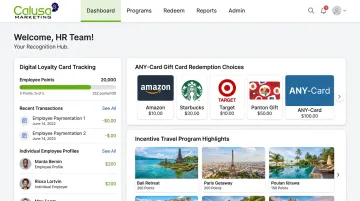
This is where a dedicated incentive partner earns its keep. Calusa Marketing, a technology-based incentive marketing firm founded in 2015, builds cloud-based reward platforms that handle the mechanics of recognition without adding work to HR's plate:
- Digital loyalty and punch cards that track recognition events in real time, no app download required
- ANY-Card gift card programs with 100+ redemption options, letting employees pick a reward that actually means something to them
- Incentive travel, from individual high-end trips to group programs for up to 10,000 people, often used for milestone recognition and top-performer rewards
Calusa Marketing has managed 1,000+ programs and 500,000+ members, with a 99% client retention rate, a track record built by treating recognition as a daily operational habit instead of a once-a-year event.
Conclusion
Employee engagement goals only work when they're specific, measurable, and reviewed on a regular cadence — not filed away after a single kickoff meeting. Trying to tackle all ten at once usually means none of them get done well.
Start with the one or two goals that match your current gaps. If recognition and retention are where you're bleeding talent, that's your starting point. And if you need a partner to help launch it, Calusa Marketing designs recognition, retention, and incentive programs built for these kinds of goals, worth a conversation as you shape your 2026 strategy.
Frequently Asked Questions
What are some good goals for employee engagement?
Strong starting points include alignment (connecting work to company priorities), recognition frequency, wellbeing program participation, and retention targets. Pick goals tied to a clear KPI, not a vague sentiment.
What are 5 SMART goals for employee engagement?
Examples include: two recognitions per employee monthly, 90% monthly 1:1 completion, 25% reduction in unscheduled absences, 15% reduction in regrettable turnover, and 60% wellness program participation within a quarter.
How often should companies review their employee engagement goals?
Review core goals quarterly, with monthly pulse checks on fast-moving metrics like recognition frequency and absenteeism. Waiting a full year to check progress usually means it's too late to course-correct.
What metrics best measure progress on employee engagement goals?
Use a mix of leading indicators (pulse survey scores, recognition frequency) and lagging indicators (turnover rate, CSAT). Leading indicators help you catch problems before they show up in exit interviews.
How does employee recognition impact engagement goals?
Consistent, specific recognition directly boosts motivation and morale, and it strengthens retention. Employees who receive quality recognition are far less likely to leave, so track it through recognition frequency and eNPS scores.
What's the difference between employee engagement and employee satisfaction?
Satisfaction measures contentment with pay, conditions, and benefits. Engagement measures whether someone is emotionally and behaviorally invested in outcomes. A satisfied employee can still be disengaged.