Most managers know they want a proactive, accountable workforce. Fewer know how to get there without hovering over every decision. Fear of losing control pushes leaders toward micromanagement, which is exactly the opposite of what builds trust.
This article defines employee empowerment, breaks down its real business benefits, and lays out strategies (including recognition and rewards) you can start using this week.
Key Takeaways
- Empowerment means giving staff trust, tools, and decision-making authority, not more work
- Engaged employees produce more, stay longer, and directly cut retention costs
- Success requires clear expectations, delegated authority, feedback loops, and consistent recognition
- Trust gaps, training shortfalls, and fear of losing control remain top barriers
What Is Employee Empowerment?
Employee empowerment is a management approach that gives employees the autonomy to make day-to-day decisions without needing constant sign-off. It's the direct opposite of micromanagement.
SHRM frames it as giving employees the autonomy, resources, and support to act independently while still holding them accountable. That last part matters. Empowerment isn't a free-for-all; it's structured trust.
Harvard Business Review takes it a step further, describing empowerment as shifting decision-making power from the center of an organization out to the front line. Handing someone a task without the authority to decide how it gets done is delegation, not empowerment.
Empowerment as a motivator works differently than a bonus check. Autonomy taps into intrinsic motivation, the internal drive people feel when they have real ownership over their work. Self-determination theory identifies autonomy, competence, and relatedness as core psychological needs. Give employees genuine choice in how they work, and motivation follows naturally. No cash incentive required.
Core Elements of Employee Empowerment
Five elements consistently show up across research on what makes empowerment stick:
- Psychological safety and trust — employees feel safe making decisions without fear of punishment for reasonable mistakes
- Recognition — contributions get acknowledged specifically and consistently, not as an afterthought
- Flexibility and autonomy — people control how, when, or where they complete their work
- Two-way feedback — communication flows both directions, and leadership actually acts on what it hears
- Growth opportunities — employees see a path to build new skills and take on bigger challenges
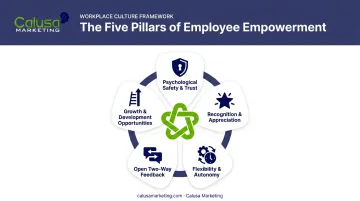
Miss one of these and the whole structure gets shaky. Autonomy without feedback, for instance, tends to produce employees who guess at what leadership wants instead of confidently acting on it.
Levels of Empowerment
Empowerment has to show up at three levels to actually take hold:
- Individual — a single employee has authority over their specific tasks and decisions
- Team — the group collectively owns outcomes and coordinates without heavy oversight
- Organizational — leadership embeds empowerment into policy, structure, and culture, not just isolated pockets
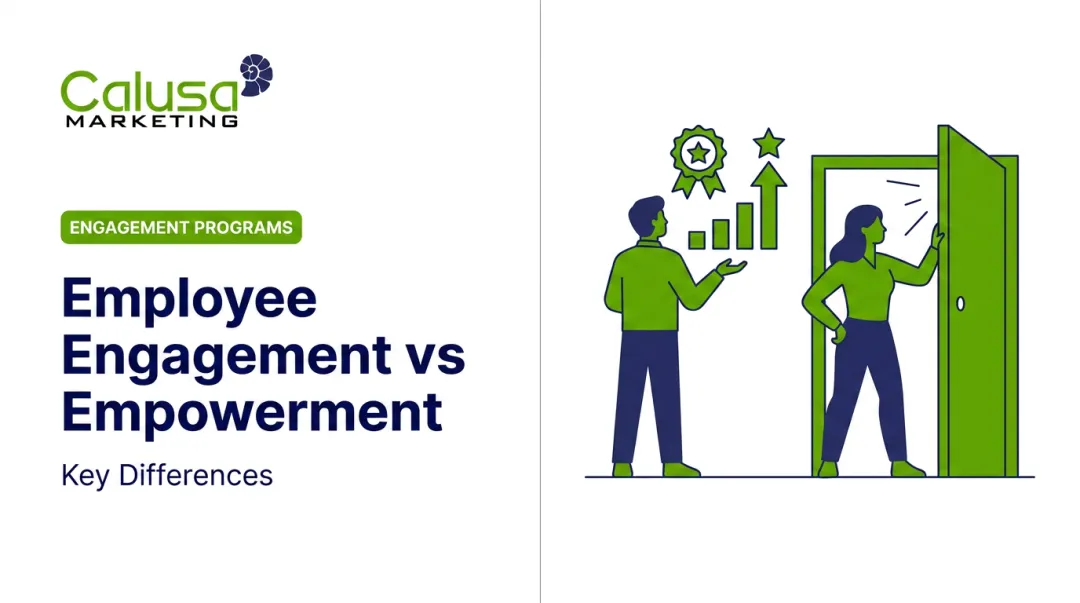
| Empowerment | Engagement |
|---|---|
| A structural, managerial input | The emotional output it produces |
| Built through autonomy, trust, and tools | Measured through commitment and effort |
| Something leaders provide | Something employees feel |
Leaders sometimes conflate the two, assuming a high engagement score means employees feel empowered. It doesn't automatically. Engagement can rise from many things: competitive pay, good coworkers, interesting projects. Empowerment specifically comes from decision authority.
Benefits of Employee Empowerment
The business case for empowerment isn't theoretical. It shows up in productivity numbers, turnover costs, and customer satisfaction scores.
Productivity, Ownership, and Innovation
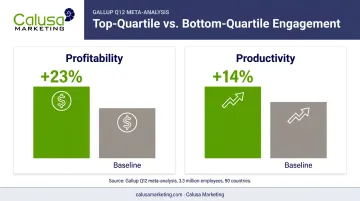
When employees own outcomes instead of just tasks, they take initiative that goes beyond the job description. Gallup's Q12 meta-analysis, covering over 3.3 million employees across 90 countries, found that top-quartile engagement units showed 23% higher profitability and 14% higher productivity compared to bottom-quartile units.
Removing constant oversight also opens room for creative problem-solving. Research on workplace creativity shows that well-timed managerial support helps creative work, while constant, unsolicited intervention shuts it down. Employees who receive frequent, helpful feedback are far more likely to take smart risks that lead to new ideas.
Retention, Trust, and Reduced Overhead
Turnover is expensive, and it gets worse the more senior the role. Replacing an employee can cost anywhere from 40% of salary for frontline staff to 200% for managers and leaders, according to Gallup workforce research. Empowered employees who feel trusted rarely walk out the door.
Delegation also changes the manager-employee dynamic. When leaders hand over real decision rights, they naturally shift from gatekeeper to coach. That builds trust in both directions and frees up leadership bandwidth:
- Fewer approval bottlenecks slowing down daily operations
- More time for managers to focus on strategy instead of sign-offs
- Stronger frontline decision-making, which translates directly to better customer interactions
Frontline employees who can resolve issues on the spot, without escalating every judgment call, create smoother customer experiences. That connection between empowered staff and business performance is why many companies pair delegation with structured recognition, using platforms like Calusa Marketing's incentive programs to reinforce good decision-making with tangible rewards.
Common Challenges to Employee Empowerment
Empowerment done poorly creates new problems instead of solving old ones. Three challenges come up repeatedly.
Inconsistent decision-making emerges when less-experienced employees receive autonomy without guardrails, inviting chaos rather than confidence. McKinsey's research on organizational decision rights warns that unclear or overlapping authority creates coordination failures, not just individual mistakes.
The trust gap stops employees from using new authority if leadership hasn't shown consistent follow-through in the past. If a team submitted feedback six months ago and nothing changed, they won't trust that new "empowerment" is any different.
Training and onboarding gaps turn responsibility into abandonment, not empowerment. Employees need:
- Clear documentation of decision boundaries and escalation paths
- Practice opportunities before high-stakes situations
- Access to a manager or mentor for questions, not just a policy handbook
Address these three head-on, and empowerment initiatives stick. Ignore them, and most programs fail within a year.
Employee Empowerment Strategies & Best Practices
Turning empowerment from a buzzword into daily practice takes deliberate structure. Here's what actually works.
- Connect roles to the bigger picture. Employees who understand how their decisions ladder up to company goals make better calls. Share the vision, not just the task list.
- Delegate real authority, not just tasks. Give employees end-to-end ownership of specific outcomes, with clear escalation thresholds for anything involving legal, financial, or safety risk.
- Invest in training. Skills and confidence go hand in hand. McKinsey recommends bite-size capability building and coaching in the flow of work, not one-off training sessions that get forgotten.
- Build structured feedback loops. Pulse surveys and regular check-ins only work if leadership visibly acts on what comes back. Skipping the follow-through undoes any trust gained.
- Offer flexibility in how work gets done. Trust employees to manage their own schedules and methods, as long as outcomes stay on track.
Recognition That Reinforces the Right Behaviors
Recognition is the mechanism that tells employees which empowered actions to repeat. Gallup found that employees who felt well-recognized were 45% less likely to have left their organization two years later. Yet only 22% said they receive the right amount of recognition, which shows most companies are leaving this lever untouched.
Recognition works best when it's specific and consistent, not sporadic. Praising an employee for the exact judgment call they made, such as resolving a customer issue without escalating or proposing a process fix, reinforces that the behavior mattered and should happen again.
This is where a structured incentive and rewards platform earns its keep. Manually tracking who deserves recognition, compiling data, and managing fulfillment adds administrative weight that busy managers don't have time for. Calusa Marketing, an incentive marketing firm built on a cloud-based SaaS platform, handles that layer directly:
- Point-based redemption lets employees track their own progress through "My Points" and "My Awards" dashboards, so managers aren't manually issuing every reward
- KPI tracking ties recognition to measurable performance, keeping rewards aligned with actual results instead of gut feel
- Dedicated account management and reporting offload the data compilation and program oversight that would otherwise land on internal HR teams
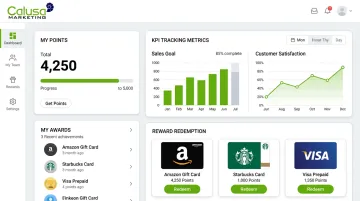
The platform requires no integration and no app download, which means programs can launch without pulling IT into the project. For managers already stretched thin, that's the difference between recognition happening consistently and recognition happening only when someone remembers.
How to Measure Employee Empowerment Success
Empowerment isn't something you roll out once and check off. It needs ongoing measurement.
Start with direct questions. Pulse surveys or one-on-one interviews should ask things like:
- "Do you feel you have the authority to solve problems without approval?"
- "When you've given feedback, has leadership acted on it?"
- "Have you received the training and resources needed to make confident decisions in your role?"
Beyond what employees tell you directly, quantifiable metrics confirm whether those answers translate into real behavior change.
Track the right KPIs over time:
| Metric | What It Signals |
|---|---|
| Engagement scores | Emotional investment resulting from empowerment |
| Voluntary turnover rate | Whether employees trust the environment enough to stay |
| Internal promotion rate | Whether growth opportunities are real, not just promised |
SHRM's 2025 benchmarking data puts median voluntary turnover at 12%, up from a 9% pre-pandemic median, a useful baseline to compare your own numbers against.
Treat measurement as a cycle: survey, act on what you find, then re-measure. A single high engagement score doesn't prove empowerment stuck. Consistent improvement over multiple cycles does.
Frequently Asked Questions
What are the top 3 motivators for employees?
Autonomy and trust, recognition, and growth opportunities consistently rank as the strongest intrinsic motivators. These align directly with the core drivers behind employee empowerment.
What is empowerment to motivate employees?
Empowerment motivates by giving employees real ownership and trust over outcomes. It taps into intrinsic drive rather than relying solely on external incentives like bonuses.
What are the 5 elements of empowerment?
The five core elements are psychological safety and trust, recognition, flexibility and autonomy, two-way feedback, and continuous growth opportunities. Each reinforces the others.
What are examples of employee empowerment?
A customer service rep resolving a complaint without escalating to a manager is one example. An employee proposing and leading a new project initiative is another.
What is the difference between employee empowerment and employee engagement?
Empowerment is the management practice, meaning autonomy, trust, and tools provided by leadership. Engagement is the resulting emotional investment and discretionary effort employees give back.
How do you measure employee empowerment success?
Use pulse surveys asking about decision-making authority, combined with retention and turnover data. Track productivity metrics and internal promotion rates alongside engagement scores for a full picture.