
Yet plenty of leaders still confuse retention rate with turnover rate, or skip the calculation entirely because the formula feels murky. That confusion leads to bad hiring forecasts, blown budgets, and reactive HR decisions instead of proactive ones.
This guide breaks down the exact retention rate formula, what counts as a "good" rate across industries like retail and call centers, and the strategies (including incentive-based ones) that actually move the needle.
Key Takeaways
- Original workforce retention rate excludes new hires, counting only employees who stay long-term
- A 90% or higher retention rate is considered strong, though benchmarks vary by industry
- Retention and turnover are related but distinct metrics — track both for a complete picture
- Pay, career growth, manager quality, and structured recognition programs drive retention gains
What Is Employee Retention Rate?
Employee retention rate measures the percentage of employees who remain with your organization over a specific period, most often calculated annually. It answers a simple question: of the people who worked for you on day one, how many are still here?
This distinction matters more than it seems. Retention rate only tracks your original cohort, meaning it doesn't count new hires added during the period, even if your total headcount grew.
A company can hire 50 new people and still have a shrinking retention rate if long-tenured employees are quietly walking out the back door.
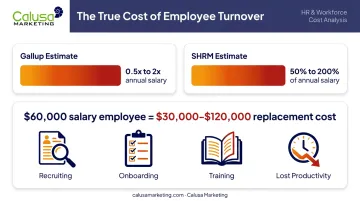
Why does this matter financially? Losing an employee isn't just an HR headache. Cost estimates vary by source:
- Gallup: replacement costs run 0.5 to 2 times the departing employee's annual salary
- SHRM's analysis: puts the range at 50% to 200% of annual salary, depending on seniority
For a $60,000-a-year employee, that's potentially $30,000 to $120,000 in recruiting, onboarding, lost productivity, and training costs — every single time someone leaves.
How to Calculate Employee Retention Rate
Calculating retention rate doesn't require fancy software. Most companies already have the data points sitting in their HRIS or payroll system, so you just need three numbers.
The Employee Retention Rate Formula
The standard formula is:
((Employees at end of period − New hires during period) ÷ Employees at start of period) × 100
You subtract new hires because they weren't part of your original workforce. Including them would inflate your retention percentage and mask the fact that veteran employees might be leaving at an alarming rate.
Step-by-Step Calculation Process
- Define your scope. Decide whether you're measuring the full company, one department, or a specific role type, and pick a time frame (quarterly is common for high-turnover teams; annual works for stable ones).
- Pull your headcount numbers. Get the count of employees at the very start of the period from HR records. Then identify how many of those specific people are still employed at the end, excluding anyone hired mid-period.
- Apply the formula and compare. Run the calculation, then stack it against last quarter, last year, or industry benchmarks to spot trends before they become crises.
Worked Example
Say your company started Q1 with 200 employees. By the end of the quarter, headcount grew to 210, thanks to 25 new hires. Here's the math:
((210 − 25) ÷ 200) × 100 = 92.5% retention rate
That means 185 of your original 200 employees stayed, even though your total headcount grew. Without subtracting new hires, you'd miscalculate a 105% "retention rate," a number that's mathematically meaningless.
Now compare two quarters:
- Q1: 200 starting, 210 ending, 25 hires → 92.5% retention
- Q2: 200 starting, 195 ending, 10 hires → 92.5% retention (185 ÷ 200)
Same percentage, different story. Q2 had fewer new hires but also lower ending headcount — worth investigating whether hiring slowed or departures increased.
What Is a Good Employee Retention Rate?
90% or higher is the general benchmark most HR sources point to, including AIHR's analysis. But that number shifts based on your industry, workforce size, and local labor market.
How Retention Varies by Industry
Annual quit-rate data from the Bureau of Labor Statistics shows just how much "good" changes by sector:
| Industry | 2024 Annual Quit Rate |
|---|---|
| Wholesale trade/distribution | 1.4% |
| Retail trade | 2.7% |
| Leisure and hospitality | 3.9% |
| Accommodation and food services | 4.1% |
| Call centers (annual turnover) | 34% |
A distribution company sitting at 95% retention is roughly on par with peers. A call center at that same rate would be an outlier in a good way. SQM Group's 2024 benchmark puts typical call center turnover near 34% annually, meaning most contact centers are fighting to keep retention even above 65-70%.
Functional vs. Dysfunctional Turnover
Here's something that surprises a lot of leaders: a 99% retention rate isn't automatically a win.
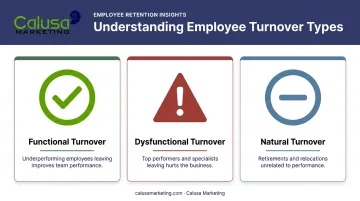
- Functional turnover happens when underperforming or poorly matched employees leave, often improving team performance
- Dysfunctional turnover happens when top performers or hard-to-replace specialists walk out the door
- Natural turnover includes retirements, relocations, and other life changes unrelated to job performance
If nobody ever leaves, you might be holding onto low performers out of inertia. The real goal is minimizing dysfunctional turnover while staying open to some natural churn.
Employee Retention Rate vs. Employee Turnover Rate
These two metrics get used interchangeably, but they measure different things.
- Retention rate tracks how many of your original employees stayed, start to finish
- Turnover rate tracks how many people left during the period — including new hires who joined and quit within the same window
Because turnover counts departures from anyone on payroll (not just the starting group), retention and turnover aren't perfect mirror opposites.
A company can post a 90% retention rate alongside a noticeably different turnover rate in the same quarter. That gap happens because new hires who left get counted in turnover but were never part of the retention calculation to begin with.
Why track both? Retention tells you how well you're holding onto tenured talent. Turnover tells you how much churn is happening across your entire workforce, new hires included. Together, they show whether your problem is a leaky bucket at the top (veteran attrition) or a broken onboarding process (early quits).
How to Improve Employee Retention Rate
Improving retention means addressing both the financial reasons people stay and the emotional ones. Pay matters, but so does feeling valued.
Competitive Pay and Benefits
Benchmark compensation against industry standards and local cost-of-living data at least once a year. Employees who feel underpaid compared to the market rarely wait around to negotiate. They leave for a better offer instead.
Clear Career Paths
Employees who can see where a role leads are more invested in staying. Map out advancement timelines, skill requirements, and internal promotion opportunities so growth feels tangible, not theoretical.
Manager Training and Feedback Loops
Manager quality is one of the strongest retention predictors out there. High-potential employees without an effective manager-coach were twice as likely to say they intended to leave, according to DDI's 2024 Global Leadership Forecast. Organizations with strong coaching cultures were nearly 3 times more likely to report they could engage and retain top talent.
Structured Recognition and Incentive Programs
Recognition has a measurable, direct impact on retention rates. Gallup and Workhuman tracked nearly 3,500 employees over two years and found that well-recognized employees were 45% less likely to leave their organization compared to peers who weren't.
This is where a done-for-you platform earns its keep. Calusa Marketing builds cloud-based recognition and incentive programs for companies in distribution, retail, and call center environments — industries where turnover pressure runs high. The platform includes:
- Digital punch cards that go live in under a week, delivered straight to an employee's phone wallet with no app download required
- A merchandise catalog with 10 million+ authentic branded items from Apple, Yeti, Nike, and other recognizable names
- Gift card and travel incentive options, including group travel programs for teams from 10 to 10,000 people

Clients like Alorica and Inktel use these programs specifically for agent recruitment, retention, and KPI achievement. Their results show structured recognition works even in historically high-turnover call center settings. Companies exploring a program like this can request a consultation to see how it fits their team size and budget.
Act on Employee Feedback
Run stay interviews and exit interviews, not just annual engagement surveys. The real value comes from closing the loop — telling employees what changed because of their input. Feedback that disappears into a spreadsheet erodes trust fast.
Frequently Asked Questions
What is a good retention rate for a company?
Most HR benchmarks put a strong retention rate at 90% or higher. The ideal number still depends on your industry, company size, and current labor market conditions.
What are the 3 R's of employee retention?
The 3 R's are respect, recognition, and reward. Each addresses a different piece of the employee experience, from daily treatment to formal appreciation programs.
What are the 5 C's of employee retention?
Commonly cited as care, connect, coach, contribute, and congratulate. These focus on building a culture where employees feel supported and recognized at every stage.
What's the difference between employee retention and employee turnover rate?
Retention rate tracks how many of your original employees stayed over a period. Turnover rate tracks everyone who left, including new hires who quit shortly after joining.
How often should a company calculate its employee retention rate?
Quarterly or annual tracking works for most companies. High-turnover departments, like call centers, benefit from more frequent monthly checks.
What are the most common causes of low employee retention?
Uncompetitive pay, poor management, limited growth opportunities, and weak recognition practices top the list. Work-life balance and scheduling conflicts also drive significant voluntary departures.